
[ICRA 2024] IGV-RRT: Solving the "Stale Map" Problem in Active Object Search
IGV-RRT: Prior-Real-Time Observation Fusion for Active Object Search in Changing Environments
This paper introduces IGV-RRT, a probabilistic planning framework for Object Goal Navigation (ObjectNav) in temporally changing indoor environments. It combines a 3D Scene Graph-based Information Gain Map (IGM) for global guidance with an online VLM Score Map (VLM-SM) to achieve State-of-the-Art search efficiency and success rates by correcting stale historical priors with real-time semantic evidence.
TL;DR
Navigating indoor environments is hard when humans move the furniture. IGV-RRT solves this by fusing "what we remember" (3D Scene Graphs) with "what we see right now" (VLM-based semantic scores). By integrating these into a real-time RRT planner, robots can now efficiently find relocated objects, achieving a +24.7% improvement in success rates over prior semantic mapping baselines.
Problem & Motivation: The "Static Map" Trap
Most robotic navigation systems assume the world is a museum—static and unchanging. They build a 3D Scene Graph (3DSG), map out where the "couch" and "table" are, and use these as anchors to find smaller objects.
However, in real homes, things move. If a robot's prior knowledge says the "Remote Control" is usually near the "Sofa," but the Sofa has been moved to another room, the robot gets trapped in a loop of searching an empty space. Current Vision-Language Model (VLM) approaches try to fix this by looking at every frame, but they lack global "intuition" and often waste time in redundant exploration.
Methodology: The Power of Dual-Layer Mapping
The CORE innovation of IGV-RRT is the Prior-Real-Time Observation Fusion. It doesn't choose between memory and sight; it weighs them dynamically.
1. The Information Gain Map (IGM) - The Global Memory
The robot builds a 3DSG using YOLOv7 and ConceptNet. This creates a "probability field" (using a Gaussian Mixture Model) of where a target should be based on commonsense (e.g., "Mugs are usually near Coffee Machines").
2. The VLM Score Map (VLM-SM) - The Real-Time Corroborator
As the robot moves, it uses BLIP-2 to evaluate the current view. The authors use a multi-prompt strategy (asking the VLM about the object name, its context, and its room type) to create a high-contrast semantic map. If the robot sees a high semantic score in a place the "Memory" didn't expect, the map updates to reflect the new reality.
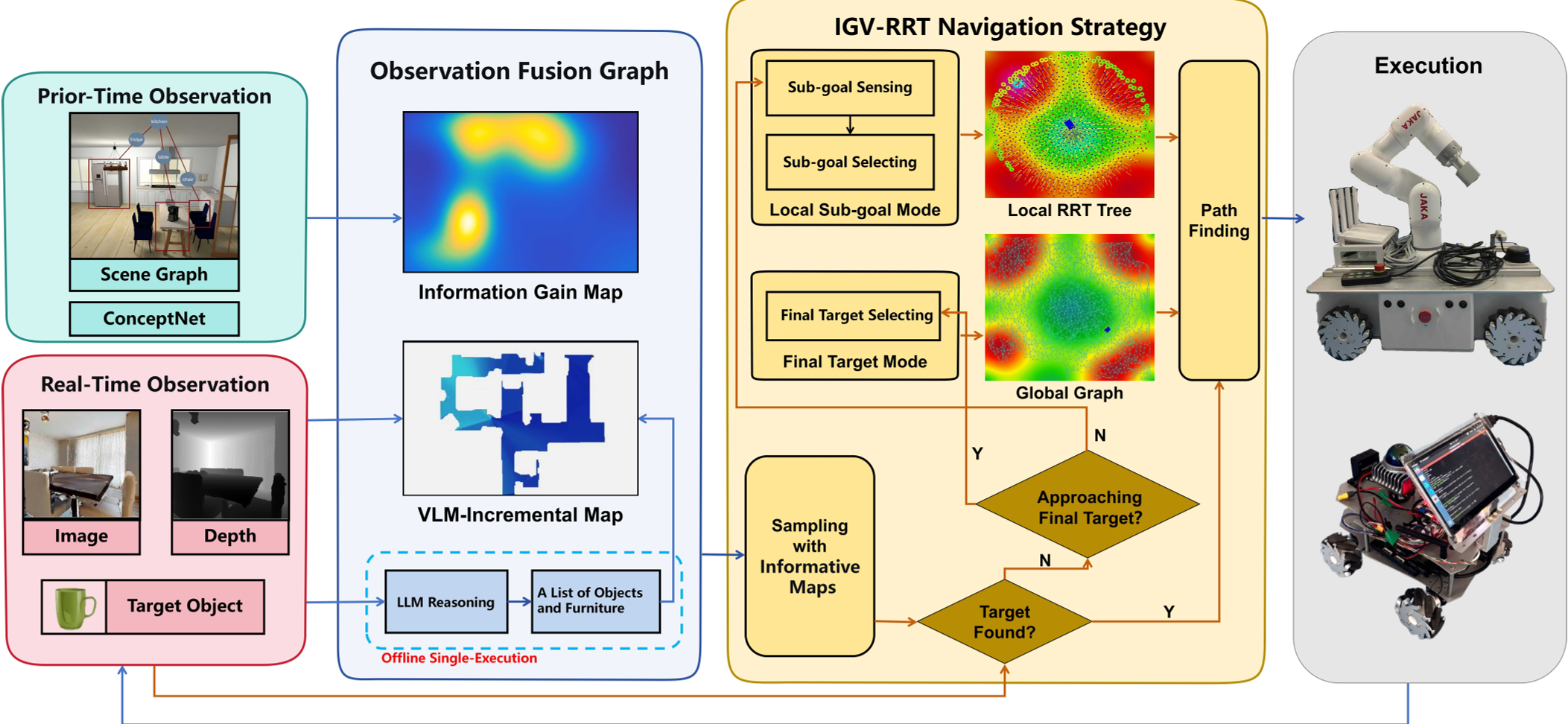 Fig 1: Overview of the IGV-RRT pipeline showing the fusion of IGM (Prior) and VLM-SM (Real-time).
3. IGV-RRT Planning: Smart Tree Expansion
The planner evaluates candidate nodes using a joint utility function:
otin \mathcal{M}_{exp}) \cdot [ \lambda_e \cdot E(v) + \lambda_s \cdot S(v) ]$$ * **$E(v)$**: Information gain from the prior (Go where we think the object is). * **$S(v)$**: VLM semantic support (Go where we actually see evidence). * **$\mathbb{I}(v otin \mathcal{M}_{exp})$**: The "Explored-Region Gating"—a crucial mechanism that stops the robot from revisiting the same spot twice. ## Experiments: Proving the Resilience The team tested IGV-RRT in the **HM3D (Habitat-Matterport 3D)** simulator and on a **Wheeltec R550** physical robot. ### SOTA Comparison In environments where objects were moved after the initial map was built, IGV-RRT crushed the **VLFM** baseline: * **Success Rate (SR)**: 42.9% vs. 34.4% * **Path Efficiency (SPL)**: 26.3% vs. 16.7% 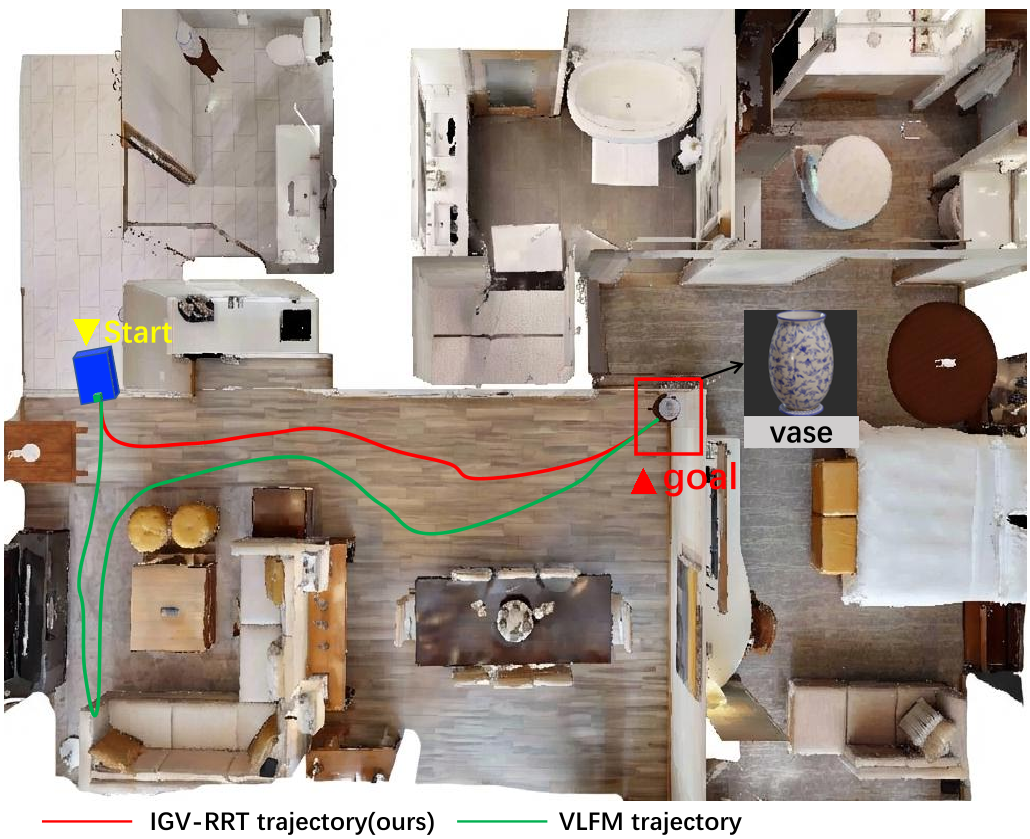 *Fig 2: Trajectory comparison. IGV-RRT (Red) uses VLM evidence to correct pathing early, while the baseline (Green) wanders aimlessly.* ### Ablation Insights The study proved that **VLM-SM (Semantic Score)** and **Explored-Region Gating (Revisit Suppression)** are synergistic. Without the gating, the robot frequently gets stuck in "semantic traps," repeatedly checking a high-scoring but empty area. ## Deep Insight & Conclusion IGV-RRT succeeds because it treats **historical data as a soft bias rather than a hard constraint**. By mathematically weighing the entropy of the prior (IGP) against the confidence of the real-time VLM, it achieves a "Bayesian-like" balance in motion planning. **Limitations**: The current IGM is still "frozen" once constructed. While the robot can ignore it, it can't yet "rewrite" its long-term memory to say "The Sofa is now in Room B." **Future Outlook**: Transitioning this into **Long-term Autonomy (LTA)**, where the robot maintains an evolving 3D Scene Graph over weeks or months, will be the next frontier in embodied AI. *** *Paper Reference: "IGV-RRT: Prior-Real-Time Observation Fusion for Active Object Search in Changing Environments"*