
[arXiv 2026] I2I-RFR: Bridging the Gap Between Simple Regression and High-Fidelity Generation
Improving Image-to-Image Translation via a Rectified Flow Reformulation
This paper introduces Image-to-Image Rectified Flow Reformulation (I2I-RFR), a plug-in method that transforms standard I2I regression backbones into continuous-time transport models. By augmenting inputs with noise-corrupted targets and using a t-reweighted pixel loss, it achieves SOTA perceptual quality in tasks like Super-Resolution, Deblurring, and Video Restoration with as few as 3 ODE solver steps.
TL;DR
Image-to-Image (I2I) translation has long been a tug-of-war between the stability of regression and the richness of generative models. Traditional regression (L1 loss) leads to blurry "mean" images, while Diffusion/GANs are heavy and hard to tune. I2I-RFR provides a "third way": a simple plug-in that turns any standard I2I network into a continuous-time transport model. It achieves near-generative quality with just 3 inference steps and zero additional trainable modules.
The Motivation: Why are our outputs so blurry?
Most I2I tasks (Super-Resolution, Low-light Enhancement, etc.) are ill-posed. For a single degraded input, there are multiple possible "perfect" reconstructions. When we train a model with MSE or L1 loss, we are mathematically forcing the model to predict the average of all those possibilities. The result? A blurry, over-smoothed image that lacks texture.
While Diffusion models solve this by modeling the distribution, they often throw away the years of engineering poured into specific I2I architectures (like SwinIR or Restormer) in favor of generic UNets. The authors of I2I-RFR asked: Can we keep our specialized backbones but give them the iterative refinement power of Flow models?
Methodology: Regression as a Vector Field
The core "aha!" moment of this paper is interpreting an I2I network as an induced velocity field.
1. The Plug-in Architecture
Instead of just feeding the input to the model, I2I-RFR feeds a pair: .
- is your degraded input image.
- is a mixture of the ground truth and Gaussian noise , defined by a linear path: .
2. The Objective
The model is trained to predict the clean image . Because the input includes the current noisy state , the network essentially learns how to "clean" the noise guided by the spatial priors of .
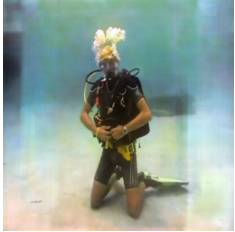 Visualizing the gap: L1 regression vs. the proposed RFR refinement.
3. Smart Sampling
To prevent the model from failing at different noise levels, the authors use a Beta(2,1) sampling for the time variable . This ensures the "high-noise" regime gets enough attention during training, making the iterative refinement robust.
Experiments: Generative Quality, Regression Speed
The authors tested I2I-RFR on everything from underwater enhancement to old film restoration.
- Efficiency: Unlike Diffusion (50+ steps), I2I-RFR works beautifully with only 3 steps.
- Compatibility: It works with CNNs (NLSN) and Transformers (SwinIR/Restormer) alike.
- Results: In SR benchmarks, it significantly lowered LPIPS (a measure of human-like perception) without the massive distortional drops usually seen in GANs.
 Table 1: Quantifying the gain. Notice how I2I-RFR consistently improves LPIPS across different backbones.
Deep Insight: vs. Velocity Prediction
In the generative AI community, most "Flow" models predict velocity (). However, this paper discovers that for I2I, predicting the clean image () directly is much better.
Why? Because in I2I, the input already tells the model 90% of what the output should look like. Predicting the clean image allows the model to leverage its internal spatial priors more effectively than trying to predict a noisy velocity vector.
Critical Analysis & Conclusion
I2I-RFR is a masterclass in Occam's Razor. It doesn't invent a new loss or a 100-billion parameter model. It simply changes how we present the data to the model during training.
Limitations:
- Inference Multiplier: While 3 steps is fast, it is still 3x slower than a single-shot regression model. For real-time 4K video, this might still be a bottleneck.
- Backbone Sensitivity: As seen with SFGNet, some highly specialized architectures might need their original composite losses (vgg, etc.) to be carefully balanced with the RFR objective.
Future Outlook:
This work paves the way for "Generative-Regression" hybrids. We might soon see this reformulation become the default standard for training restoration models, effectively retiring the simple L1/MSE-only training paradigms of the last decade.
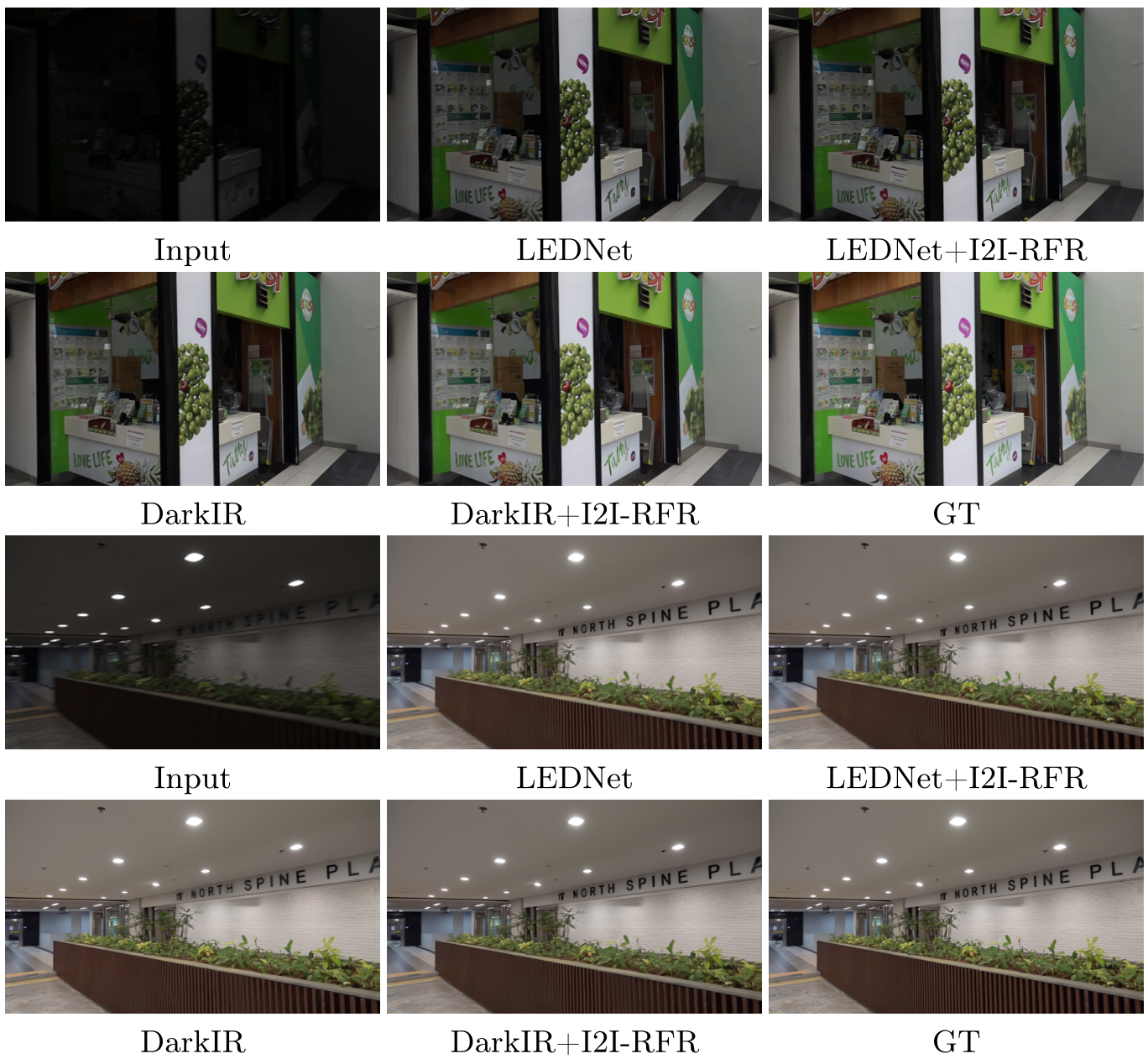 Perceptual detail restoration in low-light conditions.