
[CVPR 2026] INSPATIO-WORLD: Building a Real-Time 4D Simulator via Spatiotemporal Autoregressive Modeling
INSPATIO-WORLD: A Real-Time 4D World Simulator via Spatiotemporal Autoregressive Modeling
INSPATIO-WORLD is a real-time 4D world simulator that transforms monocular videos into interactive, navigable environments. Using a Spatiotemporal Autoregressive (STAR) architecture and a novel Joint Distribution Matching Distillation (JDMD) technique, it achieves SOTA performance on the WorldScore-Dynamic benchmark, supporting high-DoF roaming at 24 FPS.
Executive Summary
TL;DR: INSPATIO-WORLD is a breakthrough in generative world modeling that turns a single video into a "living," interactive 4D environment. By combining an autoregressive Transformer with explicit geometric constraints and a dual-teacher distillation process, it enables seamless, real-time spatial roaming (24 FPS) without the structural "drift" that plagues typical video models.
Positioning: This work moves beyond simple video generation (T2V/I2V) into the realm of World Simulators. While models like Sora focus on visual fidelity, INSPATIO-WORLD prioritizes spatial persistence and interactive control, setting a new SOTA on the WorldScore benchmark.
Problem & Motivation: The "Drifting World" Problem
Current video diffusion models are excellent at creating short, flashy clips, but they fail as "world models" for three reasons:
- Spatial Persistence: As you "move" the camera in a generated world, the background often morphs or disappears because the model has no long-term memory of the scene's geometry.
- The Plasticity Gap: Models trained on synthetic Unreal Engine data often look "plastic" and fail to capture real-world lighting and textures.
- Instruction Lag: Most models cannot translate a precise 6-DoF (6 Degrees of Freedom) camera command into a physically plausible new view in real-time.
The authors' insight is that a world model needs two things: an implicit memory of where it has been and an explicit geometric anchor of where it is going.
Methodology: STAR Architecture & JDMD
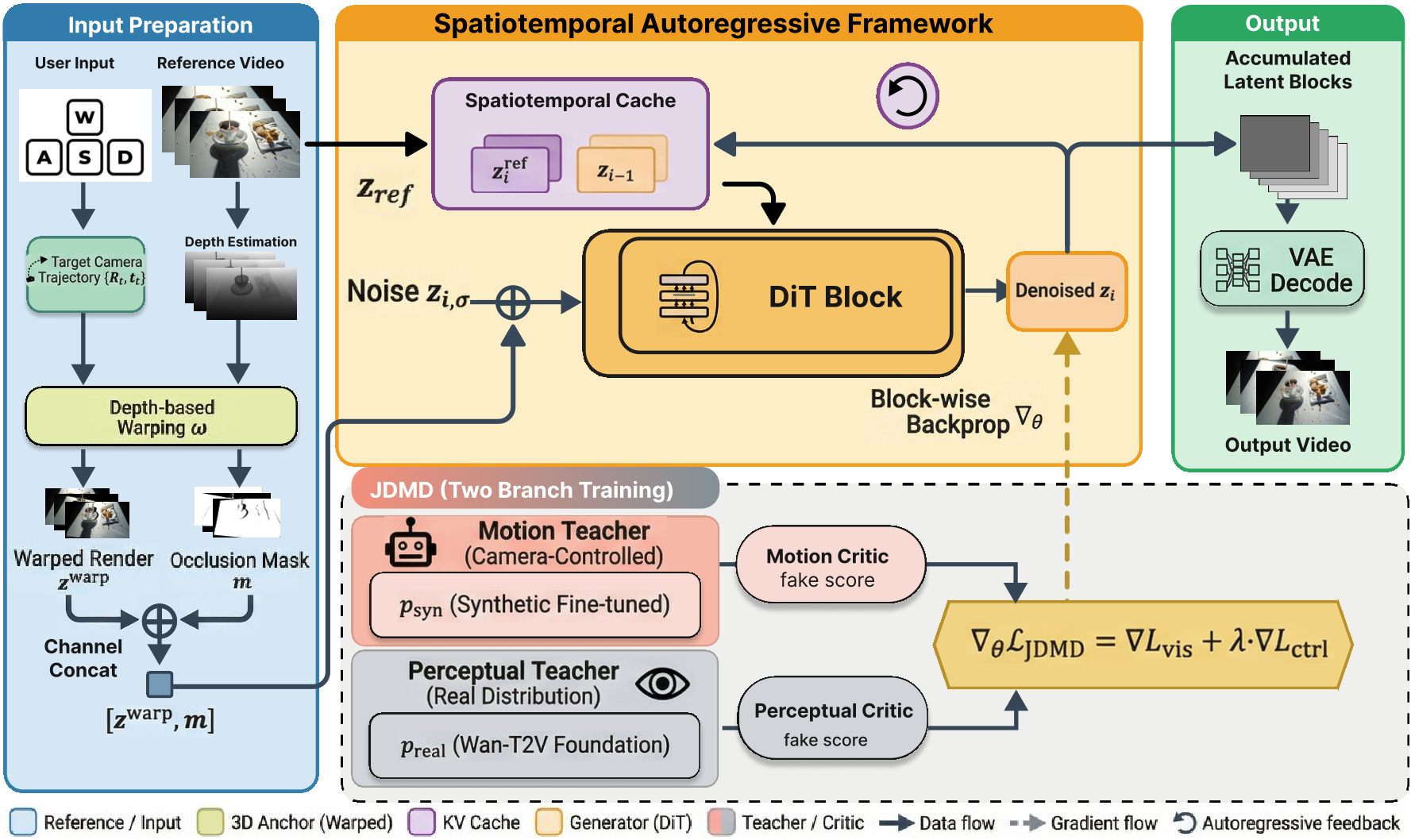
The core of INSPATIO-WORLD is the Spatiotemporal Autoregressive (STAR) framework.
1. Spatiotemporal Cache (The Memory)
Unlike standard models that treat every frame sequence as new, STAR uses an ST-Cache. It anchors the generation process to a "Global Reference Context" (the original video) and a "Historical Context" (previously generated frames). By fixing the Rotary Position Embedding (RoPE) indices, they prevent the numerical instability that usually causes videos to break down over long durations.
2. Explicit Geometry Constraints (The Anchor)
When a user provides a camera command (e.g., "move left"), the system doesn't just "guess" the next frame. It uses Feed-Forward Reconstruction (FFR) to estimate depth and then warps the reference features into the new perspective. This warped feature acts as a "skeleton" for the Diffusion Transformer (DiT) to flesh out.
3. Joint Distribution Matching Distillation (JDMD)
To solve the "plastic" look of synthetic data, the authors introduced JDMD.
- Motion Teacher: Trained on synthetic data to teach the model how to follow camera paths.
- Perceptual Teacher: A frozen real-world T2V model (Wan2.1) that acts as a "style guide," forcing the generator to maintain high-fidelity textures and lighting even when following synthetic motion paths.
Experiments & Results: Real-Time Performance
INSPATIO-WORLD was tested against heavyweight baselines like Gen-3, CogVideoX, and LingBot-World.
SOTA on WorldScore
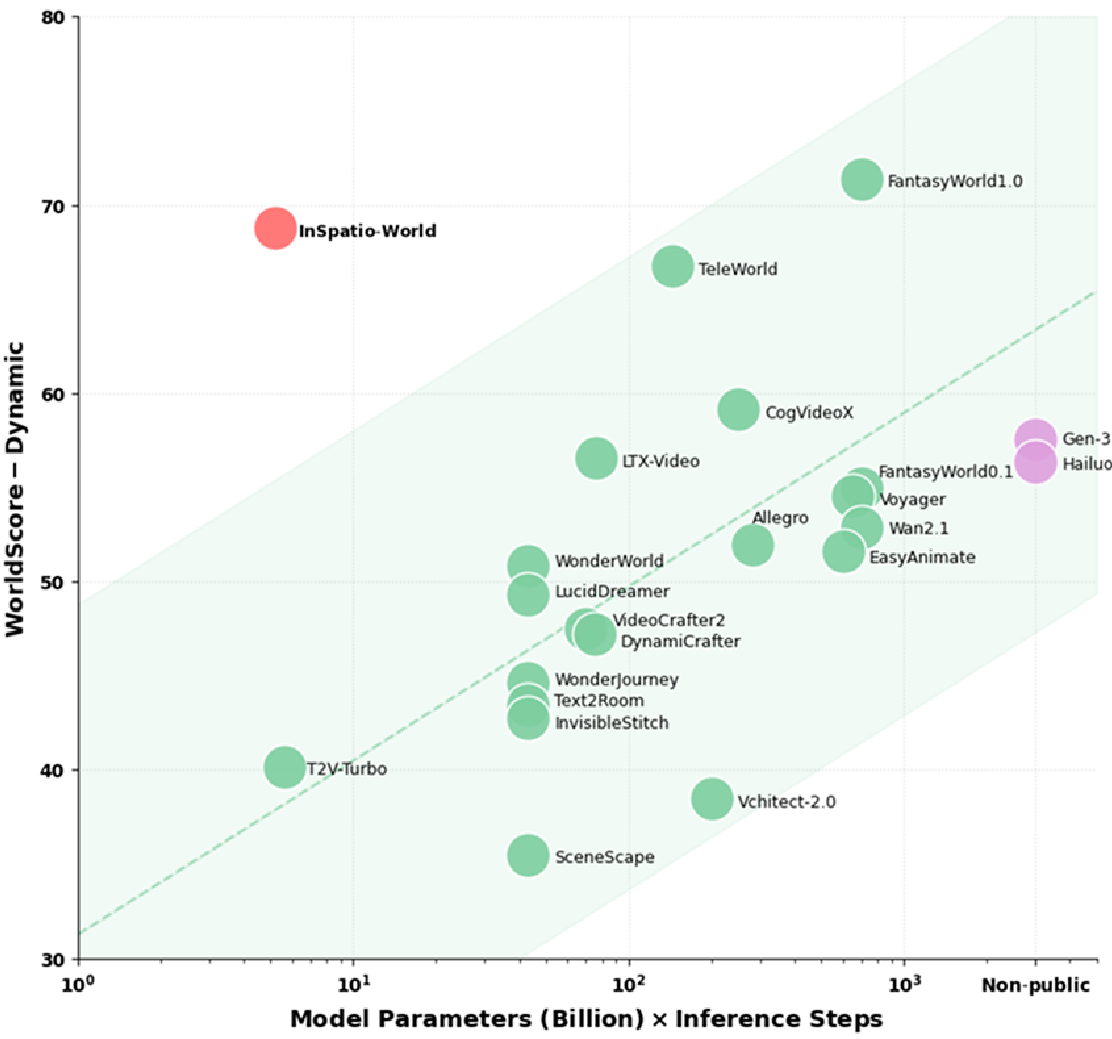
On the WorldScore-Dynamic benchmark, which measures how well a model simulates a physical world, INSPATIO-WORLD (1.3B) topped the charts for real-time models. It achieved a Dynamic Score of 68.72, significantly higher than TeleWorld (66.73), while using far fewer computational resources.
Long-Horizon Stability
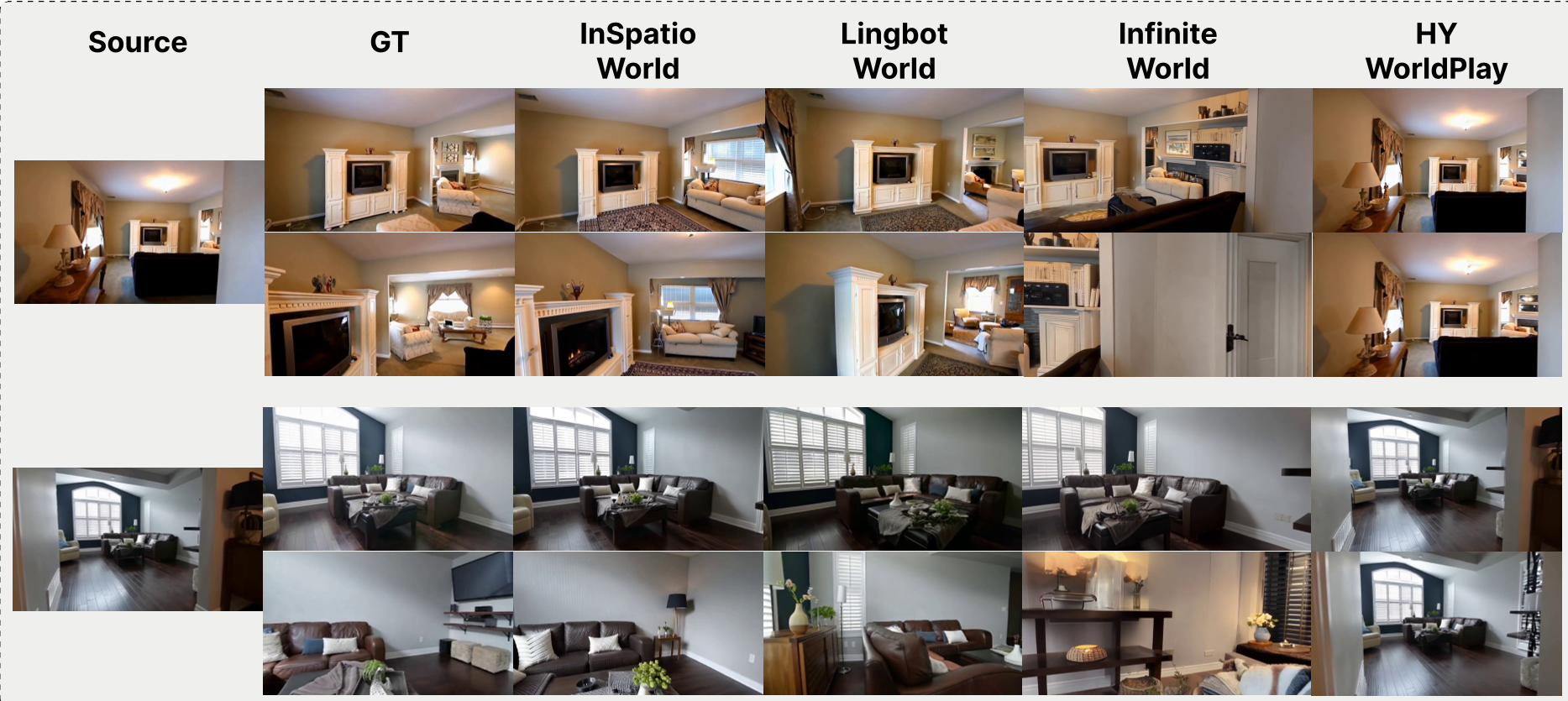
In tasks exceeding 150 frames (RE10K dataset), the model showed virtually zero "drift." While other models like Infinite-World suffered from warping, INSPATIO-WORLD maintained a rotation error of only 2.87, compared to 11.98 for its closest competitor.
Critical Analysis & Conclusion
Takeaway
INSPATIO-WORLD proves that the future of world modeling isn't just "bigger transformers"—it's about smarter distillation and geometric grounding. By decoupling motion control from visual fidelity, they’ve created a system that feels like a video game engine but looks like a real-world movie.
Limitations
The primary hurdle remains 360-degree dynamic roaming. While the model excels at "forward-facing" navigation within a known scene, generating entirely new content for a full 360-degree turn while maintaining the same dynamic elements (like a person walking) remains a challenge.
Future Outlook
The team aims to develop a "Semantic Memory System" that records fine-grained textures of autonomously generated areas, effectively creating a persistent, infinitely expandable virtual world. This is a massive step forward for Embodied Intelligence and Autonomous Driving simulation.