
[PRD 2025] Integrable Systems for GTPs: Bridging Birational Geometry and 5d Higgsed Theories
Integrable Systems for Generalized Toric Polygons and Higgsed 5d N=1 Theories
The paper introduces a framework for constructing integrable systems associated with Generalized Toric Polygons (GTPs), extending the traditional dimer integrable system correspondence. It achieves this by applying refined birational transformations to known dimer systems, which matches the Poisson structures and spectral curves between different toric geometries and their dual 5-brane webs.
TL;DR
This research maps out the integrable system landscape for Generalized Toric Polygons (GTPs). By utilizing refined birational transformations and a "freezing" mechanism for cluster variables, the authors show how integrable systems with different numbers of Hamiltonians can still be equivalent. This provides a precise mathematical description of Higgsing in 5d gauge theories using the language of dimer models and (p, q) 5-brane webs.
Problem & Motivation: The Rank Mismatch
In the world of Calabi-Yau 3-folds and 5d theories, the toric diagram is the Rosetta Stone. Usually, a toric diagram's internal points correspond to the Hamiltonians of an integrable system. But what happens when you perform a birational transformation—a standard "coordinate change" in algebraic geometry—that adds or removes an internal point?
Previously, birational equivalence was only well-understood for systems with the same number of Hamiltonians. The authors tackle the "rank-changing" problem by looking at the physics: Hanany-Witten transitions. When 5-branes in a web are grouped together, it implies a physical reduction of the theory (Higgsing). The authors' insight is that this physical reduction in the brane web corresponds exactly to a mathematical reduction in the integrable system.
Methodology: Freezing and GTPs
The core of the method lies in the transition from an ordinary toric diagram to a Generalized Toric Polygon (GTP).
- Dimer Systems: The paper starts with the Kasteleyn matrix of a bipartite graph on a torus, where the determinant provides the spectral curve.
- Refined Birational Map: They define a map .
- The Reduction (Freezing): To match a system with more Hamiltonians to one with fewer, they impose "freezing constraints" on the cluster variables (face variables ). This effectively turns dynamical degrees of freedom into constants (Casimirs).
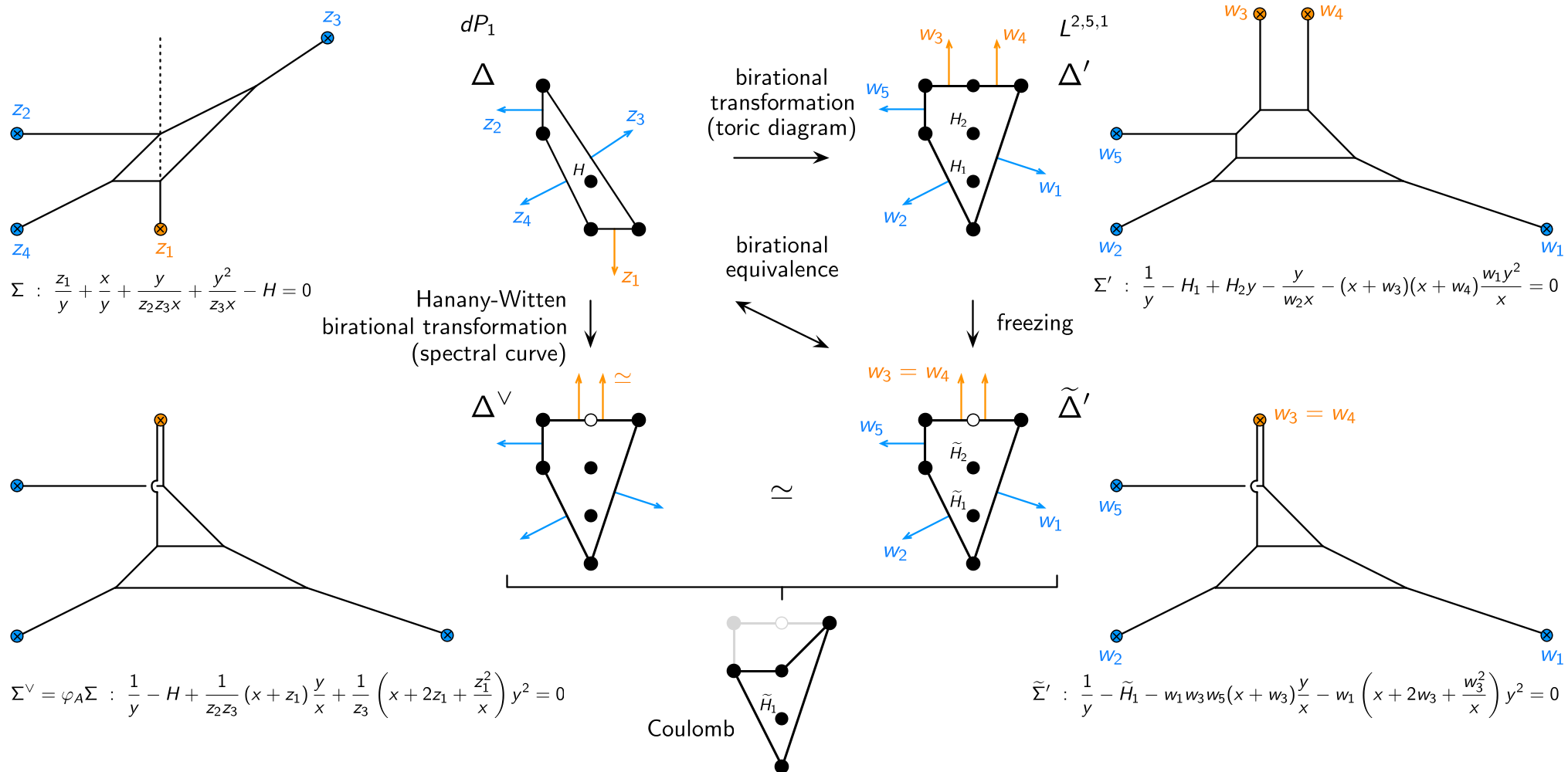 Figure 1: Illustration of the (p, q)-web and the dual GTP. The white vertices on the boundary indicate multiple 5-branes ending on a common 7-brane.
Results: The dP1 and L2,5,1 Duality
The authors prove their framework using a heavy-weight example: the mapping between the dP1 model (one internal point) and the L2,5,1 model (two internal points).
- L2,5,1 Spectral Curve: Initially possesses two Hamiltonians (Equation 7).
- The Constraint: By setting zig-zag path variables and imposing a freezing constraint on auxiliary variables , they reduce the L2,5,1 system.
- Verification: The resulting reduced curve (Equation 14) is shown to be perfectly equivalent to the birationally transformed dP1 curve.
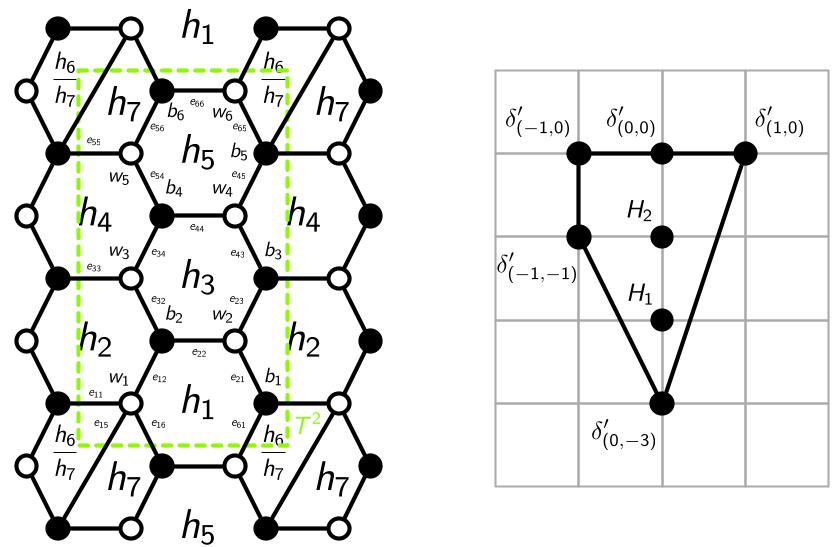 Figure 2: The L2,5,1 Brane Tiling and its corresponding toric diagram ∆'. Note the two internal points which are reduced to one through the proposed mechanism.
Critical Analysis & Conclusion
The power of this work is its ability to maintain the Poisson structure throughout the reduction. By identifying 1-loops in the reduced higher-rank system that satisfy the commutation relations of the lower-rank system, the authors provide a rigorous proof of integrability.
Limitations
While the dP1 to L2,5,1 case is compelling, the "freezing" constraints (like ) are specifically tailored. A more generalized, automated algorithm for identifying these constraints for any GTP remains an open challenge for future work.
Future Outlook
This research extends dimer integrable systems beyond their original scope. It opens the door to studying more exotic 5d SCFTs and their dual non-convex polygons, potentially leading to new breakthroughs in the quantization of these systems and their connection to relativistic Toda models.