
The Geometry of Inequality: How Data Structure Dictates Learning in Diffusion Models
The Interplay of Data Structure and Imbalance in the Learning Dynamics of Diffusion Models
Summary
Problem
Method
Results
Takeaways
Abstract
This paper investigates how data heterogeneity—specifically class variance, centroid geometry, and sampling imbalance—affects the training dynamics of score-based diffusion models. Utilizing a high-dimensional analytical framework with Random Feature models on Gaussian mixtures, the authors identify a hierarchical order where high-variance classes are generalized and memorized earlier than low-variance ones, achieving SOTA theoretical alignment with empirical U-Net results on Fashion MNIST.
## TL;DR
Why do diffusion models learn some classes almost instantly while others remain blurry or overfit? This paper provides a rigorous mathematical answer: **data geometry is destiny**. By analyzing Random Feature models on Gaussian mixtures, the authors prove that high-variance classes take the "fast lane" in training, generalization, and memorization. They uncover a fundamental trade-off: you can't balance generalization across classes without skewing their memorization rates.
## Background: The Homogeneity Myth
Most theoretical work on diffusion assumes a clean, uniform data distribution. But real-world data is messy—classes have different variances, different shapes (centroids), and unequal representation (imbalance). In this "wild" setting, the standard practice of early stopping becomes a double-edged sword: a time that regularizes the "Dog" class might already be memorizing "Cat" samples or haven't even begun to generalize "Bird" features.
## The Hierarchy of Learning
The authors identify a clear "pecking order" in how a model's neurons wake up to different data:
1. **Class Variance (The King)**: High-variance classes present smoother targets for score matching. They are generalized earlier and memorized faster.
2. **Centroid Geometry**: Classes with smaller-norm centroids (closer to the origin) are prioritized over those far away.
3. **Sampling Imbalance (The Modulator)**: While often secondary, extreme imbalance can force minority classes into a delayed "speciation" phase, making them invisible until the very end of the diffusion process.
### Visualizing the Architecture of Learning
The analysis relies on the **Gaussian Equivalence Property (GEP)**, which allows us to treat complex neural feature correlations as simpler random matrix problems.
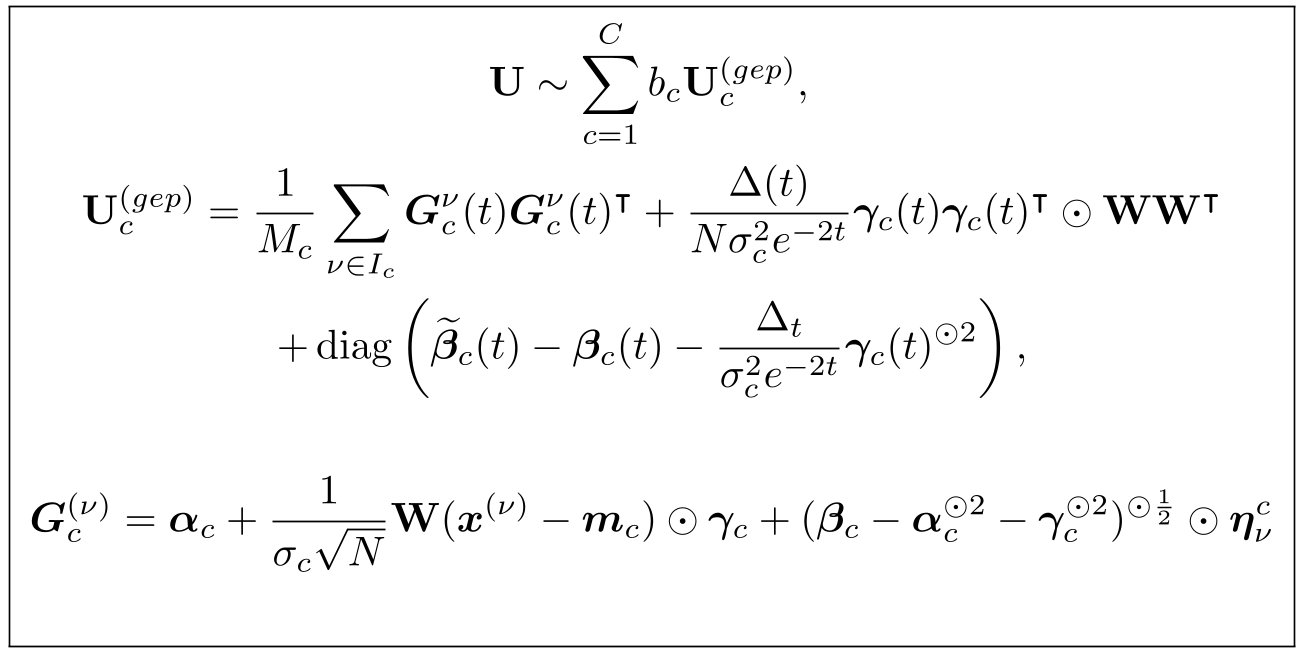
*Equation (50): The GEP decomposition of the feature-feature correlation matrix, separating the signal (centroids) from the noise (memorization).*
## Generalization vs. Memorization: A Zero-Sum Game?
One of the most striking findings is the **Generalization-Memorization Trade-off**. If you increase the sampling weight of a minority (low-variance) class to help it generalize at the same speed as the majority class, you inadvertently cause the model to memorize those minority samples much faster.
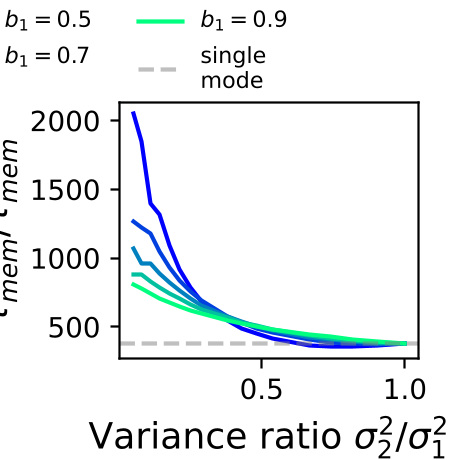
*Figure 2: The spectral density shows how different eigenvalue "bulks" correspond to generalization and memorization phases. As class diversity Increases, the window for safe generalization shrinks.*
## Empirical Proof on Fashion MNIST
Theoretical physics meets real pixels. Using U-Nets trained on Fashion MNIST pairs (like Sneakers vs. Bags), the authors confirmed that:
* **Bags** (high variance) reach the memorization threshold much earlier than **Sneakers** (low variance).
* The **Memorization Gap** correlates almost perfectly with the pixel-wise variance of the classes.
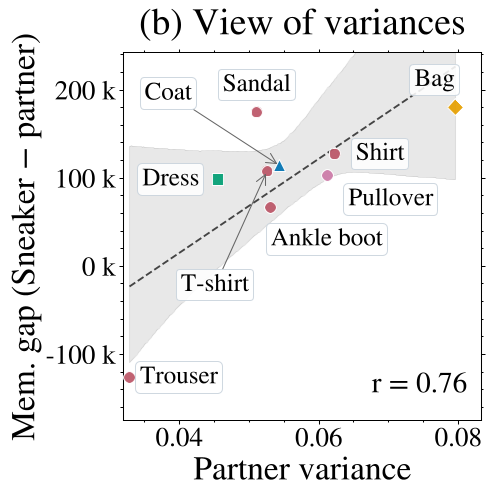
*Figure 5: Empirical evidence from DDPM training. The "Bag" class crosses the 1/3 memorization threshold long before the "Sneaker" class, confirming the variance-driven hierarchy.*
## Critical Analysis & Conclusion
The value of this work lies in its **predictive power**. We no longer have to guess why a model is biased; we can look at the variance and imbalance of the training set and predict the learning sequence.
**Limitations**: The model assumes Gaussian clusters. While this works surprisingly well (Result 4), it doesn't account for complex, non-isotropic manifolds or "outliers" that don't fit the GMM mold.
**Future Prospect**: This research paves the way for **class-specific schedulers**. Instead of one global learning rate or stopping point, future diffusion pipelines might use different trajectories for different sub-populations to ensure that every class is generalized, but none are "stolen" by memorization.
### Final Takeaway
In the world of generative AI, being "representative" is a moving target. To build fair models, we must stop treating all data as equal and start respecting the specific geometry of every class.