
HILBERT: Balancing the Scales of Long-Sequence Audio-Text Representation Learning
Joint-Centric Dual Contrastive Alignment with Structure-Preserving and Information-Balanced Regularization
HILBERT is a novel multimodal framework for document-level audio-text representation learning, specifically designed for long sequences in low-resource settings. It employs a cross-attentive joint encoder with reciprocal dual contrastive alignment and a Mixture-of-Experts (MoE) classifier, achieving significant performance gains (up to 83.85% AUC in affective tasks) over standard CLAP-style baselines.
TL;DR
HILBERT (HIerarchical Long-sequence Balanced Embedding with Reciprocal contrastive Training) is a specialized framework designed to solve the "long-sequence" problem in multimodal audio-text learning. By utilizing frozen foundation models, a cross-modal joint encoder, and a unique triple-loss regularization (Contrastive + CKA + MI), it outperforms global alignment methods like CLAP in complex, low-resource tasks such as mental health disorder prediction.
Background & Positioning
In the landscape of multimodal AI, CLIP and CLAP have set the standard for image-text and audio-text alignment. However, these models are essentially "global aligners" optimized for short clips and captions. When faced with 5-minute clinical interviews (document-level data), they struggle to capture the evolving temporal dynamics and the structural nuances of the conversation. HILBERT sits in the "High-Resolution/Long-Sequence" quadrant of the academic map, focusing on how to fuse information without losing the distinct structural identity of either audio or text.
The Core Challenge: Modality Imbalance
The authors identify a critical technical hurdle: Dimensional Imbalance. High-fidelity audio embeddings are often much higher-dimensional and "noisier" than their corresponding text embeddings. In a standard fusion model, the audio might overwhelm the text, or vice versa, leading to a "collapsed" representation where the model ignores one modality entirely.
Methodology: The HILBERT Architecture
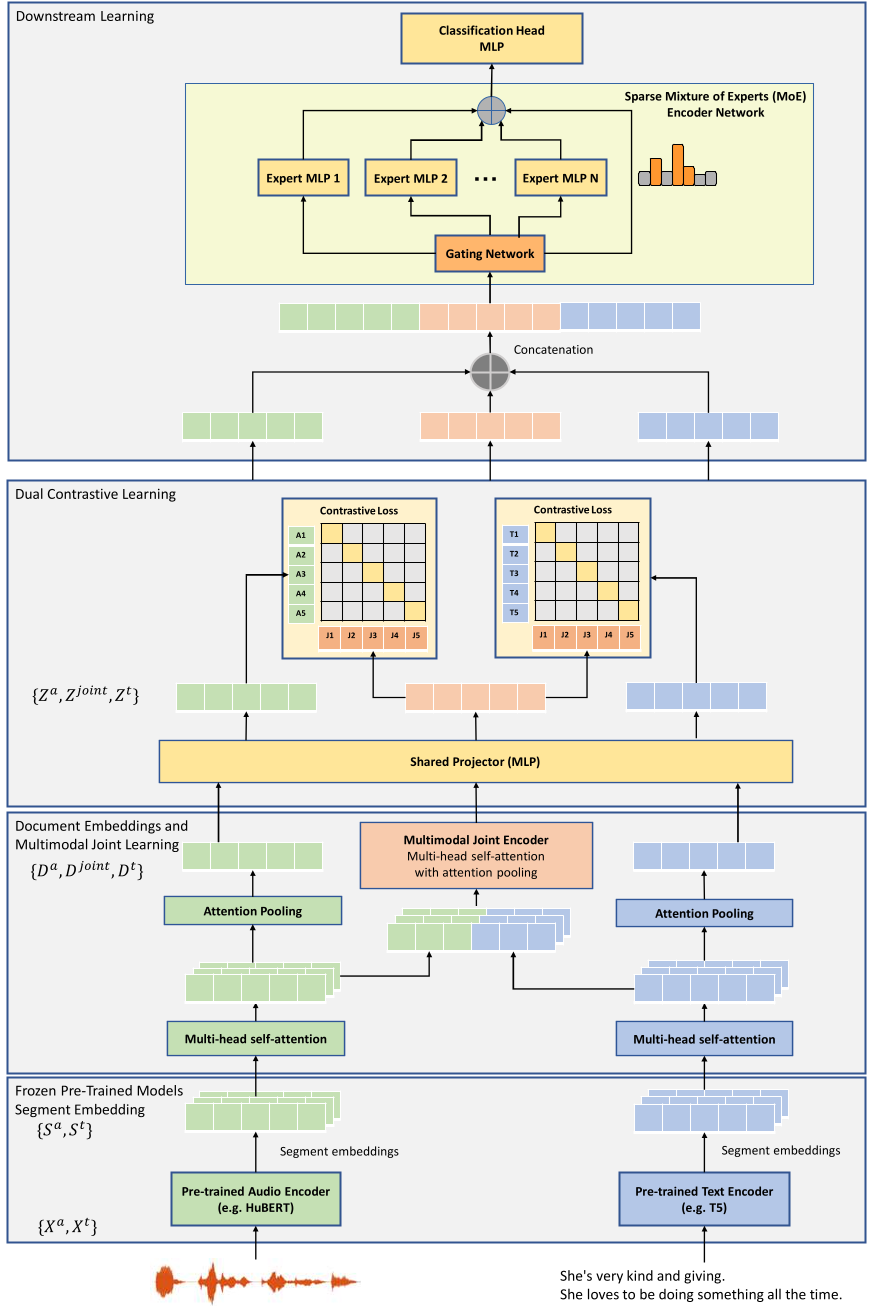
HILBERT addresses this through a hierarchical approach. Instead of processing the whole sequence at once, it breaks data into segments, extracts features using frozen backbones, and then uses a Multimodal Joint Encoder to learn cross-modal dependencies.
1. Dual Contrastive Alignment
Instead of the standard contrast, HILBERT performs:
- Audio-to-Joint alignment
- Text-to-Joint alignment This "reciprocal" strategy ensures that the joint latent space remains anchored to the most salient features of both original sources.
2. The Regularization Triad
To stabilize this process, HILBERT introduces two auxiliary losses alongside the Contrastive loss:
- Centered Kernel Alignment (CKA) Loss: This ensures the internal structure of the audio and text remains consistent as they migrate into the joint space.
- Mutual Information (MI) Balancing: This acts as a "fairness" regulator, penalizing the model if one modality contributes significantly more bits of information to the joint embedding than the other.
3. Mixture-of-Experts (MoE) Classifier
For downstream prediction, HILBERT doesn't just use a simple linear head. It employs an MoE architecture, where different "experts" (MLP layers) can specialize in different types of data (e.g., one expert focusing on prosody/audio features, another on lexical/text features).
Experimental Results: Clinical Significance
The framework was tested on the FORBOW dataset, which involves predicting mental disorders (MDD, Bipolar, Schizophrenia). These are high-stakes, low-resource, and highly imbalanced tasks.
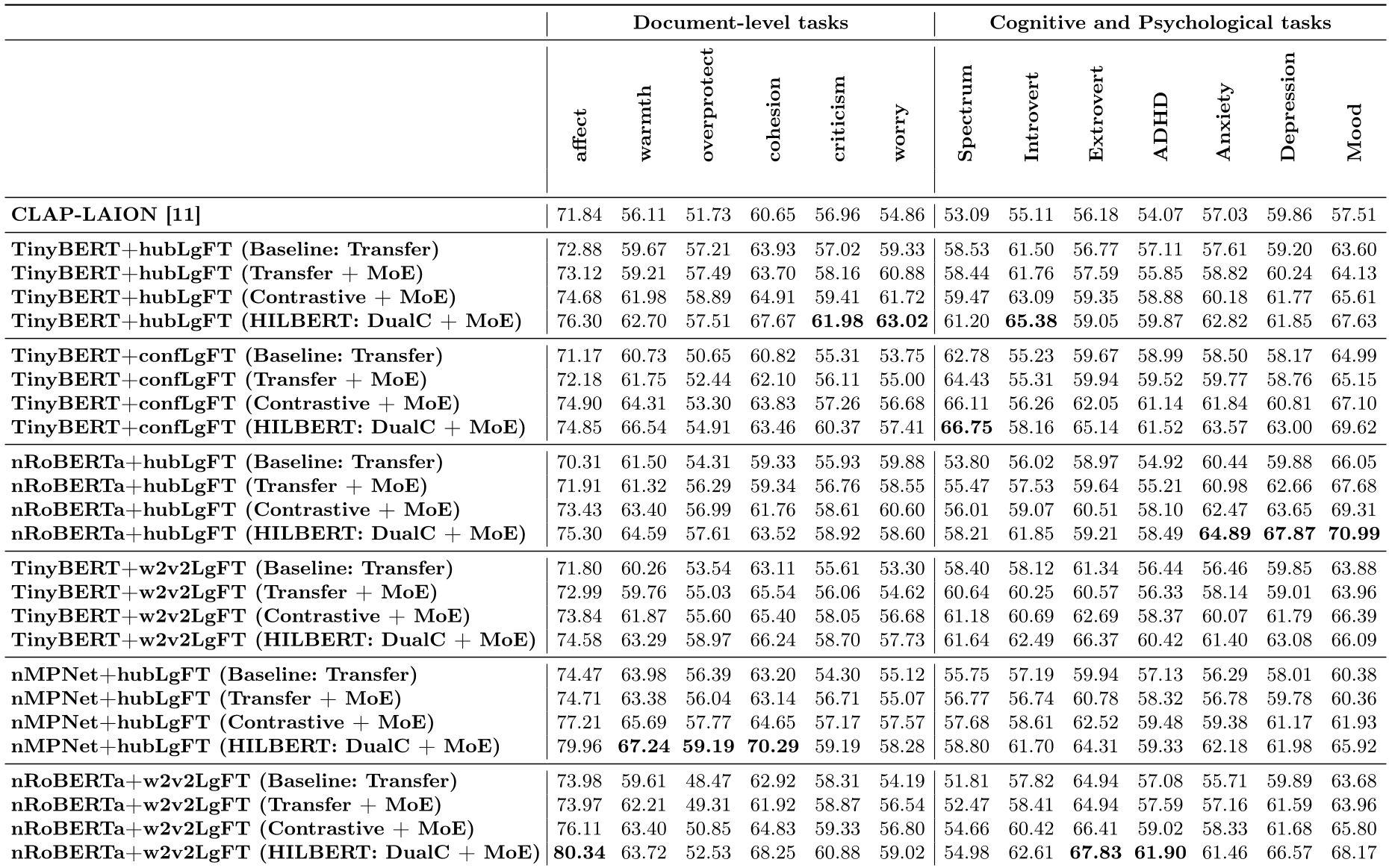
- SOTA Performance: HILBERT consistently beat baseline transfer learning and CLAP models. For instance, on the "Affect" task, it achieved an AUC of 80.34% compared to CLAP's 71.84%.
- Mental Health Insight: Interestingly, audio features (intonation, pauses) were more predictive in the "offspring" group than in the "parent" group, suggesting that HILBERT’s ability to preserve audio structure is vital for childhood developmental diagnosis.
Critical Analysis & Conclusion
Takeaway
HILBERT proves that "Frozen is Better" for low-resource domains. By keeping the massive audio/text backbones frozen and only training the hierarchical fusion layers and regularizers, the model avoids the "catastrophic forgetting" and overfitting common in small clinical datasets.
Limitations
While HILBERT handles long sequences through segmentation, the segment boundaries are currently determined by emotion or sentiment changes. In a real-time production environment, an automated, robust segmentation strategy would be necessary.
Future Outlook
This work paves the way for "Document-level Multimodal Understanding." We expect this architecture to be highly influential in legal, medical, and psychological AI assistant development where the context length is measured in minutes or hours, not seconds.