
KernelBench-X: Unmasking the Limits of LLM-Generated GPU Kernels
KernelBench-X: A Comprehensive Benchmark for Evaluating LLM-Generated GPU Kernels
KernelBench-X is a specialized benchmark comprising 176 tasks across 15 categories designed to evaluate LLM-generated GPU kernels (specifically OpenAI Triton). It introduces category-aware analysis and hardware-efficiency metrics, revealing that current SOTA models like GEAK and Claude achieve less than 31% semantic correctness and often fail to outperform standard PyTorch eager baselines.
Executive Summary
TL;DR: While LLMs are becoming surprisingly adept at writing Python code, generating high-performance GPU kernels remains an unsolved frontier. KernelBench-X reveals a stark reality: even though models like DeepSeek-V3 or Claude can be "prompted" or "agented" into producing kernels that compile, nearly half are slower than standard PyTorch, and their success depends more on the type of math (category) than the sophistication of the agent.
Background Positioning: This work is a rigorous "reality check" in the LLM-for-Code space. Unlike previous benchmarks that focused on whether code runs, KernelBench-X investigates whether code wins in the brutal arena of hardware efficiency.
Problem & Motivation: The Illusion of Correctness
In the pursuit of training-efficient models like DeepSeek-V3, custom Triton kernels have become essential. However, the industry has relied on "vibe-based" evaluations of LLM kernel coders. Previous benchmarks struggled with:
- Selection Bias: Only testing simple operators.
- Weak Verification: Passing implementations that only work on Gaussian noise but fail on real-world outliers.
- Efficiency Neglect: Ignoring that a "correct" kernel that is 2x slower than PyTorch is, in practice, a failure.
The authors' insight is profound: Correctness is not a single wall, but a sequence of distinct barriers.
Methodology: A Multi-Dimensional Microscope
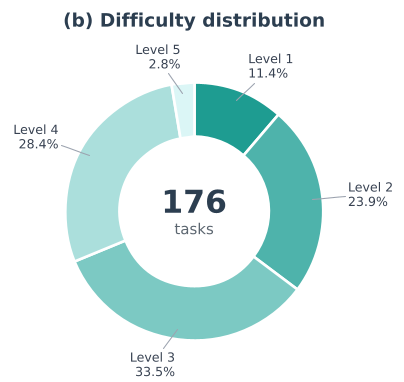
KernelBench-X evaluates 176 tasks through a unified pipeline that doesn't just check y == ref_y.
1. Robust Correctness Protocol
The benchmark uses a two-stage gate. The second stage specifically employs outlier mode—injecting amplified values to ensure models haven't just memorized the most common numerical paths but actually understand the mathematical contract.
2. The Hard-Category Taxonomy
Tasks are grouped by Computational Structure (e.g., Parallel Aggregation vs. SpatialOps) rather than operator name. This allows the researchers to isolate why a model fails.
3. Hardware Efficiency Metrics
Instead of just "time," they measure IOU (IO Utilization) and MFU (Model Flops Utilization). This tells us if the LLM understands whether its kernel is memory-bound or compute-bound.
Key Findings: The "Repair" Bias
The most surprising result is the Iterative Refinement Trajectory. We usually expect agents (like GEAK) to get better with more rounds. While they do get "more correct," they get "less efficient."
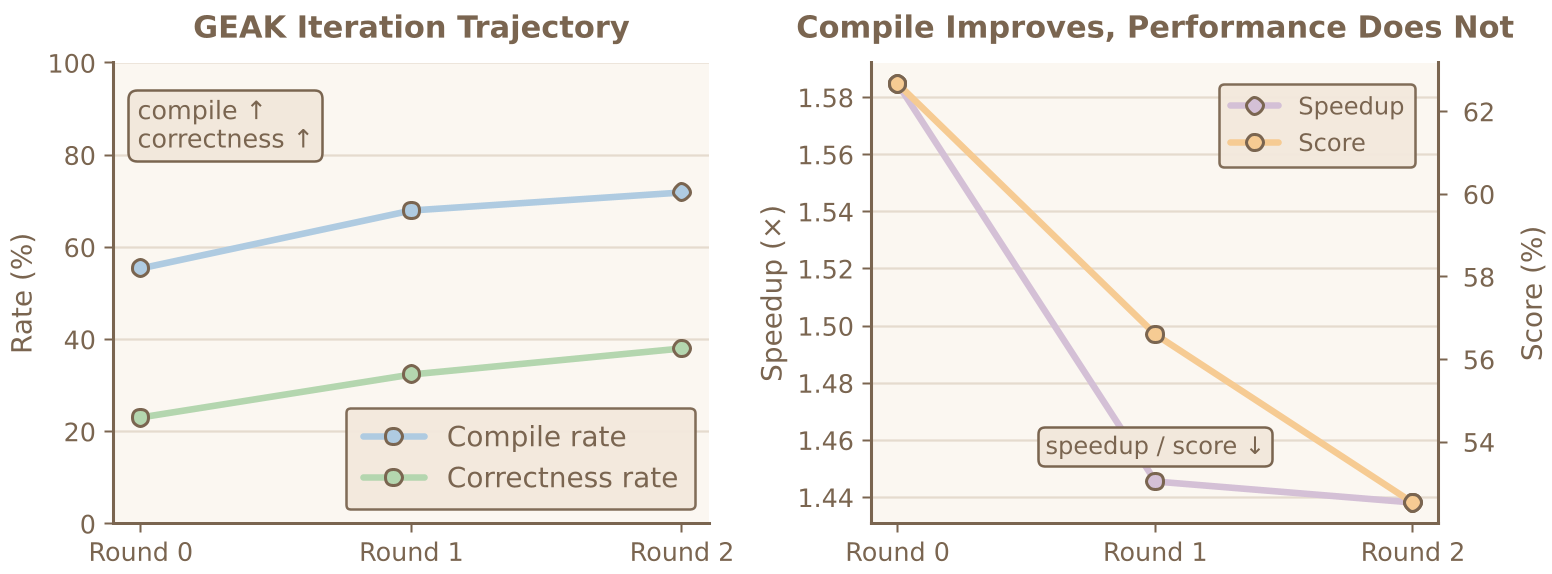
- Observation: In Round 0, the model tries a bold, fast implementation. If it fails to compile, the agent "repairs" it by adding safer, slower logic (like complex coordinate mapping).
- The Gap: Newly "rescued" kernels in Round 1 averaged 1.16x speedup, whereas those that worked immediately in Round 0 had 1.58x. The agent is trading performance for a "Pass" grade.
Experiments & Results: Category is Destiny
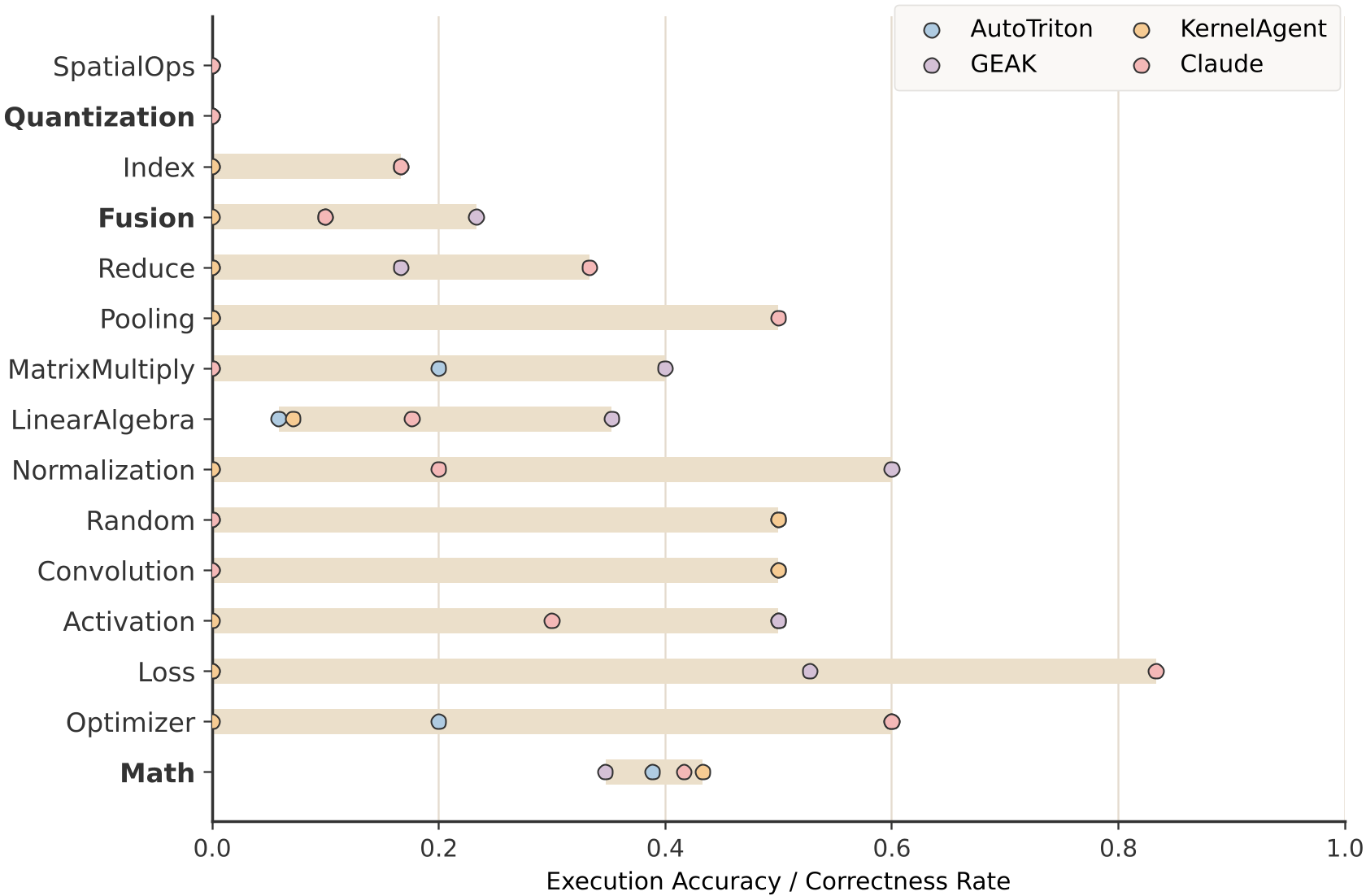
The research finds that if you know the task category, you can predict success much better than if you know the model name.
- Success: Activation and Math tasks are almost always solved.
- The "Wall": Fusion and Quantization are virtually unsolved.
- Hardware Portability: A kernel that is fast on an A100 might be a disaster on an L20, yet LLMs currently have zero awareness of the specific hardware they are targeting.
Critical Analysis & Conclusion
Takeaways
- Semantic Contracts: LLMs fail when they need to maintain consistent logic across global memory layouts (e.g., handling padding in fused operations).
- Optimization requires Search, not just Reasoning: You cannot "reason" your way to the best tiling size without hardware-specific feedback.
Limitations & Future Work
The benchmark shows that Prompt Engineering has hit a ceiling for kernel generation. To move forward, we need:
- Hardware-Aware Training: LLMs must see hardware specs (shared memory size, bandwidth) as part of the prompt.
- Efficiency Feedback: Agents must be rewarded for MFU/IOU, not just a binary "Pass" from the compiler.
KernelBench-X provides the community with a high-quality dataset of "Error-Correction" pairs, serving as the perfect training ground for the next generation of hardware-savvy AI engineers.