
[CMU & JHU Research] The Implicit Curriculum: Decoding the Secret Order of LLM Skill Acquisition
What do Language Models Learn and When? The Implicit Curriculum Hypothesis
The paper proposes the "Implicit Curriculum Hypothesis," suggesting that LLMs acquire skills during pretraining in a stable, compositional order. By evaluating 9 model families (410M to 13B parameters), the authors demonstrate that skill emergence is predictable across different architectures and data mixtures, ultimately reaching a State-of-the-Art understanding of how internal representations align with training dynamics.
TL;DR
Standard scaling laws tell us that a model improves, but not what it learns or when. A new study from CMU and JHU introduces the Implicit Curriculum Hypothesis, proving that LLMs follow a remarkably stable sequence when learning skills during pretraining. By analyzing internal "Function Vectors," the researchers can even predict the future performance of a model on complex tasks before those tasks actually emerge.
Background: Beyond the Smooth Loss Curve
We are used to seeing training loss as a smooth, descending line. However, this smoothness is an illusion of aggregation. Beneath the surface, qualitatively different skills—like logical negation or German translation—emerge at sudden "phase transitions."
The core question this paper asks is: Is this emergence random? If we train two different models on different data, will they learn to "copy" before they learn to "reason"? The answer, according to the Implicit Curriculum Hypothesis, is a resounding yes.
The Implicit Curriculum Hypothesis
The authors propose that pretraining is governed by three rules:
- Compositional Ordering: Simple tasks (prerequisites) emerge before complex ones that depend on them.
- Cross-Model Stability: The relative order of skill acquisition is consistent across different model families (OLMo, Pythia, LLM360).
- Representational Alignment: Tasks that "look" similar in the model's hidden layers are learned at similar times.
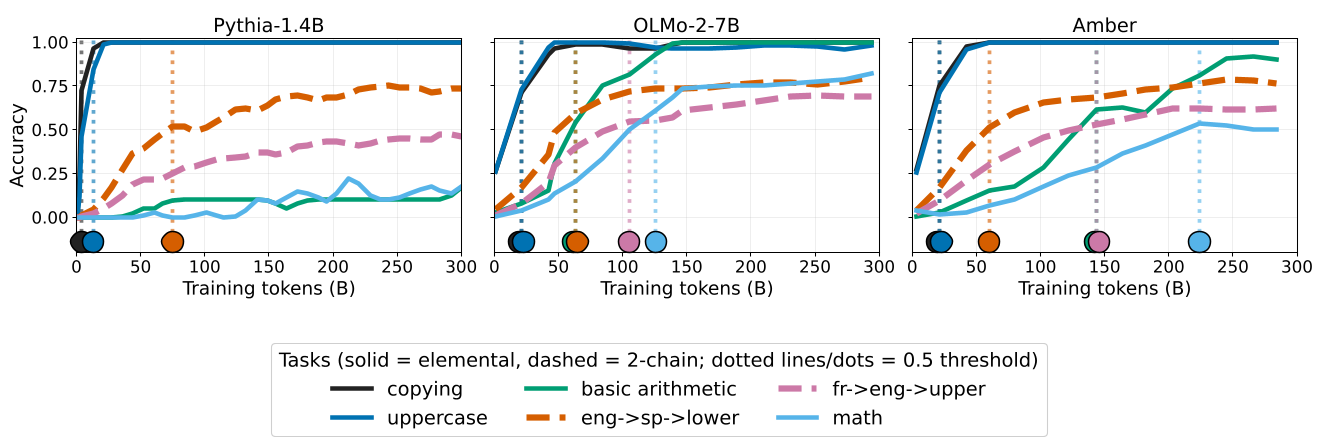 Figure 1: The emergence order remains strikingly consistent despite differences in total compute or model size.
Methodology: Probing the Architecture
To test this, the authors created a "Task Suite" of 91 tasks, ranging from simple string manipulation (uppercase/lowercase) to multi-step arithmetic and logic. They evaluated models like OLMo-2 and Pythia at various checkpoints (every 20B tokens).
Function Vectors (The "How")
The most impressive part of the methodology involves Function Vectors (FV). By extracting activations from the residual stream at the precise moment a model solves a task, the researchers created a "representation space." If the vector for "Present-to-Gerund" is close to "Singular-to-Plural," the model likely treats these as similar computational primitives.
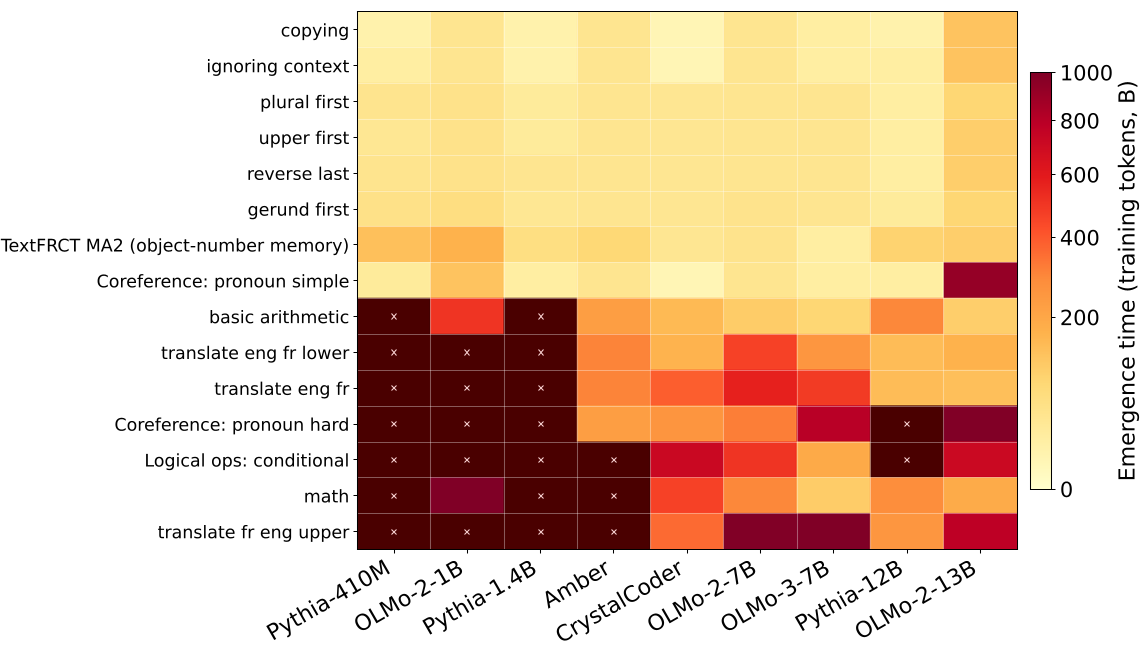 Figure 2: Heatmap showing tasks sorted by consensus emergence order. Note the consistent vertical gradients across different models.
Key Results
- Universal Ordering: Across 45 model pairs, the Spearman correlation of skill emergence was 0.81. Models almost always learn to "copy" first, followed by morphological changes, then world knowledge, and finally logic.
- Predicting the Future: Using Kernel Ridge Regression on the Function Vectors, the team was able to predict the full training trajectory of a "held-out" task. For example, by looking at how the model handles "translation" and "uppercasing" separately, they could accurately predict when the model would learn the composite task "translate-to-French-then-uppercase."
- Prerequisite Violations: The authors found that while 71% of composite tasks follow their parents, some "inversions" occur—specifically involving "first letter" extraction, suggesting some skills might be learned through "shortcuts."
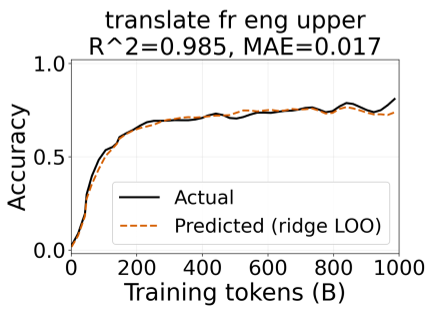 Figure 3: Predicted vs. Actual trajectories for complex tasks. The internal geometry of the model "knows" its developmental path.
Critical Insight: Why This Matters
This research moves us from observation to prediction. If we know the "Implicit Curriculum," we can:
- Monitor Training Health: If a $100M training run is halfway finished but hasn't acquired "coreference" yet, we can predict that it will fail at complex reasoning tasks later, allowing for early termination.
- Audit Data Mixtures: We can see how changing the ratio of code to natural language shifts the "curriculum" of skill acquisition.
Conclusion & Limitations
The study proves that pretraining is a structured developmental process. However, the authors note that this consistency only holds for absolute thresholds (fixed accuracy). If we only look at "relative" improvement, the order becomes noisy. This suggests that there is a physical "circuit formation" threshold in models that represents true skill acquisition.
Future work will likely explore whether we can force a more efficient curriculum or if the "Implicit" one we found here is the most mathematically optimal path for gradient descent.