
HeadsUp: Apple’s Scalable Leap into High-Fidelity 3D Digital Humans
Large-Scale High-Quality 3D Gaussian Head Reconstruction from Multi-View Captures
HeadsUp is a scalable feed-forward framework developed by Apple for high-fidelity 3D head reconstruction from multi-view captures. By regressing UV-parameterized 3D Gaussians anchored to a neutral template using a cross-attention transformer, it achieves State-of-the-Art (SOTA) photorealism on the massive Internal10K and public Ava-256 datasets.
TL;DR
HeadsUp is a feed-forward reconstruction model designed to transform multi-view studio captures into photorealistic 3D head assets in milliseconds. Unlike previous methods that struggle with memory as camera counts increase, HeadsUp uses a clever UV-parameterized 3D Gaussian approach. It scales to over 10,000 unique identities, outperforms current SOTA models in sharp detail (hair, eyes, skin), and provides a latent space powerful enough to generate entirely new people or animate them via blendshapes.
The Scalability Bottleneck in Digital Humans
Photorealistic digital humans are the "Holy Grail" of immersive telepresence. However, the industry has long faced a "Trilemma" of 3D reconstruction:
- Quality: Detailed enough to see individual hair strands and skin pores.
- Speed: Instantaneous (feed-forward) rather than taking hours to optimize a single person.
- Scalability: Capable of handling dense camera rigs without crashing GPU memory.
Prior works like Avat3r or pixelSplat often use "pixel-aligned" Gaussians. In those models, every pixel in the input images generates a Gaussian. If you have 16 high-resolution cameras, you end up with millions of Gaussians, leading to massive memory overhead and "floating" artifacts.
The HeadsUp Insight: Decoupling Input from Output
HeadsUp breaks this bottleneck by moving the reconstruction from image-space to UV-space. Instead of predicting Gaussians for every pixel, the model predicts a fixed-resolution UV map (e.g., 256x256) where each texel represents a 3D Gaussian anchored to a neutral head template.
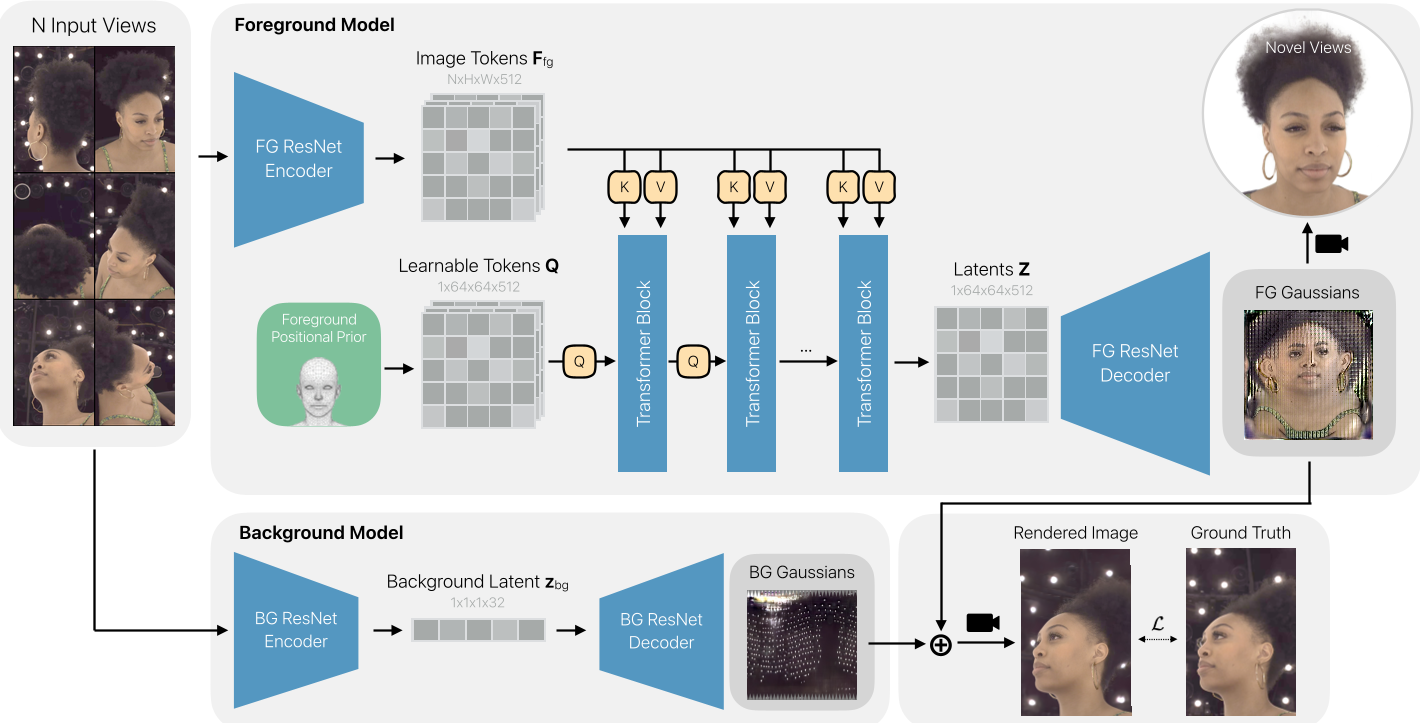
Key Architectural Components:
- Multi-View Encoder: Uses a transformer with cross-attention to "look" at all available camera views. Because it uses a fixed set of query tokens, the computation doesn't explode when more cameras are added.
- Geometric Anchor: By anchoring Gaussians to a fixed mesh, the model benefits from a strong "human shape" prior, allowing it to focus its capacity on appearance and fine textures.
- Explicit Background Modeling: Most models "cut out" the person (matting), which often ruins hair boundaries. HeadsUp reconstructs the background separately, allowing for cleaner hair and accessory details.
Experimental Dominance: 10,000 Identities and Counting
Apple trained this model on a massive internal dataset of 10,000 subjects—an order of magnitude larger than public datasets. The results show a clear "scaling law": the more identities the model sees, the better it generalizes to people it has never seen before.
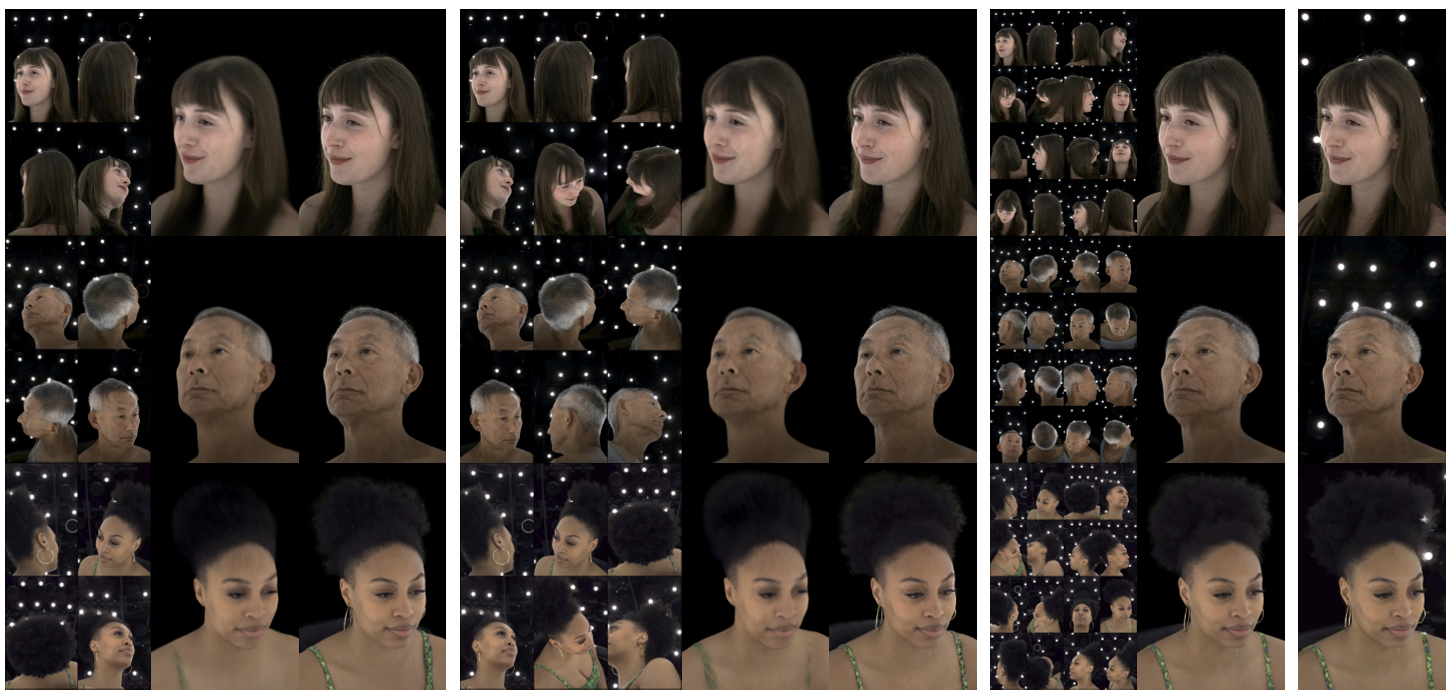
As shown in the comparison above, HeadsUp captures much sharper details in the eyes, mouth, and earrings compared to the previous SOTA, Avat3r. Quantitatively, it reaches a PSNR of 29.25 dB on the internal dataset, leaving the baseline (24.37 dB) far behind.
Beyond Reconstruction: Generation and Animation
Because HeadsUp compresses a 3D head into a compact 2D latent representation, the authors were able to treat these latents as "images" for a Diffusion Transformer (DiT).
- Identity Generation: You can now prompt a model with text and have it "hallucinate" a fully renderable 3D head in the HeadsUp format.
- Latent Animation: By training a small transformer to manipulate these latents using facial blendshapes, the 3D heads become fully animatable, allowing for realistic smiles and expressions without losing the original identity.
Conclusion
HeadsUp represents a major shift toward Generalizable 3D Gaussian Splatting. By moving away from per-pixel predictions and embracing UV-space anchors, Apple has created a system that is not only faster and more memory-efficient but also significantly more photorealistic. This paves the way for a future where high-fidelity digital twins can be created instantly from just a few photos or a high-end studio rig, with zero trade-offs in quality.