
Analyzing Late Interaction Dynamics: Why Your Retrieval Model Favors Long Documents
Working Notes on Late Interaction Dynamics: Analyzing Targeted Behaviors of Late Interaction Models
This paper investigates the underlying interaction dynamics of Late Interaction (LI) retrieval models, specifically analyzing "Length Bias" and "Similarity Distribution" beyond the MaxSim operator. Evaluating state-of-the-art models like ColBERT and Jina-embeddings-v4 on the NanoBEIR benchmark, the authors quantify how architectural choices (causal vs. bi-directional) influence retrieval artifacts.
In the landscape of modern Information Retrieval (IR), Late Interaction (LI) models like ColBERT have set the standard for balancing computational efficiency with the nuanced semantic matching of transformers. However, as we push these models toward using Causal LLM backbones (like Llama or Qwen), we encounter hidden behavioral quirks.
A recent study by Illuin Technology titled "Working Notes on Late Interaction Dynamics" dives deep into the "physics" of these models, specifically uncovering why they are biased toward long documents and whether we are wasting valuable information by using the MaxSim operator.
1. The TL;DR
The research confirms a critical architectural flaw: Causal multi-vector models (e.g., Jina-v4) suffer from a systemic length bias. Because of the way they process text, longer documents almost "cheat" their way to the top of the results. While bi-directional models (like ColBERT) handle this better, they aren't immune. Additionally, the study finds that the MaxSim operator—despite its simplicity—is surprisingly sufficient, as there is little "hidden gold" in the lower-ranked token similarities.
2. The Mechanics of Length Bias
The core of Late Interaction is the MaxSim operation. For every token in a query, the model finds the document token with the highest similarity and sums these scores:
The "Superset" Problem in Causal Models
In a Causal Encoder, the embedding of token t only depends on preceding tokens. If you add a paragraph to the end of a document, the original tokens' embeddings stay exactly the same. Consequently, the set of embeddings for a long document is a strict superset of a shorter version of that document.
- The Result: The
maxvalue for any query token can only stay the same or go up. It can never go down if you add more text. This creates a "monotonic length bias"—longer is always better in the eyes of the math, regardless of relevance.
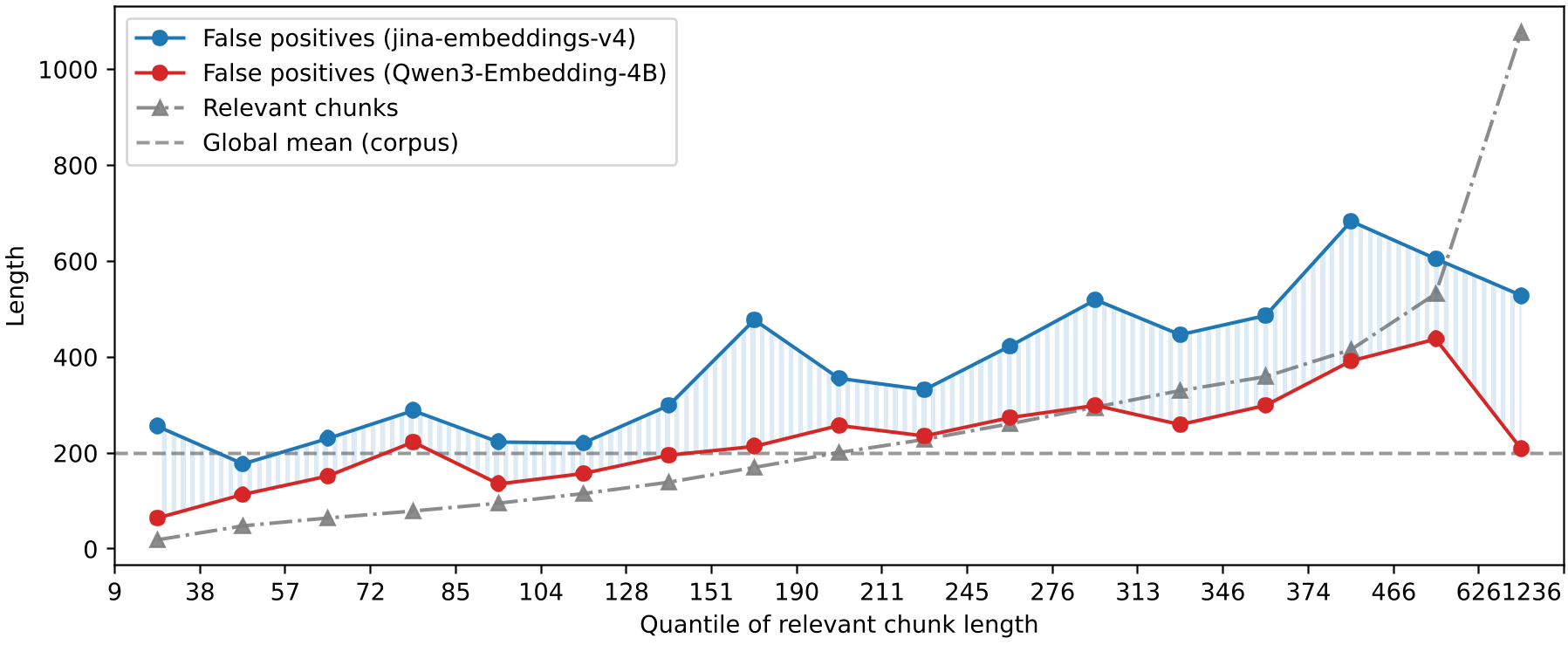 Figure 1: Notice how the Causal Multi-vector model retrieves false positives that are significantly longer than the ground truth (orange vs blue).
3. Architecture Matters: Causal vs. Bi-directional
The authors compared four configurations to isolate the cause of this bias.
- Causal Multi-vector (e.g., Jina-v4): Extreme length bias.
- Causal Single-vector (e.g., Qwen3): No significant length bias (fixed-size bottleneck).
- Bi-directional Multi-vector (e.g., ModernColBERT): Mitigates bias because every token "sees" every other token; adding irrelevant text can dilute the attention and actually lower similarity scores.
However, even Bi-directional models showed "fragility" at the extremes—very short or very long documents still caused unexpected drops in ranking quality (nDCG).
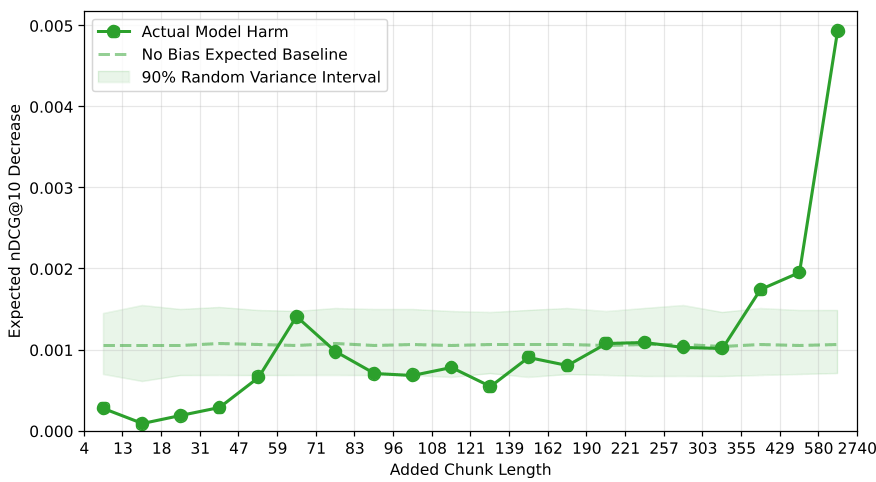 Figure 2: Performance harm vs. document length. (a) shows the aggressive monotonic harm of the causal model compared to the flatter profile of (c) and (d).
4. Is MaxSim Throwing Away Data?
A common critique of MaxSim is that it only looks at the "Best Match." If Document A has 10 tokens that are almost perfect matches, and Document B has 1 token that is a perfect match, MaxSim might prefer B.
The researchers analyzed the full similarity distribution on failed queries to see if the "lost" tokens contained a signal.
- The Finding: Locally (on specific datasets like NanoArguAna), there were hints that the signal persisted beyond the top-1 token.
- The Global Reality: Averaged across the NanoBEIR benchmark, there was no significant trend. The positive documents didn't have a "thicker tail" of high-similarity tokens compared to negatives.
- Conclusion: MaxSim is actually quite optimal for current models; there isn't much useful information left on the table.
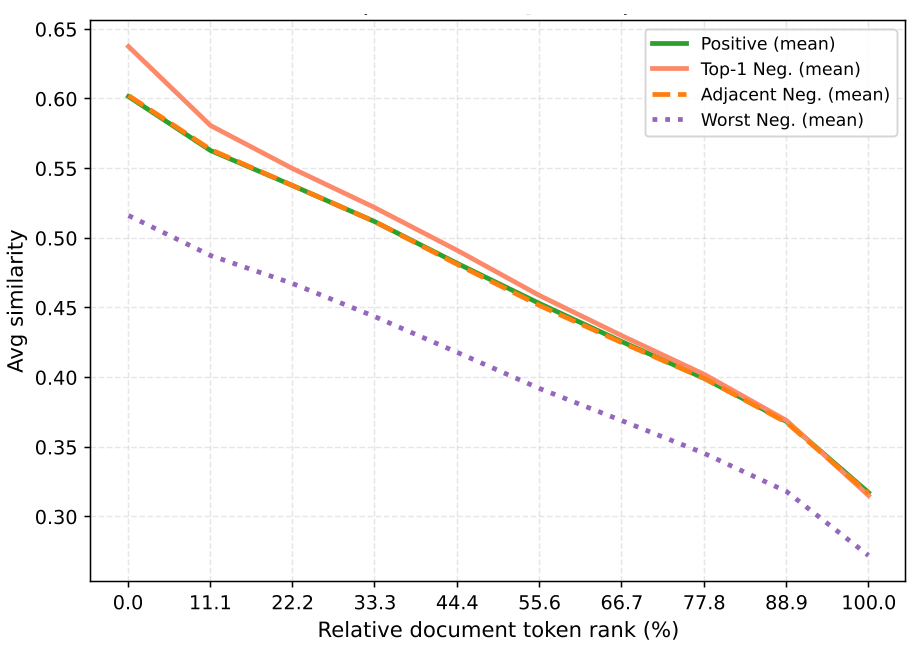 Figure 3: Similarity curves for positive vs. negative documents. The overlap suggests that looking beyond the top-1 token rarely helps distinguish relevance.
5. Summary & Future Outlook
This work serves as a warning for those building RAG (Retrieval-Augmented Generation) systems: be wary of Causal LLM encoders in multi-vector setups.
- Key Insight: If you utilize a causal backbone for retrieval, you must implement length normalization or risk your system becoming a "long document vacuum."
- Architecture Choice: Bi-directional encoders (like BERT/RoBERTa variants) remain superior for the Late Interaction paradigm because their attention mechanism provides a natural "check and balance" against length-based score inflation.
- Next Steps: Future research will likely focus on "Training-time interventions"—teaching models to explicitly ignore the length of a passage while maintaining high-granularity semantic matching.