
Latent Bridge: Why Fast VLA Inference is About Skipping, Not Just Pruning
Latent Bridge: Feature Delta Prediction for Efficient Dual-System Vision-Language-Action Model Inference
The paper introduces Latent Bridge, a lightweight delta-prediction model designed to accelerate dual-system Vision-Language-Action (VLA) models. By predicting the temporal changes (deltas) in VLM features or KV-caches between steps, it allows the expensive VLM backbone to be skipped for 50-75% of control cycles while maintaining 95-100% of the baseline success rate.
TL;DR
Dual-system Vision-Language-Action (VLA) models provide state-of-the-art robot control but are painfully slow due to their massive VLM backbones. Latent Bridge solves this by predicting the delta of the VLM's output features, allowing the robot to skip the heavy backbone for up to 3 out of 4 steps. This results in a 1.73x net speedup with almost zero loss in success rate—outperforming traditional pruning methods that hit a "speedup ceiling."
The "Amdahl Ceiling" in Dual-System VLAs
In dual-system architectures like GR00T or π0.5, the VLM backbone generates a latent representation (like a feature map or KV-cache), and a lightweight "action head" (often a Diffusion Transformer or Flow-matching model) turns that latent into motor commands.
The problem? Even if you prune or quantize the VLM to make it 50% faster, the action head still runs at every step. Because the VLM is only a portion of the total inference time, your net speedup is severely limited by the "un-optimized" parts. The authors call this the Amdahl Ceiling. To truly break through, you need to stop running the VLM at every step.
Methodology: Bridging the Latent Gap
The core insight is Feature Temporal Redundancy. In high-frequency robot control, the VLM's output doesn't change much from step to . So, instead of running the whole VLM, why not just predict what changed?
1. The Bridge Architecture
The authors propose the Latent Bridge, a small Transformer that takes:
- The previous latent feature ()
- Proprioceptive state ()
- Previous action ()
- Cheap visual context (like stable early-layer VLM features)
It then outputs , such that .
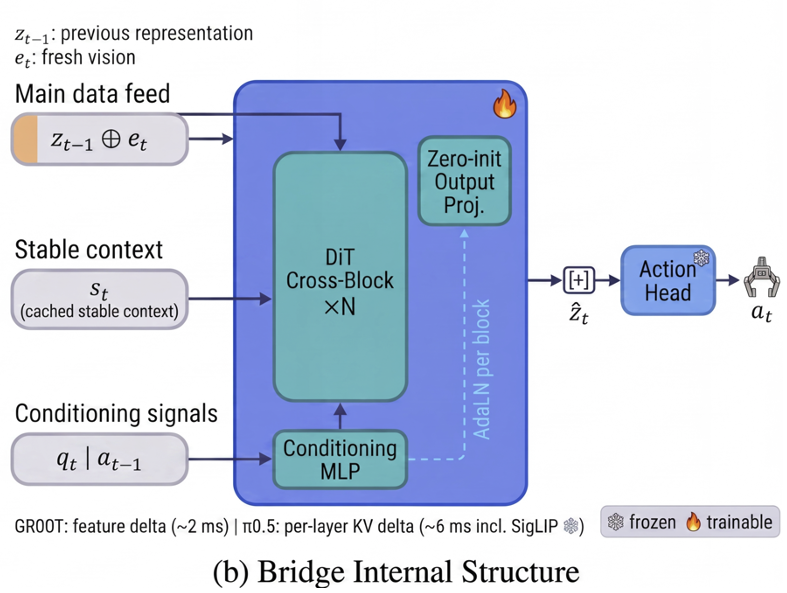 Figure: The bridge adapts to different VLAs, predicting either final features (GR00T) or per-layer KV-cache updates (π0.5).
2. Solving Distribution Shift with DAgger
If you only train the bridge on "clean" VLM data, it fails when deployed. This is because, at step , the bridge is predicting a delta based on its own previous prediction at step . Small errors compound. The solution is a DAgger (Dataset Aggregation) pipeline: the bridge is rolled out in a simulator, and a VLM "oracle" provides ground-truth labels for the bridge's own (possibly noisy) trajectory.
Results: Efficiency Without Sacrifice
The experiments across LIBERO (30 tasks), RoboCasa (24 tasks), and ALOHA show a clear victory for the bridge approach.
- Near-Sync Performance: In π0.5, Latent Bridge retains 96.9% success rate while using a VLM call period of (skipping 75% of calls).
- Wall-Clock Speed: Unlike token pruning (which managed only ~1.08x speedup), Latent Bridge achieved 1.65x to 1.73x net episode speedup.
- Fidelity: As shown in the KV-cosine analysis, the bridge maintains a >0.99 cosine similarity to ground truth, while simple "feature caching" (reusing the old frame) crashes quickly.
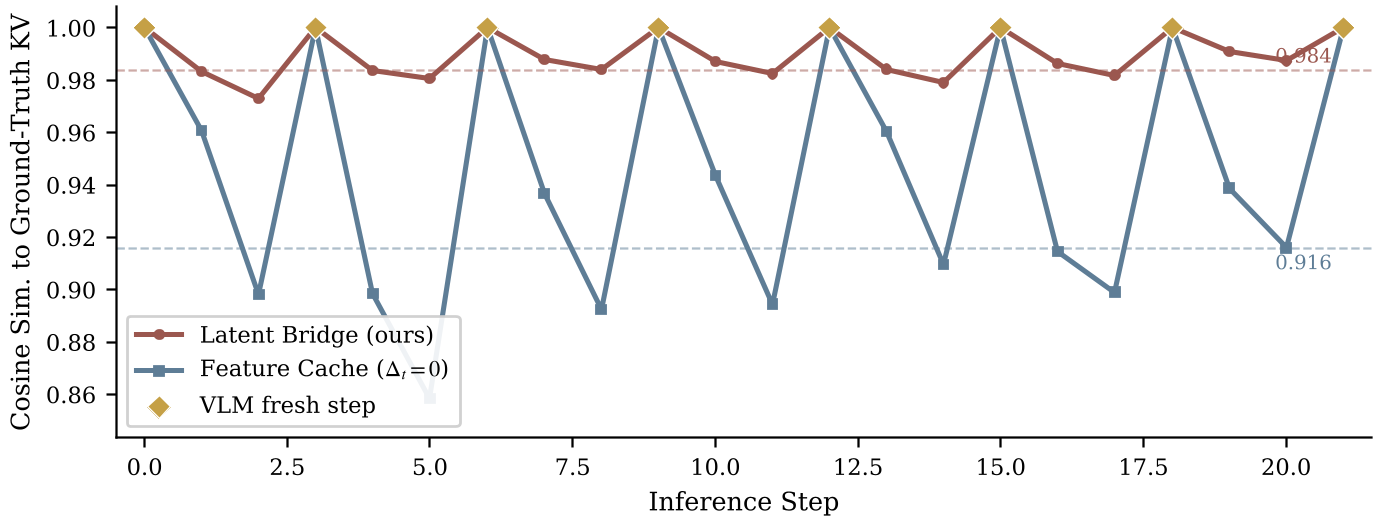 Figure: Cosine similarity comparison. The bridge (blue) tracks the ground truth almost perfectly, while caching (red) exhibits a "sawtooth" failure pattern.
Critical Analysis & Conclusion
Takeaway
Latent Bridge proves that for high-frequency embodied AI, the latent space is smooth enough to be modeled by a much smaller network. This "delta-prediction" paradigm is likely the future of real-time VLA deployment on edge hardware.
Limitations
- Simulator Dependence: The DAgger stage requires an online simulator to generate "noisy" labels. Applying this to purely real-world data without a simulator remains a challenge.
- Checkpoint Specificity: Each bridge is tied to a specific VLA checkpoint. If you update your model, you must retrain your bridge (though this only takes a few hours).
Ultimately, Latent Bridge transitions us from "how do we compress the VLM?" to "how often do we actually need the VLM?", a shift that yields significantly higher returns for robotic autonomy.