
LatentRAG: Shifting Agentic Reasoning and Retrieval into the Latent Space
LatentRAG: Latent Reasoning and Retrieval for Efficient Agentic RAG
LatentRAG is a novel agentic RAG framework that performs reasoning and retrieval in the continuous latent space rather than discrete natural language. By shifting intermediate "thoughts" and "subqueries" to latent tokens, it achieves performance comparable to state-of-the-art agentic RAG methods while reducing inference latency by approximately 90%.
TL;DR
Agentic Retrieval-Augmented Generation (RAG) is powerful but painfully slow due to its "think-then-generate-query" loop. LatentRAG breaks this bottleneck by performing reasoning and retrieval entirely in the LLM's continuous latent space. It achieves the accuracy of multi-step agents with the speed of single-step RAG—reducing inference latency by a staggering 90%.
The Latency Paradox in Agentic RAG
We know that simple RAG often fails at complex, multi-hop questions. The industry solution has been Agentic RAG: making the LLM act as an agent that generates a "thought" (CoT) and a "subquery," retrieves data, and repeats.
However, as the authors demonstrate, this comes at a heavy cost. In models like Search-R1, the generation of these intermediate text strings accounts for 90% of the total latency. Why? Because autoregressive decoding is a sequential process where each token depends on the previous one. We are essentially forcing the model to "talk to itself" in natural language, which is computationally expensive and redundant.
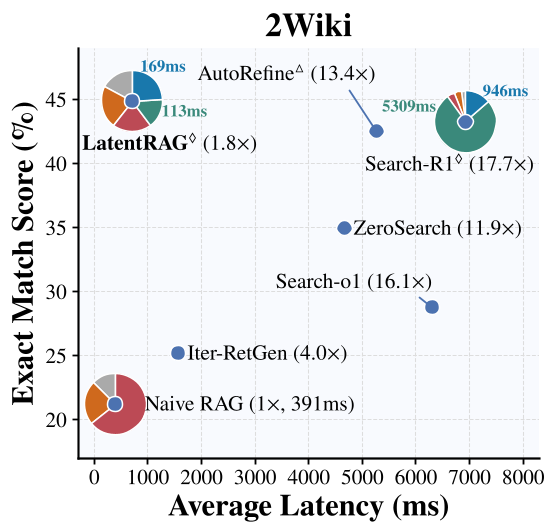 Above: LatentRAG achieves comparable EM scores to Search-R1 and AutoRefine but stays in the latency ballpark of Naive RAG.
Methodology: Thinking and Searching Without Words
The core intuition of LatentRAG is that human-readable text is for humans, not for the internal optimization of an agent.
1. Latent Generation
Instead of decoding tokens one by one, LatentRAG appends a fixed set of special tokens (e.g., 4 <think> tokens and 16 <query> tokens) to the input. In a single forward pass, the model produces the hidden states for these positions. These hidden states—latent tokens—encapsulate the semantics of the reasoning and the query without the overhead of text generation.
2. Latent Retrieval Alignment
How do you search a vector database with a hidden state instead of a text query? The authors bridge this gap using a Retriever Projector.
- The Challenge: Standard retrieval training requires millions of pairs, but agentic data is scarce.
- The Solution: They use a KL-divergence loss to align the latent subquery's similarity distribution with that of a "teacher" (a pretrained dense retriever using natural language). This allows the LLM to learn to "point" to the right vector space effectively.
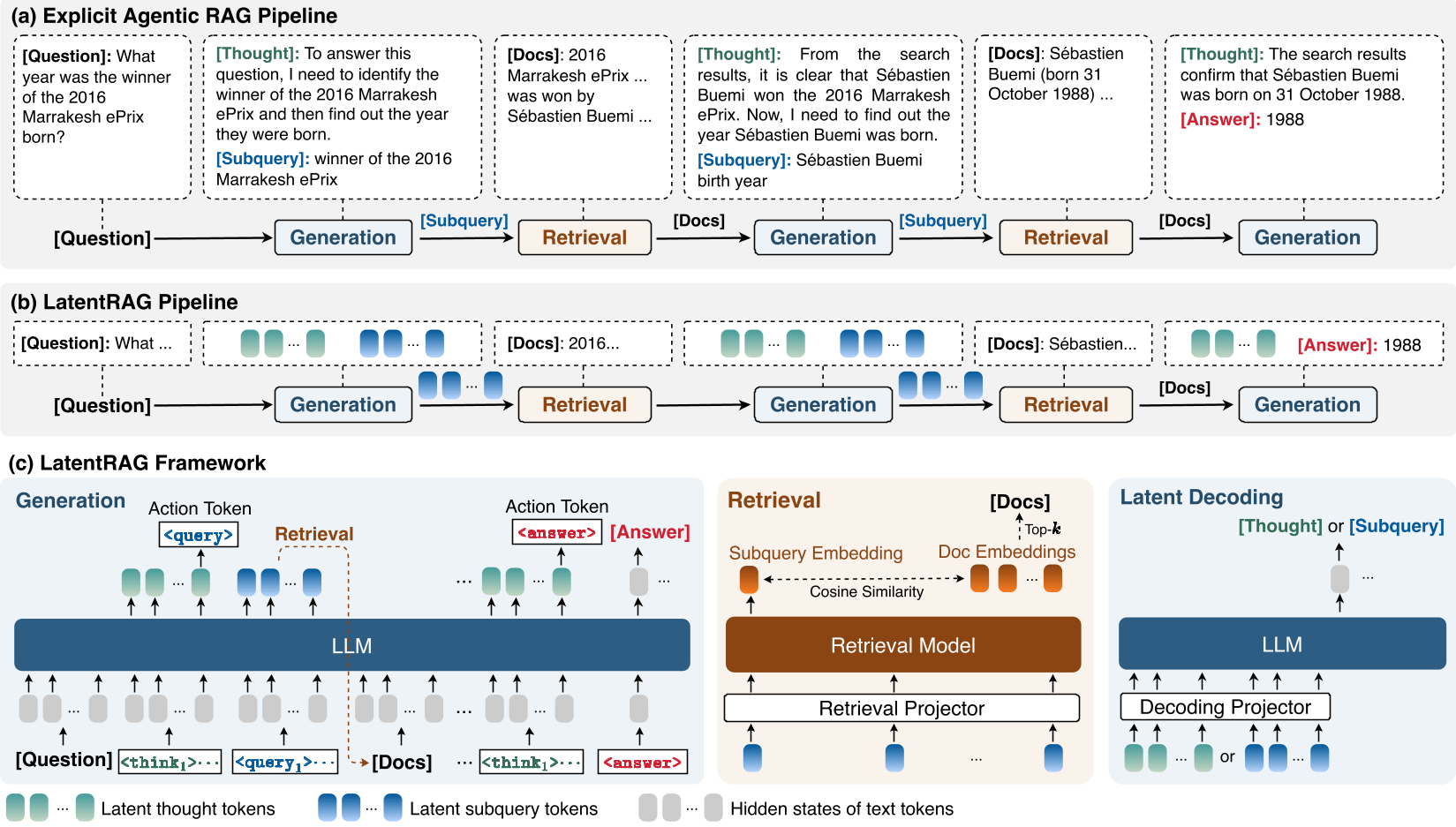 Figure 2: The architecture of LatentRAG versus traditional Agentic RAG. Notice how the explicit text loop is replaced by a continuous latent flow.
3. Parallel Latent Decoding
To avoid the "black box" problem, LatentRAG includes a decoder that can translate latent tokens back into text. Crucially, because the latent tokens are already computed, decoding multiple steps can happen in parallel, unlike the sequential requirement of standard CoT.
Experimental Results: Near-SOTA Performance at 10x Speed
The researchers tested LatentRAG against heavyweights like Search-R1 and AutoRefine across seven datasets.
- Speed: Across the board, latency dropped by ~90%.
- Scale: The method scales beautifully. Scaling the LLM from 3B to 14B increases performance without the massive latency spike seen in explicit methods.
- Visualization: Using LogitLens, the authors found that these latent tokens actually encode high-level concepts (e.g., "Christianity Today") more densely than text tokens, suggesting latent reasoning might be more "expressive" per unit of computation.
Critical Analysis & Takeaways
LatentRAG marks a transition in AI architecture: moving away from "Human-Oriented" text interfaces between system components toward "Agent-Oriented" latent interfaces.
Limitations:
- Teacher Dependency: It currently relies on SFT from teacher trajectories (like Search-R1).
- Precision: As seen in failure cases (e.g., naming a dog "Montmoreiras" instead of "Montmorency"), latent representations can sometimes prioritize abstract concepts over lexical precision.
Future Outlook: The next step is likely Latent Reinforcement Learning, where agents explore the latent space to find even more efficient reasoning paths that natural language doesn't permit. If we want agents that can think through thousands of steps in milliseconds, the path forward is clearly through the hidden states.
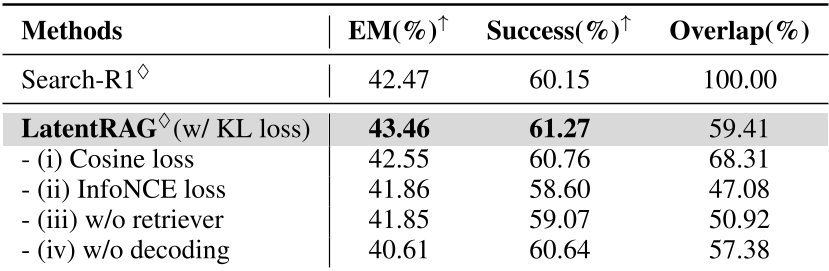 Table: The KL loss is the "secret sauce" for alignment, outperforming standard Cosine or InfoNCE losses in retrieval success.