
Neural Parameterization: Bridging the Gap Between Markov Rigor and Deep Learning in Finance
Learning Time-Inhomogeneous Markov Dynamics in Financial Time Series via Neural Parameterization
The paper introduces a framework for learning time-inhomogeneous Markov dynamics in financial time series by using neural networks as parameterization engines for explicit stochastic operators. The method, called Neural Parameterization, overcomes the data sparsity issues of classical count-based estimation in fine-grained state spaces, enabling the recovery of interpretable, time-varying transition matrices that traditionally collapse in high-noise environments.
TL;DR
Financial modeling often suffers from a trade-off between interpretability (Markov chains) and power (Neural Networks). This paper proposes a "Middle Ground": using neural networks to generate explicit, time-varying Markov Transition Operators. This approach solves the data sparsity problem of classical counting while allowing researchers to "look under the hood" using classical tools like the Chapman-Kolmogorov equations to see exactly how market rules shift during crises.
The "Sparsity Barrier" in Market Modeling
In classical finance, we often discretize returns into bins (states). If we want high-resolution models (e.g., 55 bins to capture extreme tail risks), the number of possible transitions between those bins becomes .
In reality, we rarely have enough data to see every possible transition. Standard empirical counting—the bedrock of classical Markov analysis—collapses. Most of the transition matrix becomes filled with zeros or noise, making it useless for regime-change analysis. This is the Sparsity Barrier: the more detail you want, the less reliable your statistics become.
Methodology: The Neural Transition Engine
Instead of counting how many times "State A" followed "State B," the authors treat the transition row as a conditional density estimation problem.
They train a Multi-Layer Perceptron (MLP) that takes the current market state and exogenous features (like interest rates or volatility) and outputs a probability vector.
By calculating this for every potential input state , they assemble a full stochastic operator at every single timestamp.
 Visualizing the neural parameterization where the softmax layer ensures that each row of the generated matrix sums to 1, fulfilling the requirement of a stochastic operator.
Key Insights: Volatility Homogenizes the Market
One of the paper’s most striking findings is the "Homogenization" effect. Intuitively, one might think a volatile market (like the COVID-19 crash) would produce chaotic, diverse transition rules.
The data suggests the opposite: In times of high realized variance, transition rows actually become more similar (lower entropy).
 The strong negative correlation (r = -0.62) indicates that under stress, the market's "next-step" logic collapses toward a similar, concentrated distribution regardless of the starting state.
Debugging Physics: The Chapman–Kolmogorov Diagnostic
Usually, Deep Learning practitioners treat the "Markov Property" (the future depends only on the present) as a binary assumption. This paper treats it as a diagnostic tool.
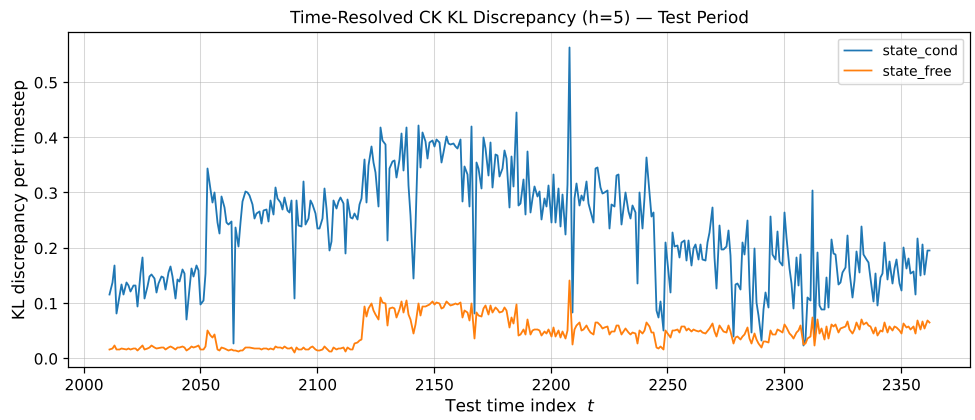
By comparing a direct 5-step forecast with the composition of five 1-step forecasts (), the authors use the Chapman–Kolmogorov (CK) discrepancy to pinpoint exactly when the Markov assumption fails.
- Low Discrepancy: The system is behaving like a clean, first-order Markov chain.
- High Discrepancy: The market has "memory" or is being driven by hidden latent factors not captured by current features.
Critical Analysis & Future Outlook
While the predictive gains in this single-asset study (JPM) were modest (), the real value lies in the framework.
Strengths:
- Transparency: No longer a black box; we can see the "rules" of the market as heatmaps.
- Mathematical Rigor: Permits the use of the Dobrushin coefficient and spectral analysis on neural outputs.
Limitations:
- The single-asset focus limits the predictive signal. Expanding this to a multi-asset universe where cross-correlations exist would likely unlock much higher accuracy.
- The features used (quarterly fundamentals) are lower frequency than the price data, creating a lag in the neural engine's responsiveness.
Conclusion: This research proves that we don't have to choose between the flexibility of Deep Learning and the clarity of Markov Theory. By constraining neural networks to "speak" the language of operators, we gain a calibrated microscope for the non-stationary world of finance.