
NEO: From Passive Prediction to Active Theorizing of the World
Learning to Theorize the World from Observation
This paper introduces Learning-to-Theorize (L2T), a paradigm that moves beyond simple future prediction by inducing explicit, executable programs as theories of the world from raw, non-textual observations. The authors instantiate this via the Neural Theorizer (NEO), a probabilistic model that learns a "Language of Thought" composed of reusable primitives to achieve SOTA-level compositional generalization on benchmarks like OTIB.
TL;DR
In the quest for true "understanding," current AI models often settle for being sophisticated "next-token predictors." This paper argues that real intelligence requires Learning to Theorize. By introducing the Neural Theorizer (NEO), the authors demonstrate that an agent can discover the "Language of Thought"—discrete, reusable primitives—directly from raw observations. NEO doesn't just guess what happens next; it constructs a program to explain how the world changed, allowing it to generalize to scenarios far more complex than those seen during training.
The Motivation: Why Prediction is Not Understanding
Modern world models (like Dreamer or Sora) excel at predicting the next frame. However, they lack compositional systematicity. If a model learns to "move left" and "move down" as a single entangled unit, it will struggle when it suddenly sees a "move up" operation.
The authors draw from developmental psychology—the "Baby as Scientist" perspective. Humans build internal theories. We don't just see pixels; we see a "Rotate" operation followed by a "Mask" operation. The core challenge addressed here is: Can a machine discover these abstract primitives without any text, labels, or program supervision?
Methodology: The Architecture of a Theorizer
The Neural Theorizer (NEO) treats an observation pair as a transformation that needs a "theory" (a program) to explain.
1. The Theory Programmer & Executor
NEO consists of two main loops:
- Theory Programmer: A policy () that looks at the current state and the goal, then selects a discrete "primitive" from a learned codebook.
- Program Executor: A transition model () that executes the selected primitive in the latent space.
2. Minimum Description Length (MDL)
To prevent the model from over-complicating its "theories," NEO uses an MDL weight (). It penalizes long programs, forcing the model to find the simplest set of operations that explains the change. This pressure is what forces the model to decompose complex actions into atomic, reusable steps.
3. State Grounding
A common failure in latent models is "off-manifold drift"—where intermediate states become blurry or meaningless. NEO uses a State Grounding Loss to ensure every step of a multi-part program results in a state that could be a real observation.
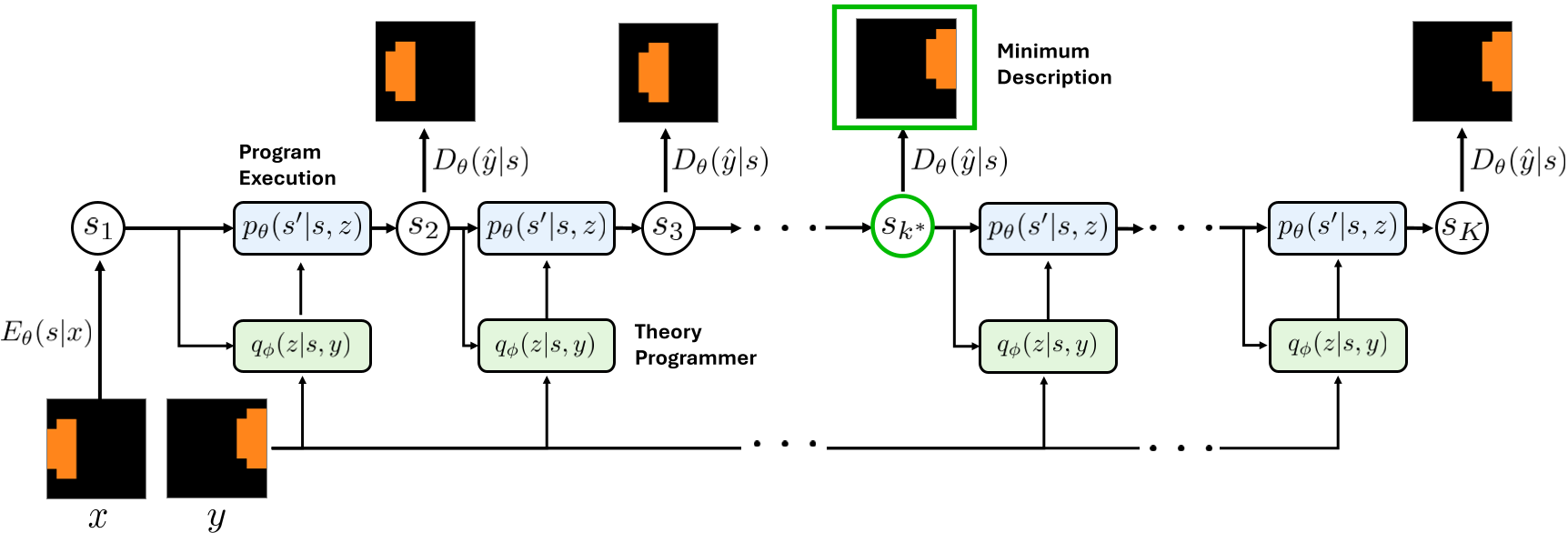 (Figure 2: The NEO computation graph, showing the iterative selection of primitives and the MDL-based length selection.)
Experiments: The OTIB Benchmark
The authors introduced the Observation-to-Theory Induction Benchmark (OTIB), covering GridWorld, Arithmetic, and Image Editing.
Key Finding 1: Discovery of Unseen Primitives
Even when the training data only showed "entangled" moves (e.g., always moving Left and Down together), NEO's MDL principle allowed it to "primitivize" these into separate "Left" and "Down" tokens.
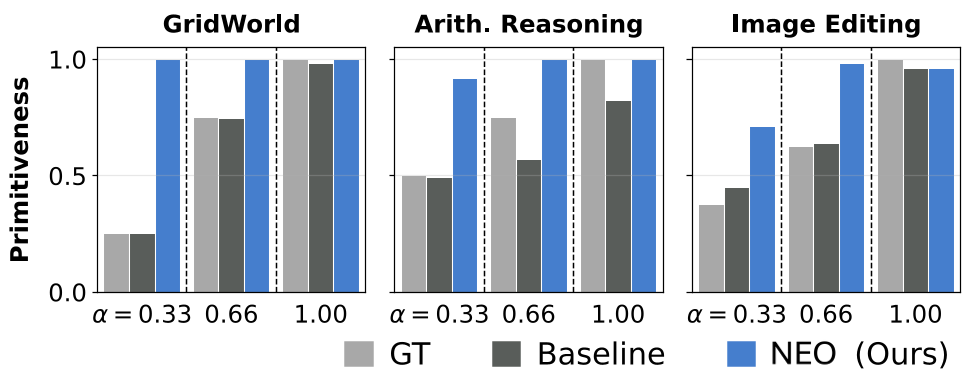 (Figure 7: NEO consistently recovers more ground-truth primitives than what is directly observable in the training set.)
Key Finding 2: Length Generalization
Unlike monolithic models (Disc-Mono) that represent an action as a single vector, NEO can unroll its programmer for 8 steps even if it only saw 3 steps during training. This is "Productivity"—the ability to explain infinite complexity with finite means.
Key Finding 3: Test-Time Scaling (NEO-S)
By treating the theory programmer as a probabilistic sampler, the model can "think" at test time. By sampling candidate programs and picking the most frequent successful one (Majority Voting), NEO achieves massive boosts in OOD accuracy.
 (Table 2: Comparison in Arithmetic Reasoning, showing NEO's dominance in OOD transferability.)
Critical Analysis & Conclusion
NEO is a significant step toward Neuro-Symbolic world models that learn their own symbols. However, it currently relies on a discrete set of primitives and deterministic environments.
Takeaway: The success of NEO suggests that the next generation of LLMs and World Models should not just scale parameters, but scale the structural simplicity of their internal explanations. By "Learning to Theorize," we move closer to AI that understands the causal logic of the world, not just its visual surface.