
From Spin Glasses to LLMs: The Statistical Physics of AI
Lecture Notes on Statistical Physics and Neural Networks
These lecture notes by Olaf Hohm provide a rigorous bridge between classical statistical physics and modern artificial intelligence. The work details how the Boltzmann-Gibbs distribution and Renormalization Group (RG) theory underpin Hopfield networks, Boltzmann Machines, and the scaling laws of Transformers and Large Language Models (LLMs).
Executive Summary
TL;DR: This comprehensive survey by Olaf Hohm (Humboldt University) deconstructs the "magic" of AI through the lens of statistical mechanics. It demonstrates that the architecture of modern deep learning—specifically the layers of hidden neurons—is a physical manifestation of the Renormalization Group (RG), where learning is an iterative process of "integrating out" noise to reveal macroscopic patterns (features).
Background: This work is a pedagogical bridge, situating the 2024 Nobel Prize-winning work of Hopfield and Hinton within the academic coordinate system of phase transitions and thermodynamic limits.
Problem & Motivation: Why Physics Matters for AI
Current AI research is heavily empirical. We know that scaling Transformer models leads to better performance, but we struggle to explain "Why?"
The author argues that the limitation of prior work in machine learning theory is its focus on discrete optimization without considering the Thermodynamic Limit (). In physics, we know that as the number of particles (or neurons) goes to infinity, singularities (phase transitions) appear. These transitions are where "learning" actually happens—a sudden shift from a disordered state (random weights) to an ordered state (a model that understands language).
Methodology: The Core Intuition
The fundamental bridge is the Energy Function. In a spin-glass model, we seek to minimize energy . In a Hopfield network, we seek to minimize a cost function. They are mathematically identical.
1. The Renormalization Group (RG) as Feature Extraction
The author provides a brilliant intuition: an RG transformation (coarse-graining a lattice) is identical to a layer in a neural network.
- In physics: Summing over some spins to get an "effective" coupling.
- In AI: Processing pixels through a hidden layer to get "effective" features (edges, shapes, faces).
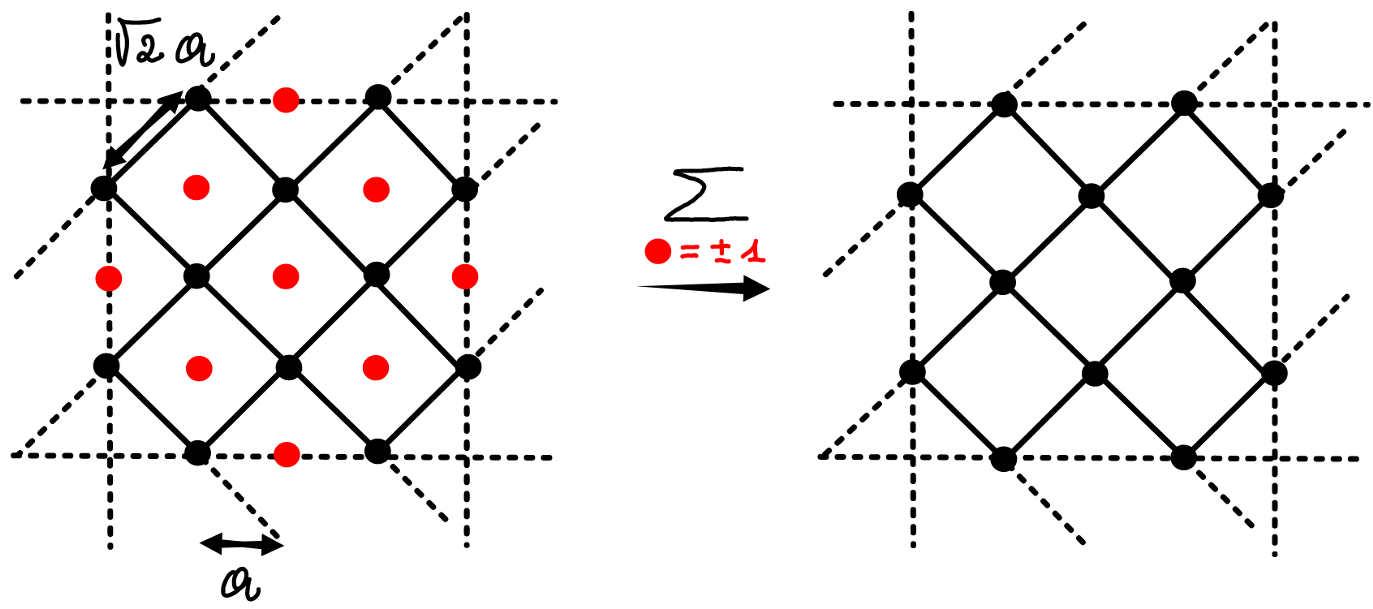 Figure: The process of integrating out spins in a 2D Ising model mirrors the hierarchical feature extraction in deep layers.
2. From Boltzmann Machines to Transformers
The author derives how a Restricted Boltzmann Machine (RBM) uses hidden neurons to encode higher-order correlations. When you "integrate out" the hidden layer, you generate an effective energy function for the visible layer that contains complex, non-linear interactions. The Transformer architecture takes this further, using "Attention" to dynamically calculate these couplings (weights) based on context.
Experiments & Results: The Power of Scale
The notes analyze the Scaling Laws of LLMs, noting that the training loss follows a power law:
This is not a random coincidence. In statistical physics, near a critical point, the Correlation Length also follows a power law. The author suggests that LLMs operate near a Critical Fixed Point, explaining why they are "scale-invariant"—meaning the same architecture works at 1 sampling or 1 trillion samples, it just becomes more precise.
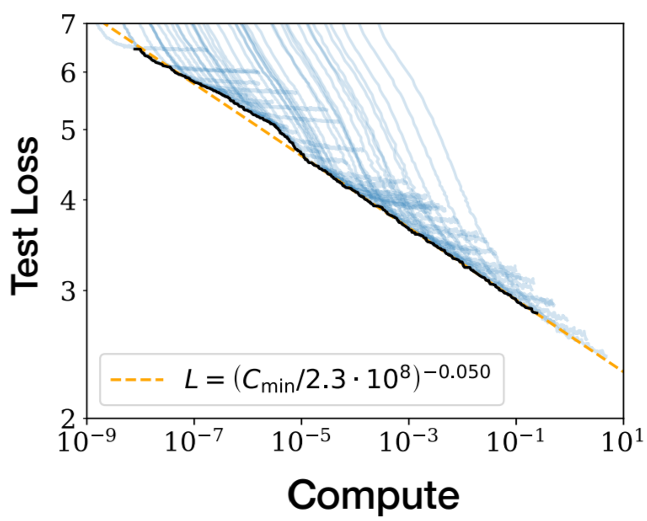 Figure: The empirical power-law decline in loss as a function of compute and parameters, paralleling critical exponents in physics.
Critical Analysis & Conclusion
Takeaway
The architecture of AI is not arbitrary; it mimics the way Nature handles information at different scales. The Hidden Layers of a Deep Network are essentially the "Intermediate Scales" of an RG flow.
Limitations
While the mapping to the Ising model is elegant, modern LLMs use Backpropagation, which is a non-equilibrium process. Classical statistical physics describes systems in equilibrium. The author acknowledges that a "Non-equilibrium Statistical Mechanics of Learning" is the next frontier.
Future Outlook
If we can identify the "Universal Critical Exponents" of different datasets, we could theoretically predict the exact number of parameters needed to achieve "intelligence" for any given task, ending the era of wasteful trial-and-error in AI training.