
[CVPR 2025] LensWalk: Empowering Agents to "Plan How They See" for Adaptive Video Understanding
LensWalk: Agentic Video Understanding by Planning How You See in Videos
LensWalk is an agentic video understanding framework that uses a Large Language Model (LLM) as a reasoner to dynamically plan and control its visual observations. By establishing a "reason-plan-observe" loop, it achieves a 5-11.5% accuracy boost on long-video benchmarks like LVBench and Video-MME without requiring fine-tuning.
TL;DR
LensWalk is a plug-and-play agentic framework that transforms video understanding from a static recognition task into a dynamic, reason-plan-observe loop. By allowing an LLM to actively decide where to look and how densely to sample, it achieves SOTA results on long-video benchmarks (LVBench, Video-MME) with massive accuracy gains (up to 11.5%) and high efficiency.
The core insight: Instead of trying to feed a whole video into a model at once, let the model act like a human—scanning for cues, zooming in on details, and verifying hypotheses step-by-step.
The Perception-Reasoning Disconnect
Current Vision-Language Models (VLMs) face a "resource bottleneck." Long videos contain massive amounts of data, but context windows are limited. Most current solutions try to solve this by:
- Uniform Sampling: Picking X frames across the whole video (misses short, key events).
- Heuristic Selection: Pre-filtering "key" frames before reasoning starts.
- Retrieval-Augmented Generation (RAG): Searching through a pre-computed index of captions or embeddings.
The authors of LensWalk argue these are all static. If the model changes its mind halfway through reasoning, it can't "go back and look closer" at the raw video. Perception is fixed while reasoning evolves.
Methodology: The Reason-Plan-Observe Loop
LensWalk replaces the "one-shot" pipeline with an iterative agentic workflow. Each turn involves three stages:
- Reason: The LLM (the Reasoner) reflects on the question and previous observations.
- Plan: The agent selects a tool and parameters (time range, sampling rate/FPS).
- Observe: A VLM (the Observer) executes the plan on the raw video and returns findings.
The Observation Toolkit
The secret sauce lies in three specialized tools that provide the agent with "adjustable lenses":
- Scan Search: A broad-stroke tool that slices a time window and looks for cues parallelly.
- Segment Focus: A high-res "magnifying glass" for a specific time interval to extract fine details.
- Stitched Verify: A unique tool that stitches together non-contiguous clips (e.g., comparing the beginning and end) to confirm causal links.
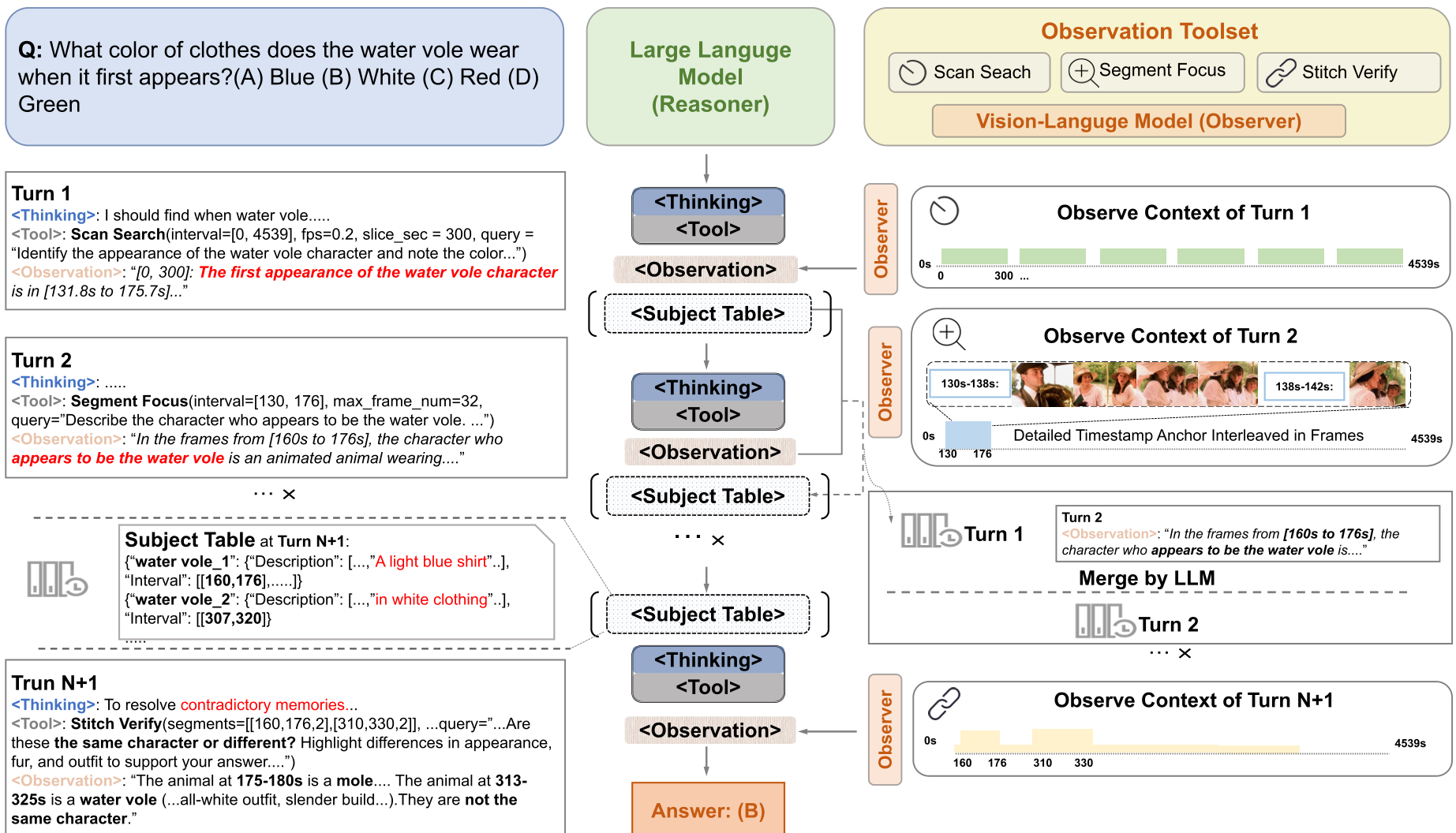 Figure: The reasoning-scheduled active observation process in action.
Lightweight Memory: Keeping the Agent Grounded
To prevent the agent from getting lost in multi-turn dialogues, LensWalk uses:
- Timestamp Anchors: Highlighting specific moments in the tool outputs.
- Subject Memory Table: A global, structured table tracking entities (people, objects) and their states across the video to maintain consistency.
Performance: SOTA Results and Efficiency
LensWalk was tested across challenging benchmarks like LVBench, Video-MME, and Video-MMMU. The results show that it provides a "free lunch" for powerful models:
- Accuracy Boost: The o3 model improved by 11.5% on LVBench.
- Plug-and-Play: It works across various models (GPT-4o, Gemini, Qwen).
- Efficiency: Unlike retrieval agents that pre-process thousands of captions, LensWalk only looks at what it needs. It typically resolves easy questions in ~2.6 turns but scales up to 6+ turns for complex 60-minute movies.
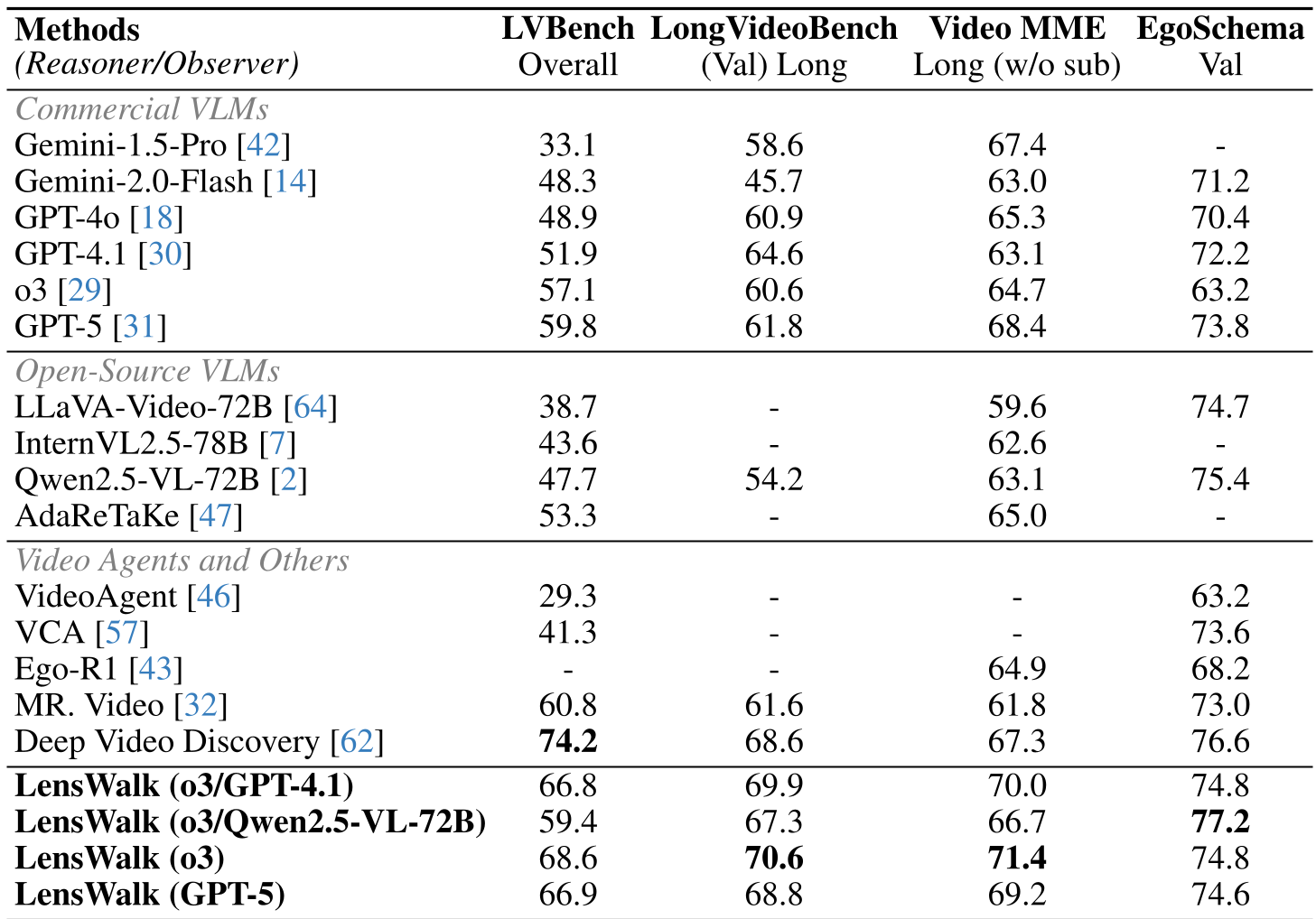 Table: Comparison across major long-video benchmarks.
Emergent "Human-Like" Strategies
By analyzing the tool-call traces, the researchers found that LensWalk exhibits sophisticated cognitive behaviors:
- Progressive Zoom-in: Scanning the whole video, then narrowing down the search.
- Strategic Reflection: If a search hits a dead-end, the agent pauses and re-plans a broader scan.
- Integrative Verify: Checking multiple moments simultaneously to verify a single hypothesis.
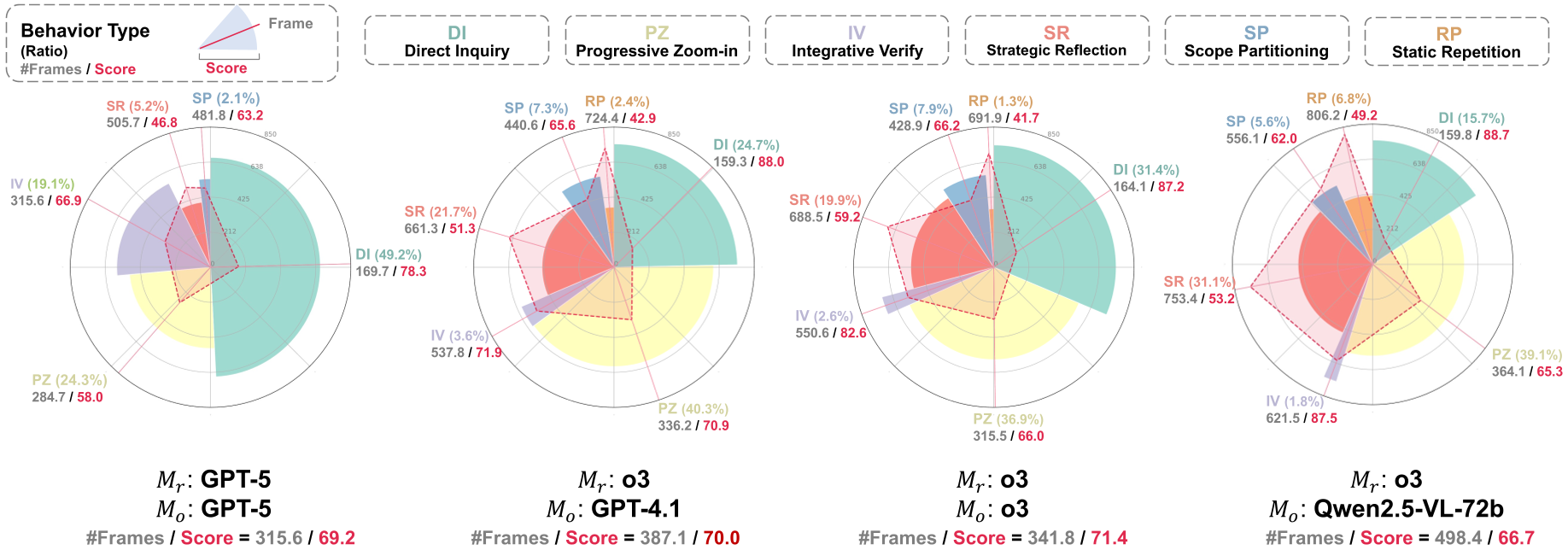 Figure: The taxonomy of different observation strategies adopted by the agent.
Critical Insight & Future Outlook
LensWalk proves that visual cognition is not just about representation, but about orchestration. The performance gap between a static forward pass and an active search is massive.
Limitations: The agent can still fall into "Static Repetition" (looping on the same interval) or suffer from "Evidence Dilution" if it explores too much irrelevant content.
Future Work: The authors envision a future where multimodal agents don't just "see" what they are given, but learn how to think through seeing, eventually lead to self-directed agents capable of navigating hours of footage as efficiently as a human editor.