
Let ViT Speak: Minimalist Generative Pre-training for the MLLM Era
Let ViT Speak: Generative Language-Image Pre-training
This paper introduces GenLIP (Generative Language-Image Pre-training), a minimalist framework that trains a single Vision Transformer (ViT) to predict language tokens directly from visual patches using a standard autoregressive objective. It eliminates the need for contrastive batching or separate text decoders, achieving SOTA performance on multimodal benchmarks like OCR and Document QA.
TL;DR
GenLIP (Generative Language-Image Pre-training) is a minimalist framework that ditches contrastive learning and complex multi-tower architectures. By treating a Vision Transformer (ViT) as a generative language model—concatenating image patches with text and predicting the next token—it achieves superior performance on multimodal benchmarks with significantly higher data efficiency than CLIP or SigLIP.
Strategic Position: This work marks a shift from "discriminative alignment" to "generative alignment" for vision encoders, specifically optimized to serve as the "eyes" for Large Language Models (LLMs).
1. The Death of Architectural Redundancy
For years, the industry relied on CLIP-style Dual-Encoders (which align modalities via contrastive loss) or Encoder-Decoder pairs (where a vision backbone is indirectly trained via a text head).
The authors of GenLIP argue this is unnecessary. They propose a "Minimalist Design Philosophy":
- No Contrastive Loss: No more complex batch construction.
- No Extra Text Decoder: The ViT itself handles the multimodal sequence.
- Direct Optimization: The vision backbone is trained directly on the target Task (Next Token Prediction).
2. Methodology: How to Make a ViT "Talk"
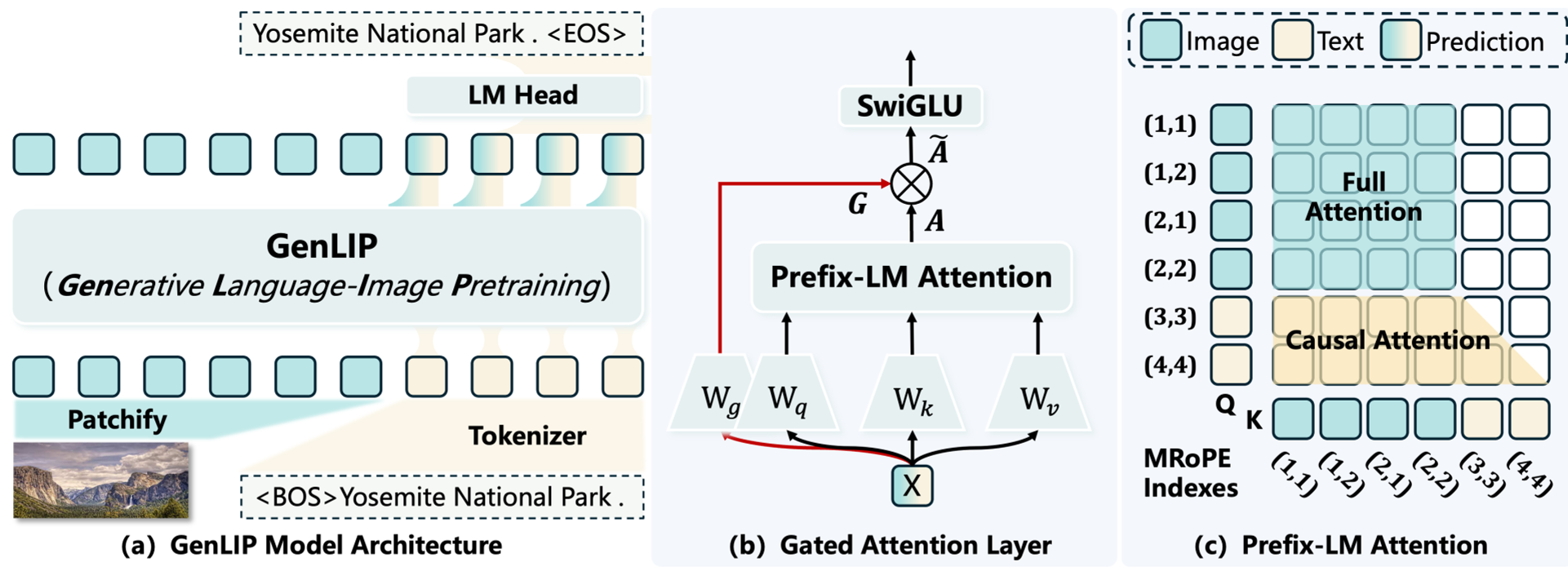
The core of GenLIP is its Unified Transformer architecture.
Sequence Composition
Instead of separate towers, the input is a single sequence: where are image patches and are text tokens.
Prefix-LM Attention & MRoPE
The model uses Prefix-LM Attention:
- Image tokens attend to each other bidirectionally (acting as a prefix).
- Text tokens attend to the image and preceding text causally.
- MRoPE (Multimodal Rotary Position Encoding) is used to unify positional awareness across patches and tokens.
Solving the "Attention Sink"
Without careful management, the text tokens tend to "ignore" most visual patches and focus solely on the first patch (). To solve this, GenLIP introduces Gated Attention (GA). GA acts as a per-token regulator that prevents information collapse, forcing the model to utilize the full spatial diversity of the image.
3. Experimental Results: The Power of Generative Alignment
SOTA in OCR and Document Understanding
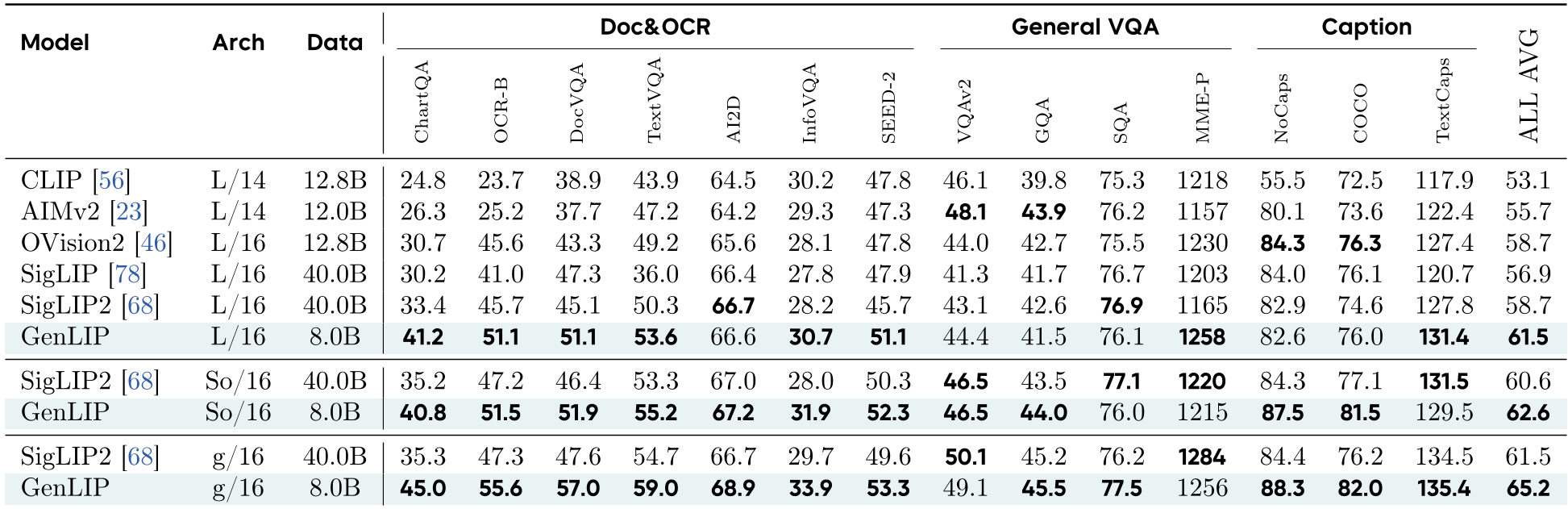
GenLIP shines in tasks requiring fine-grained detail. In frozen-feature evaluations (where the encoder is not fine-tuned), GenLIP-g/16 consistently outperformed SigLIP2 (trained on 5x more data) in Doc&OCR tasks by nearly 6 points.
Emergent Visual Grounding
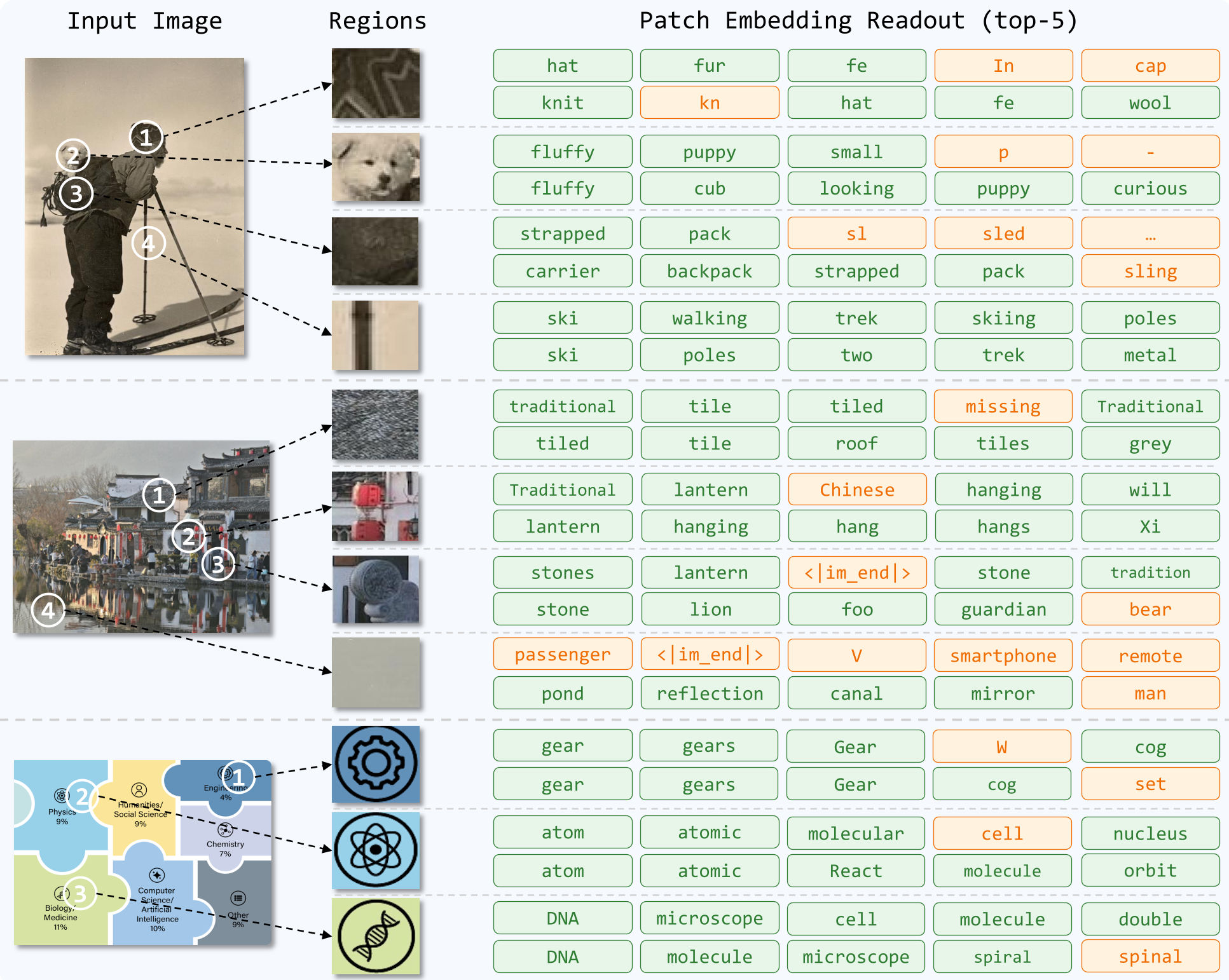
One of the most fascinating findings is Patch Semantics Readout. By passing a single visual patch feature through the LM head, the model can literally "name" the object in that specific region (e.g., identifying a "Bulbasaur" or "Charmander" from local patches) without ever having been explicitly trained on object detection.
4. Scalability and Efficiency
The research team demonstrated that GenLIP follows a clear scaling law. As the model grows from Large (L) to giga (g), its ability to handle complex OCR and spatial reasoning improves significantly. More importantly, it achieves "data efficiency" by reaching SigLIP2-level performance with only 20% of the pre-training samples.
5. Critical Analysis & Future Outlook
Takeaways
- Generative > Contrastive: For MLLM vision encoders, generative pre-training offers a more "natural" inductive bias because it aligns with the LLM's autoregressive nature.
- Simplicity Wins: By removing the text decoder, the gradient flow to the vision encoder is more direct, leading to better representation learning.
Limitations
- Data Quality: GenLIP relies heavily on high-quality captions (e.g., Recap-DataComp), which are expensive to generate at scale.
- Discriminative Gap: While it excels at semantics, it still lags slightly behind SigLIP2 in pure discriminative tasks like ImageNet probing, likely due to a lack of dense pixel-level supervision.
The Future
GenLIP suggests a future where vision and language are no longer "aligned" post-hoc, but are born as a unified sequence. This paves the way for truly native multimodal foundations where the distinction between "vision encoder" and "language model" eventually disappears.
Senior Editor's Note: GenLIP proves that architectural minimalism isn't just about efficiency—it's about removing the "noise" that prevents vision models from truly understanding the world in the way language models do.