
LLaDA2.0-Uni: Bridging the Gap Between Seeing and Creating with Unified Diffusion
LLaDA2.0-Uni: Unifying Multimodal Understanding and Generation with Diffusion Large Language Model
LLaDA2.0-Uni is a unified discrete diffusion Large Language Model (dLLM) that integrates multimodal understanding and generation into a single framework. It features a 16B MoE backbone, a semantic SigLIP-VQ tokenizer, and a distilled diffusion decoder, achieving SOTA performance in VQA and high-fidelity image synthesis.
Executive Summary
TL;DR: LLaDA2.0-Uni is a 16B Mixture-of-Experts (MoE) model that unifies multimodal understanding (VQA, OCR) and generation (T2I, Editing) under a single discrete diffusion framework. By treating images and text as tokens in a shared semantic space, it eliminates the "modeling gap" between specialized models, matching the performance of dedicated vision-language models while natively supporting interleaved reasoning and image creation.
Positioning: This work represents a significant shift from the dominant Autoregressive (AR) paradigm (like Janus or Emu3) toward a fully unified Discrete Diffusion (dLLM) approach. It positions dLLMs as a viable SOTA alternative for next-generation foundation models.
Problem & Motivation: The "Semantic Gap" in Unified Models
Most existing "unified" models fall into two traps:
- Heterogeneous Objectives: They use Autoregression for text and Diffusion for images, requiring a delicate balancing act during training.
- Weak Visual Semantics: Previous diffusion-based unified models (like MMaDA) used standard VQ-VAEs meant for reconstructing pixels. These "reconstructive" tokens are great for drawing but poor for "understanding" (e.g., answering "how many people are in this image?").
The authors' core insight is that semantics are the universal bridge. If you tokenize an image based on its meaning (Semantic VQ) rather than just its pixels, you can train a single model to both reason about and generate visual content using the same mathematical objective.
Methodology: The Core Architecture
LLaDA2.0-Uni consists of three pillars:
- SigLIP-VQ Tokenizer: Instead of a pixel-loss VQ, it uses a SigLIP-based encoder to map images to a discrete codebook that "speaks" the same language as the LLM.
- 16B MoE dLLM Backbone: A Mixture-of-Experts transformer that uses Block-wise Masked Diffusion. It treats the sequence as a series of blocks and predicts masked tokens within those blocks. This preserves the parallel decoding speed of diffusion while maintaining the logical coherence of AR models.
- Diffusion Decoder: Since the SigLIP tokens are semantic (abstract), they need a specialized "translator" to turn them back into high-fidelity pixels. The authors distilled a 6B transformer into an 8-step "Turbo" decoder.
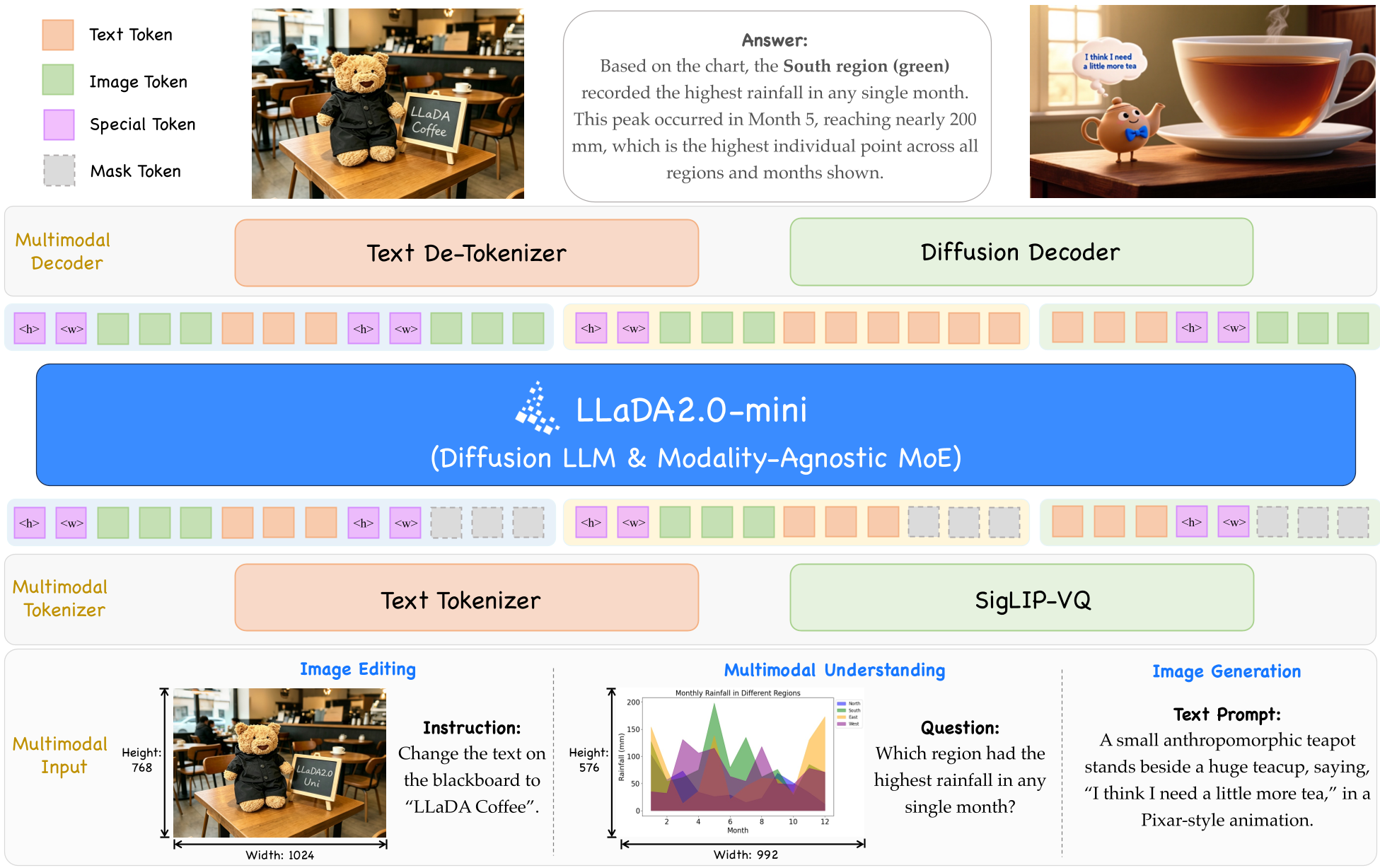 Figure 1: The unified pipeline where understanding and generation share a discrete semantic token representation.
Inference Acceleration via SPRINT
The paper introduces SPRINT (Sparse Prefix Retention with Inference-time Non-uniform Token Unmasking).
- Sparse Prefix: Prunes the Key-Value (KV) cache for image tokens (which have high redundancy) while keeping text tokens (which contain vital reasoning).
- Non-uniform Unmasking: Instead of unmasking a fixed number of tokens per step, it unmasks based on confidence, skipping redundant steps for "easy" parts of the image/text.
Experiments & Results: Matching the Specialists
LLaDA2.0-Uni performs a "double-threat" maneuvers by excelling in both categories:
- Multimodal Understanding: On the MMStar benchmark, it scored 64.1, outperforming the specialized Qwen2.5-VL-7B (63.9). It shows remarkable gains in complex reasoning and OCR compared to previous unified diffusion models.
- Image Generation: In GenEval (compositional T2I), it achieved 0.89, nearly matching top-tier generation-only models like Qwen-Image.
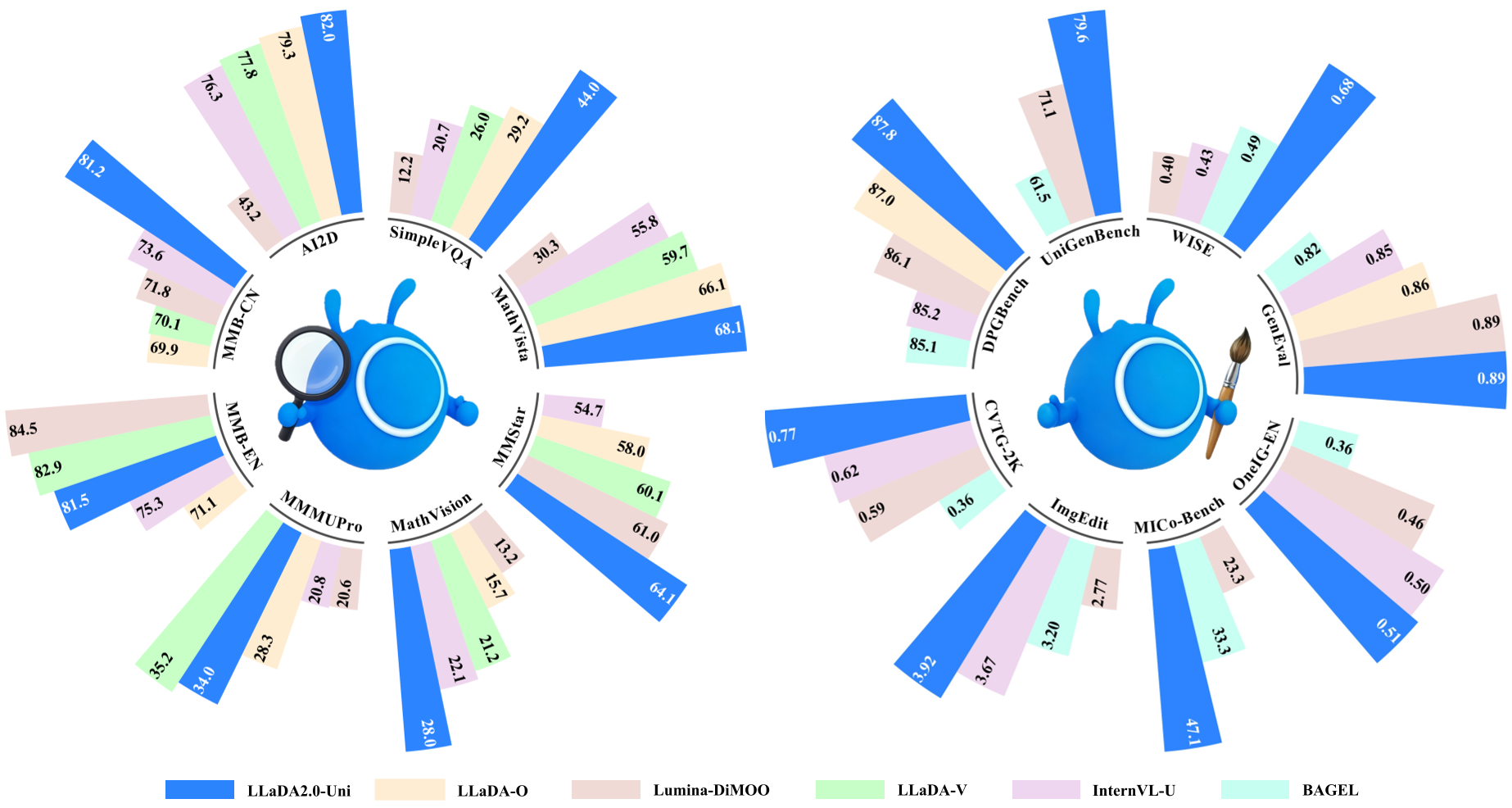 Figure 2: Performance metrics showing LLaDA2.0-Uni bridging the gap with specialized models.
The Power of Interleaved Reasoning
Because the model is natively unified, it can perform "Chain-of-Thought" (CoT) reasoning before generating an image. On the WISE-Bench, adding a "thinking" mode improved image generation accuracy by 10%, proving that "understanding" directly helps "creating."
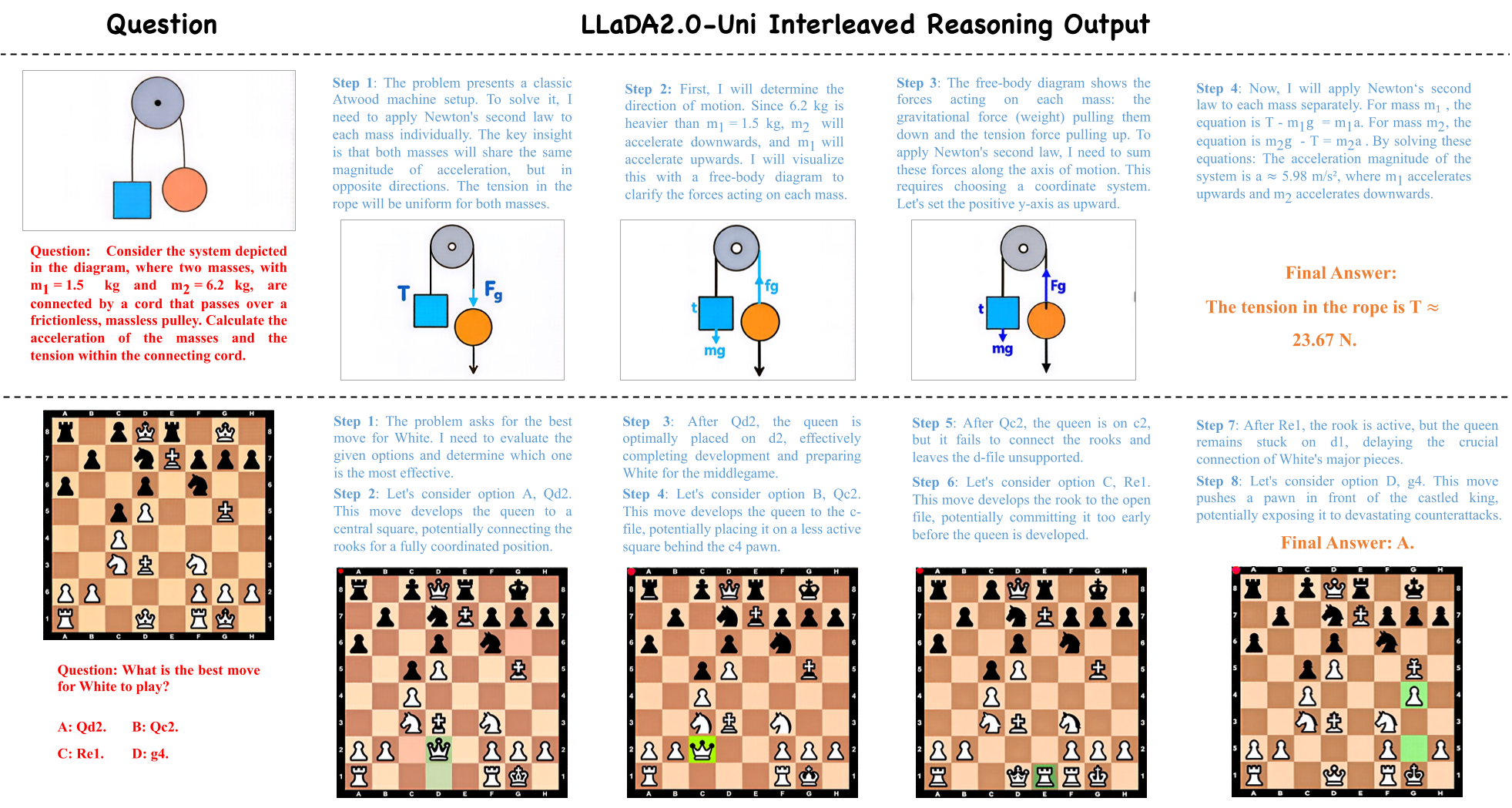 Figure 3: Qualitative examples of the model solving physics and chess problems through interleaved reasoning.
Critical Analysis & Conclusion
Takeaways
LLaDA2.0-Uni suggests that the future of AGI models might not be purely Autoregressive. The Discrete Diffusion approach offers a more natural way to unify modalities without the stability issues found in hybrid AR+Diffusion pipelines.
Limitations
- Fine-grained Detail: The semantic tokenizer, while excellent for logic, still loses some pixel-level detail during the abstraction process, which can affect extremely detailed image editing.
- Complexity: The system still requires a three-component stack. Moving toward a "single-stack" transformer for both tokens and pixels remains the final frontier.
Future Work: The authors point toward Reinforcement Learning (RL) as the next step to further boost the "thinking" capabilities of unified diffusion models.