
[Research Insight] How LLMs Distort the Human Voice: From Creative Nuance to "Algorithmic Neutrality"
How LLMs Distort Our Written Language
This study investigates how Large Language Models (LLMs) distort human writing, transitioning it toward a "neutral" and "homogenized" semantic mode. Using a randomized controlled trial and counterfactual analysis, the authors demonstrate that extensive LLM assistance leads to a 70% increase in neutral argumentative stances and a significant loss of personal voice.
TL;DR
A multi-institution study (UC Berkeley, Google DeepMind, etc.) reveals that LLMs don't just "fix" our grammar—they fundamentally re-engineer our meaning. By analyzing human-AI collaboration, researchers found that heavy LLM use causes a 70% shift toward neutrality in arguments and creates a "semantic cluster" where the unique human voice is replaced by a formal, detached, and "safe" AI persona.
The Background: Beyond Stylistic Flattening
We’ve all felt the "uncanny valley" of AI prose—the perfectly balanced paragraphs, the "it's important to note" transitions, and the persistent use of adjectives like "tapestry" or "testament." However, this paper argues the problem is deeper than style. LLMs act as a semantic attractor, pulling diverse human viewpoints into a homogenized center.
The Core Problem: The Erasure of Stance
The researchers conducted a randomized controlled trial (N=100) asking users: "Does money lead to happiness?"
- Human Control: Produced diverse, emotionally charged, and opinionated stances (For/Against).
- LLM-Influenced: Users who relied heavily on AI were 68.9% more likely to produce "Neutral" essays.
The "why" is rooted in the training: RLHF rewards AI for being helpful, harmless, and honest, which often manifests as a refusal to take a strong, potentially "offensive" or "incorrect" side. When we write with AI, we inadvertently adopt this "path of least resistance."
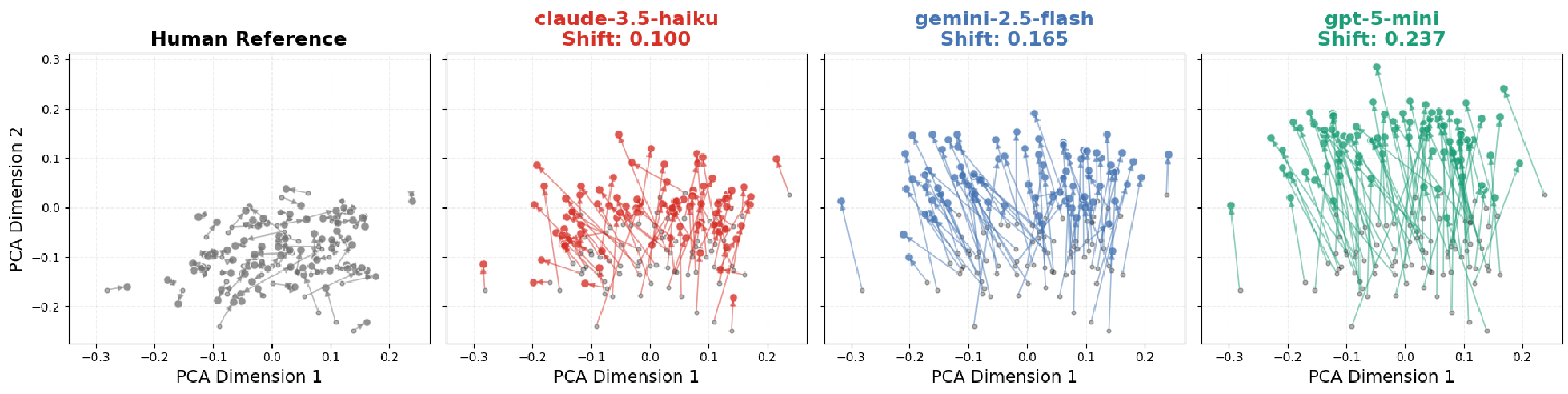 Figure 1: While human edits (left) are surgical and preserve the original's position in semantic space, LLM revisions (right) act like a powerful magnet, dragging varied human drafts toward a single, homogenized cluster.
Methodology: The Counterfactual Analysis
To prove that LLMs over-edit, the team used the ArgRewrite-v2 dataset (collected in 2021 before the LLM boom). They compared:
- How humans revised their own drafts based on expert feedback.
- How LLMs (GPT-5-mini, Gemini, Claude) revised the same drafts using the same feedback.
The result? LLMs made 3x the lexical changes that humans did. Even when asked for "minimal grammar edits," the models replaced personal anecdotes with statistical jargon and swapped first-person pronouns ("I feel") for impersonal nouns ("It is observed").
Real-World Impact: The Crisis in Peer Review
Perhaps most alarming is the study's analysis of ICLR 2026 peer reviews. With 21% of reviews identified as AI-generated:
- Score Inflation: AI reviews were 1.0 point higher on average.
- Metric Shift: Humans care about Clarity and Significance. LLMs care about Reproducibility and Scalability.
- Institutional Distortion: We are moving toward a world where the criteria for "good science" are being subtly redefined by the training data of the models used to review it.
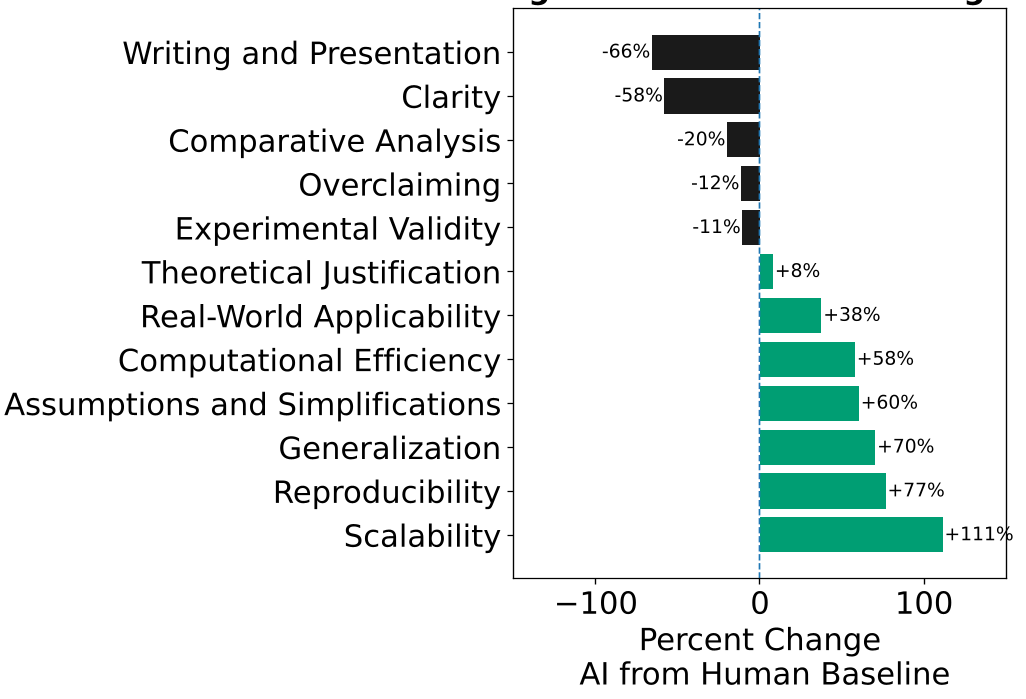 Figure 2: The divergence in evaluation criteria between AI and Humans in academic peer review.
Critical Analysis: The "Clickbait" of Logic
A fascinating paradox emerged: LLMs increased both emotional language and analytical language. The authors suggest LLMs are producing the written equivalent of "clickbait"—using emotional hooks and logical-sounding structures to satisfy the reward models of RLHF, without actually adhering to the user's intended nuance.
Limitations
The study primarily focused on English-speaking users in the US. The distortion effects might be even more pronounced—or entirely different—in low-resource languages or different cultural contexts where the "Western-centric" training bias of frontier models clashes with local norms.
Conclusion: Reclaiming the Human Voice
The takeaway for AI researchers is a clear capability deficiency: LLMs are currently unable to assist in writing without altering the underlying meaning. For the rest of us, it’s a warning. If we continue to outsource our "voice" to models optimized for "averageness," we risk a future where our cultural and scientific discourse becomes a lukewarm, homogenized reflection of a training set.
Moving Forward: We need "meaning-preserving" alignment—algorithms that prioritize the intent of the human author over the formality of the model's internal persona.