
AutoTTS: Bridging the Gap Between AutoML and LLM Reasoning Efficiency
LLMs Improving LLMs: Agentic Discovery for Test-Time Scaling
AutoTTS is an environment-driven framework for the automatic discovery of Test-Time Scaling (TTS) strategies, utilizing an explorer LLM to synthesize code-defined controllers. It achieved SOTA accuracy-cost tradeoffs on mathematical reasoning benchmarks (AIME, HMMT) while reducing token consumption by up to 69.5% compared to Self-Consistency baselines.
TL;DR
Researchers from UMD, Meta, and Google have introduced AutoTTS, a framework that automates the design of Test-Time Scaling (TTS) strategies. By treating the allocation of inference compute (width vs. depth) as a controller synthesis problem, AutoTTS discovers strategies that significantly outperform human-designed heuristics. The discovered "Confidence Momentum Controller" beats current SOTA baselines while reducing token costs by nearly 70%.
The "Hand-Crafted" Bottleneck in Test-Time Scaling
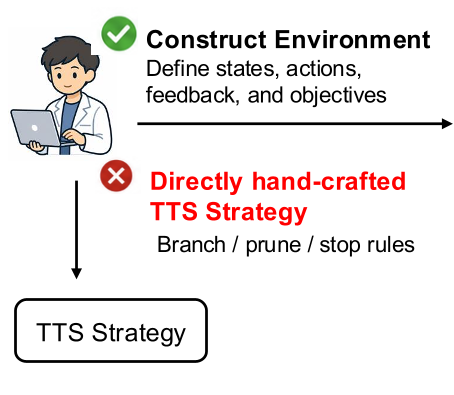
Test-Time Scaling (TTS) — the practice of spending more compute during inference to get better answers — has become the new frontier for LLM performance. However, we are currently stuck in a "feature engineering" phase. Researchers manually decide:
- When to branch? (Widening exploration)
- When to prune? (Stopping dead-end reasoning)
- When to stop? (Finalizing the answer)
This manual tuning is slow, expensive, and often results in "brittle" thresholds that don't generalize across different model scales or tasks.
AutoTTS: Strategy Discovery as an Algorithmic Search
AutoTTS changes the human's role. Instead of writing the strategy, humans build the Discovery Environment. The framework operates on three critical pillars:
1. The Replay Environment (MDP Formulation)
To make search affordable, the authors pre-collect reasoning trajectories. The discovery agent (e.g., Claude) interacts with a "Replay MDP" where actions like BRANCH, CONTINUE, and PROBE have fixed costs but zero LLM latency.
2. Beta Parameterization
One major risk in automated discovery is overfitting to the search set. AutoTTS forces the agent to map all complex internal hyperparameters (like pruning thresholds) to a single scalar . As increases, the compute budget must monotonically increase. This forces the agent to discover robust "budget schedules" rather than "lucky numbers."
3. Execution Trace Feedback
Unlike traditional AutoML which only sees a final score, AutoTTS provides the agent with full execution traces. If a strategy fails, the agent sees exactly where it pruned a correct branch or why it stopped too early, allowing for targeted code improvements.
Methodology: The Confidence Momentum Controller (CMC)
The most successful controller discovered, named CMC, introduced a logic that human researchers had largely overlooked: Momentum-aware stopping.
Instead of stopping when consensus hits a threshold, CMC tracks an Exponential Moving Average (EMA) of confidence. It only stops if confidence is high AND the trajectory is not declining. This "evidence inertia" prevents stopping on lucky early clusters of identical (but potentially wrong) answers.
Experimental Performance
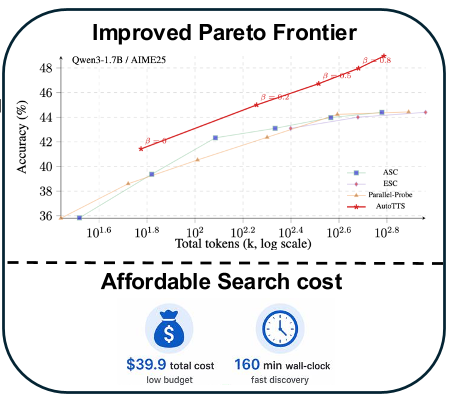
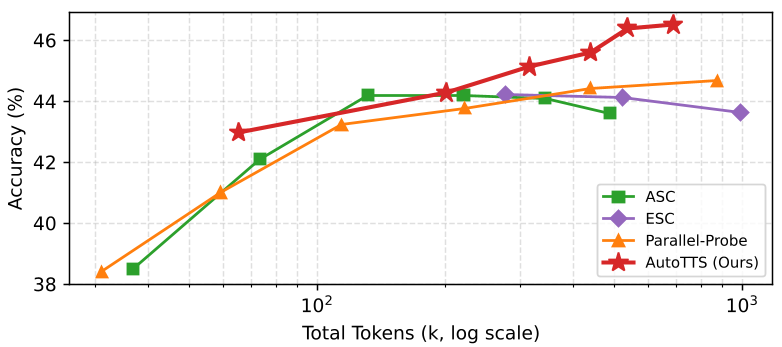
The results on search sets (AIME24) and held-out sets (AIME25, HMMT25) demonstrate a clear dominance over baselines like Self-Consistency (SC) and Parallel-Probe:
- Efficiency: At similar accuracy levels, AutoTTS uses ~70% fewer tokens than SC@64.
- Scaling Frontier: By varying , the discovered controller forms a superior Pareto frontier compared to any handcrafted method across Qwen3-0.6B to 8B models.
- Cross-Model Generalization: A controller discovered on Qwen models worked out-of-the-box for DeepSeek-R1-Distill-Llama-8B, proving the strategy captures fundamental reasoning dynamics rather than model-specific quirks.
Critical Insights & Future Outlook
Why does it work? AutoTTS succeeds because the allocation space is too high-dimensional for humans to navigate. The discovered CMC uses "Coordinated Complexity"—simultaneously adjusting width based on confidence trends while focusing depth on consensus-aligned branches.
Limitations: The current framework is restricted to the width-depth control space. Future work could expand the action set to include "backtracking" or "cross-leaf verification."
Summary: AutoTTS proves that the "LLMs Improving LLMs" loop is not just for training data generation; it is a potent tool for inference-time architectural discovery. As inference costs become the dominant factor in AI deployment, environment-driven discovery will likely become the standard for squeezing every drop of intelligence out of our models.