
The Cost of Silence: Can LLMs Truly Understand Trauma?
Can LLMs Understand the Impact of Trauma? Costs and Benefits of LLMs Coding the Interviews of Firearm Violence Survivors
This study evaluates the effectiveness of open-source Large Language Models (LLMs), specifically Llama-3.1-8B and Llama-3.2-1B, in automating the inductive qualitative coding of interviews with Black men who survived community firearm violence. The authors developed a machine coding pipeline and compared its performance against expert-level human thematic analysis.
TL;DR
Researchers at the University of Maryland explored whether open-source LLMs (Llama 3.1 & 3.2) could replace human experts in coding interviews with firearm violence survivors. While the models show promise in speed, they suffer from narrative erasure—where safety guardrails trigger refusals on 44% of traumatic data—and a significant drop in accuracy after organizing themes.
Context: AI and the Unspoken Voices
Qualitative coding (thematic analysis) is the "gold standard" for understanding human experience, but it is notoriously slow. In the context of firearm violence—a leading cause of death for Black men in the U.S.—underfunding makes scaling this research nearly impossible. While "AI-assisted" coding is marketed as a panacea, this paper asks a critical ethical question: Can a model trained on general web data grasp the nuances of systemic trauma and African American English (AAE)?
The "Narrative Erasure" Problem
The most striking discovery wasn't a lack of technical capability, but a systemic failure of "safety" mechanisms.
- Refusal Bias: LLMs frequently categorized survivors' testimonies as "graphic violence" or "promoting illegal acts."
- Linguistic Erasure: The use of AAE, particularly certain cultural identifiers or slang, often triggered safety filters, causing the model to refuse to process the text entirely.
This creates a paradox: the very groups whose voices are most marginalized are the ones AI "safety" filters are most likely to silence.
Methodology: The Machine Coding Pipeline
The authors didn't just run a single prompt; they built a rigorous pipeline to test 118 different configurations.
1. Data Processing
They experimented with:
- Full Text: Passing the entire interview.
- Paired Chunks: Sequential speaker-turn pairings (capped at 256 tokens).
- Question Chunks: Using Sentence Transformers to match subject responses to the original interview protocol questions.
2. The Clustering Step
Initially, LLMs generated over 3,000 unique codes—too many for a human to manage. The team used BERTopic to cluster these into "Formal Codes" (e.g., "Masculinity," "Systemic Inequality").
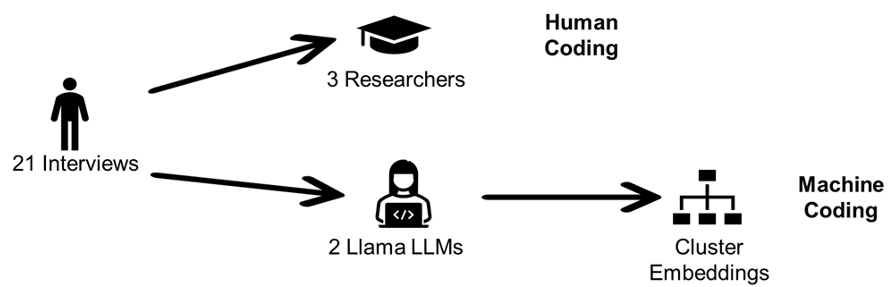 Figure 1: The dual-stage pipeline transitioning from raw interview text to clustered formal codes.
Experiments and Results
The researchers used two critical metrics:
- Percent Captured (Recall): Did the AI find what the humans found?
- Percent Relevant (Precision): Is the AI's output actually meaningful, or is it "hallucinating" patterns?
| Coder Type | Time Spent | # Formal Codes | % Captured (Final) |
|---|---|---|---|
| Human (HC) | 35 Hours | 11 | N/A |
| Llama 8B (Best) | 5.75 Hours | 45 | 36% |
| Llama 1B (Best) | 1.45 Hours | 57 | 36% |
The "Inconsistency" Trap
While the 8B model was more computationally expensive, it wasn't vastly superior to the 1B model in final recall. However, both models showed a significant performance "cliff" when moving from initial broad themes to clustered formal codes.
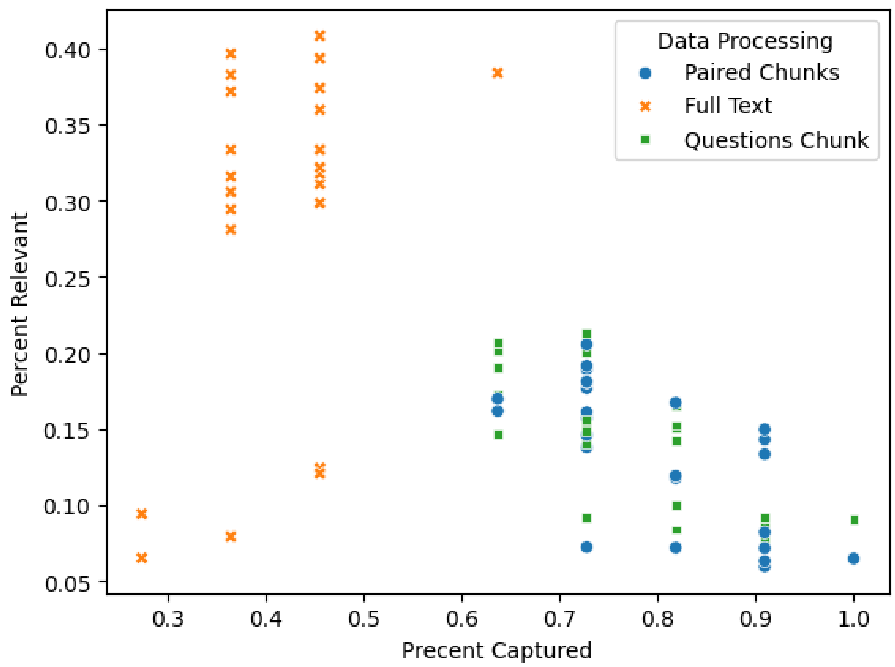 Figure 2: The tradeoff between capturing human themes (Recall) and maintaining overall relevance (Precision).
Critical Insight: The "Difference-Awareness" Gap
A key takeaway from the paper is that LLMs are not "difference-aware." They tend to fixate on non-standard English linguistic characteristics (like the frequency of the word "like" in AAE) rather than the underlying thematic content. Furthermore, the "safety" guardrails meant to protect users actually work against social science by sanitizing the lived reality of violence and trauma.
Conclusion & Future Outlook
The study concludes that fully automated qualitative coding is not yet viable for sensitive research. The time saved in processing is often lost during the "validation" phase, where humans must fix AI hallucinations and fill the gaps left by narrative erasure.
Future Work must focus on:
- Improving LLM performance on long-form, non-standard English.
- Developing adjustable guardrails for researchers that distinguish between "promoting violence" and "analyzing violence."
- Building low-resource AI tools that can be run locally by community-based organizations without massive GPU clusters.