
[CVPR 2026] Loc3R-VLM: Equipping 2D Models with a 3D "Cognitive Map" via Situational Awareness
Loc3R-VLM: Language-based Localization and 3D Reasoning with Vision-Language Models
Loc3R-VLM is a novel framework that equips 2D Vision-Language Models (VLMs) with advanced 3D spatial understanding and situational awareness from monocular video. By integrating camera pose priors from a 3D foundation model and employing dual objectives—Global Layout Reconstruction and Explicit Situation Modeling—it achieves state-of-the-art performance in language-based localization and 3D question answering.
TL;DR
Loc3R-VLM transforms standard 2D Vision-Language Models into 3D-aware systems capable of navigating and reasoning within complex physical environments using only monocular video. By mimicking human spatial cognition—forming a global mental map while maintaining an egocentric perspective—this model shatters the performance of existing point-cloud-based experts in language-driven localization and viewpoint-dependent 3D QA.
The Spatial Blind Spot of Modern VLMs
While GPT-4o and Gemini have mastered the art of describing 2D images, they remain "spatial toddlers." When tasked with understanding a sequence of video frames, most models fail to build a persistent, unified global context. They treat space as a collection of disjointed pixels rather than a metric, 3D world.
Previous attempts to fix this usually involved feeding the model dense 3D point clouds or requiring ground-truth depth maps at inference time. However, these solutions are often impractical for real-world applications where only a raw video stream is available. The authors of Loc3R-VLM asked a fundamental question: Can we teach a model to "think in 3D" using regular 2D video?
Methodology: Building an Internal Cognitive Map
Loc3R-VLM introduces three core innovations to bridge the 2D-to-3D gap:
- Global Layout Reconstruction (The Map): Inspired by human cognitive maps, the model is trained to project visual tokens onto a gravity-aligned Bird’s-Eye-View (BEV) plane. This forces the model to understand where objects are relative to each other across various video frames.
- Situation Modeling (The Perspective): The model introduces two special tokens,
<Pos>and<Ori>, which explicitly represent the agent's position and orientation. This allows the model to "stand" in the scene and reason from a specific viewpoint (e.g., "What is to my left?"). - Camera Pose Priors: By utilizing a pre-trained 3D foundation model (CUT3R), the system gains a sense of metric scale, allowing it to predict distances in meters rather than just relative terms.
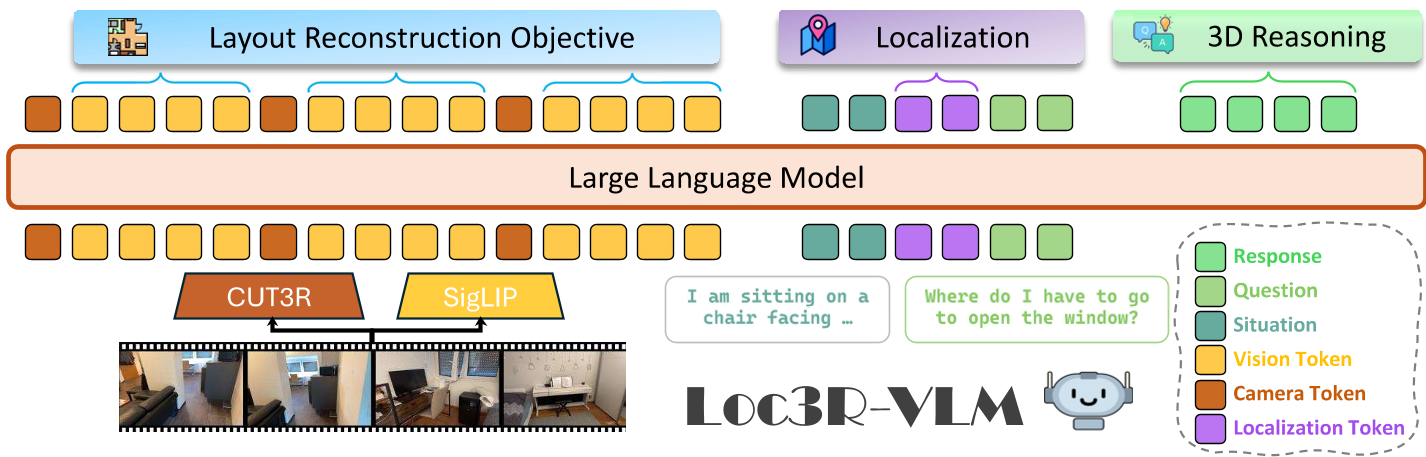 Fig 1. The Loc3R-VLM architecture: Integrating camera priors with global layout and situational tokens.
Outperforming 3D Experts with 2D Inputs
The most striking result is that Loc3R-VLM—which only sees video—outperforms models that have direct access to 3D point clouds. In the SQA3D localization task, it achieved a staggering +39.0% improvement in 1.0m accuracy over the previous SOTA, View2Cap.
| Method | Input | Acc@1.0m (Pos) | Acc@30° (Ori) |
|---|---|---|---|
| SIG3D | 3D Point Cloud | 59.1 | 42.5 |
| View2Cap | 3D Point Cloud | 36.9 | 28.5 |
| Loc3R-VLM (Ours) | 2D Video | 75.9 | 63.0 |
This suggests that the inductive bias provided by the BEV layout and explicit situational supervision is significantly more powerful than simply increasing the dimensionality of the input data.
 Fig 2. Ablation study showing the cumulative impact of Situation Modeling, Layout Reconstruction, and Camera Priors.
Deep Insight: Why Why This Works
The success of Loc3R-VLM lies in its probabilistic grounding. By predicting position and uncertainty simultaneously, the model learns which parts of a scene are ambiguous. This uncertainty is fed back into the reasoning process, allowing the LLM to "know what it doesn't know" before answering a complex spatial question.
Furthermore, the transition from local frame processing to a global BEV representation solves the "memory" problem in long videos. Instead of trying to remember every pixel, the model updates a persistent, low-dimensional spatial representation.
Conclusion & Future Look
Loc3R-VLM proves that 3D awareness is an architectural and supervisional challenge, not just a data challenge. While it currently focuses on static indoor scenes and 2D BEV projections (which loses vertical granularity), it sets a new benchmark for Embodied AI research.
In the future, we can expect this framework to be extended into dynamic multi-floor environments, where models must not only map space but also track moving objects and navigate between levels, paving the way for truly autonomous household robots and advanced spatial assistants.