
Tropical Quantum Security: Stress-Testing Commercial QKD in the Heat of Rio
Long-term Performance Analysis of a Commercial QKD Device Under Real-world Deployment Conditions
This paper presents a long-term performance evaluation of the ID Quantique Clavis XGR, a commercial Quantum Key Distribution (QKD) system, deployed in the Rio Quantum Network, Brazil. It characterizes the system's stability across indoor spooled fiber (~40 km) and outdoor underground fiber (3.5 km) under tropical climate conditions, achieving a stable Quantum Bit Error Rate (QBER) below 1% and visibility above 97%.
TL;DR
Researchers field-tested the ID Quantique Clavis XGR in Rio de Janeiro, Brazil, to see how commercial Quantum Key Distribution (QKD) handles the humidity and heat of a tropical climate. Over months of operation across both 40km indoor spooled fiber and 3.5km outdoor underground fiber, the system maintained a QBER below 1% and visibility above 97%, though it hit a hard operational ceiling when internal temperatures breached 40°C.
Background: Beyond the Laboratory
Most QKD performance data comes from the "Global North," where climates are temperate. However, as quantum-safe infrastructure goes global, we must know: Can these sensitive interferometric systems survive the thermal stress of the tropics? This study, situated within the Rio Quantum Network, provides one of the first long-term "stress tests" in such a demanding environment.
The Bottleneck: Thermal Stress & Phase Stability
Thermal fluctuations are the enemy of QKD. In fiber-based systems:
- The Channel: Temperature shifts change propagation delay and birefringence in the fiber, ruining the interferometric visibility required to decode quantum states.
- The Hardware: Heat increases "dark counts" (noise) in the Single-Photon Avalanche Diodes (SPADs).
The authors discovered that while the fiber can be resilient, the hardware is the primary point of failure. The Clavis XGR units entered a protective shutdown whenever internal temperatures exceeded 40°C—a frequent occurrence in tropical server rooms without aggressive cooling.
Methodology: A Biased BB84 Approach
The system uses a biased BB84 protocol with decoy states. Unlike standard BB84, this version uses the Z-basis for 75% of the time to generate keys and the X-basis sparingly to monitor eavesdropping. This asymmetry optimizes the Secret Key Rate (SKR).
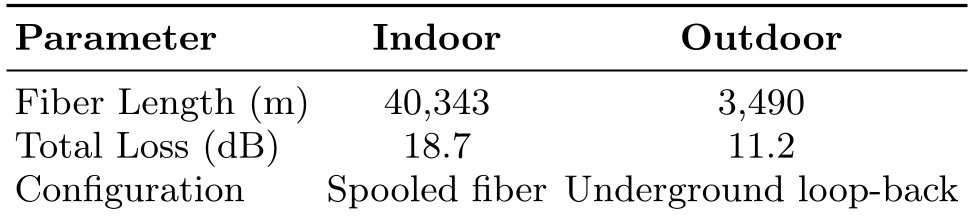
The experiment compared two distinct topologies:
- Indoor Spool: 40.3 km, high loss (18.7 dB), stable environment.
- Outdoor Underground: 3.5 km, lower loss (11.2 dB), but subjected to urban vibrations and ground temperature shifts.
Key Insights from the Results
Surprisingly, the indoor 40km channel outperformed the outdoor 3.5km channel in terms of Final Secret Key Rate.
| Parameter | Indoor (~40km) | Outdoor (~3.5km) |
|---|---|---|
| Key Rate (bps) | 10,500 ± 500 | 9,400 ± 500 |
| QBER (%) | 0.7 ± 0.2 | 0.9 ± 0.2 |
| Visibility (%) | 98.2 ± 0.6 | 97.9 ± 0.6 |
Why did the shorter outdoor link perform worse?
The authors point to Confounding Field Variables. While the outdoor link had less attenuation (meaning more photons arrived at the detector), it suffered from:
- Micro-vibrations from Rio's city traffic.
- Dynamic polarization drifts that didn't exist in the static lab spools.
- Local mechanical stress on the underground cable.
These factors forced the post-processing algorithms (error correction and privacy amplification) to discard more data, ultimately lowering the final secure bit rate.
Hard Thresholds: The 40°C Ceiling
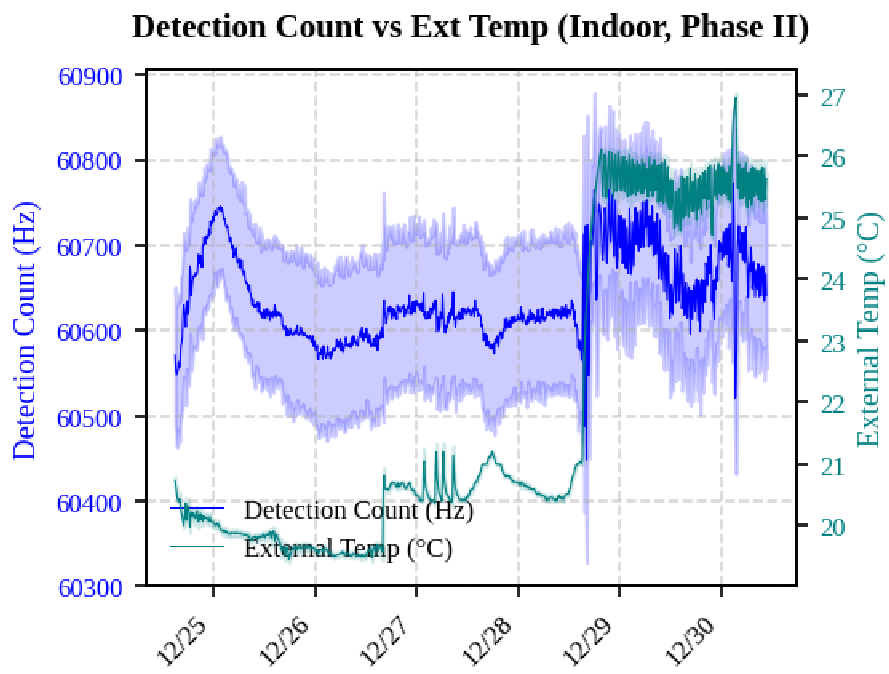
The study proved that the Clavis XGR uses high-sampling frequency internal sensors that track external ambient temperature with a correlation of 0.96. During Phase II, where temperatures were intentionally modulated, the researchers mapped the exact moment of "Quantum Collapse."
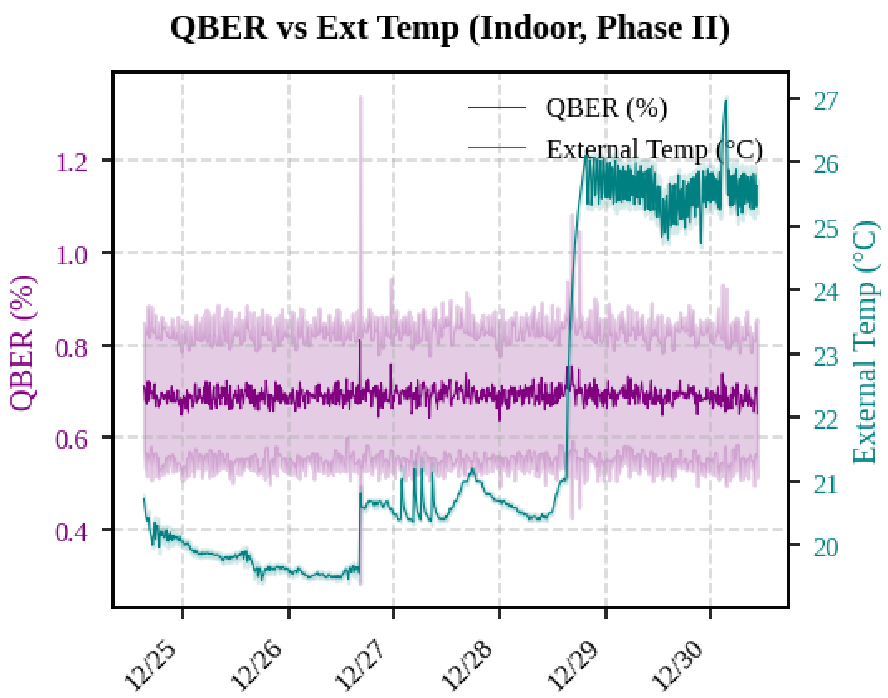
As shown above, the QBER remains remarkably stable until temperatures reach extreme peaks. The system doesn't gradually fail; it maintains high fidelity until the thermal threshold is reached, at which point key generation is halted to protect the hardware and security integrity.
Critical Analysis & Conclusion
Takeaway: Commercial QKD is ready for the "real world," but the infrastructure requirements are non-trivial. In tropical regions, "Quantum-Safe" also means "Aggressively Cooled."
Limitations: The study identified "point-like anomalies" in QBER during rapid temperature transitions in spooled fibers. This suggests that while slow thermal shifts are handled by the system's internal auto-compensation, sudden gradients (e.g., turning on an AC unit) can cause transient glitches in secret key production.
Future Outlook: This data provides a baseline for the Rio Quantum Network and other emerging metropolitan quantum infrastructures. Future work will likely focus on more robust "athermal" hardware designs that can withstand the 40°C+ environments common in the developing world without the need for constant, high-energy air conditioning.