
LongSeeker: Mastering the "Elastic" Memory for Long-Horizon Search Agents
LongSeeker: Elastic Context Orchestration for Long-Horizon Search Agents
This paper introduces LongSeeker and the Context-ReAct paradigm, a novel framework for long-horizon search agents that enables dynamic working memory management. By co-generating five atomic meta-operations (Skip, Compress, Rollback, Snippet, Delete) alongside standard tool calls, LongSeeker achieves state-of-the-art performance on benchmarks like BrowseComp (61.5%) and BrowseComp-ZH (62.5%), significantly outperforming major baselines like Tongyi DeepResearch.
TL;DR
LongSeeker introduces Context-ReAct, a paradigm shift that transforms agent memory from a passive, append-only log into an elastic, surgical working space. By training an agent to use meta-operations like Rollback and Snippet, it breaks the context bottleneck, maintaining high performance and low token costs across tasks involving hundreds of steps.
The Context Bottleneck: When More is Less
In the world of AI agents, the standard ReAct (Reason + Act) loop has a fatal flaw: unbounded growth. As an agent searches the web, every observation, tool output, and reasoning trace is appended to the context. This leads to several critical issues:
- Signal-to-Noise Ratio (SNR) Decay: Vital clues get lost in a sea of redundant search snippets.
- Hallucination Risk: Excessive context confuses the model's internal attention, leading to "lost in the middle" phenomena.
- Cost and Latency: Processing 100k+ tokens at every step is computationally prohibitive.
Current fixes like sliding windows are "dumb"—they might delete the very first instruction required for the task. LongSeeker's insight is that context management must be part of the agent's reasoning policy.
Methodology: The Context-ReAct Paradigm
LongSeeker doesn't just think about the task; it thinks about how to remember the task. At every turn, it generates a four-field structured output: <think>, <meta_tool_call>, <motivation>, and <standard_tool_call>.
The Five Atomic Meta-Operations
The researchers defined a "mathematically complete" set of operations to manipulate history:
- Skip: Do nothing (maintain current context).
- Compress: Turn verbose history into a concise summary.
- Snippet: A lossless operation that extracts verbatim substrings (e.g., a specific URL or a price) using pointers, preventing summarized hallucinations.
- Delete: Wipe out useless steps (e.g., a failed search query).
- Rollback: The most powerful tool—it allows the agent to recognize a "dead end," prune the failed branch, and return to a previous state with a "lesson learned" note.
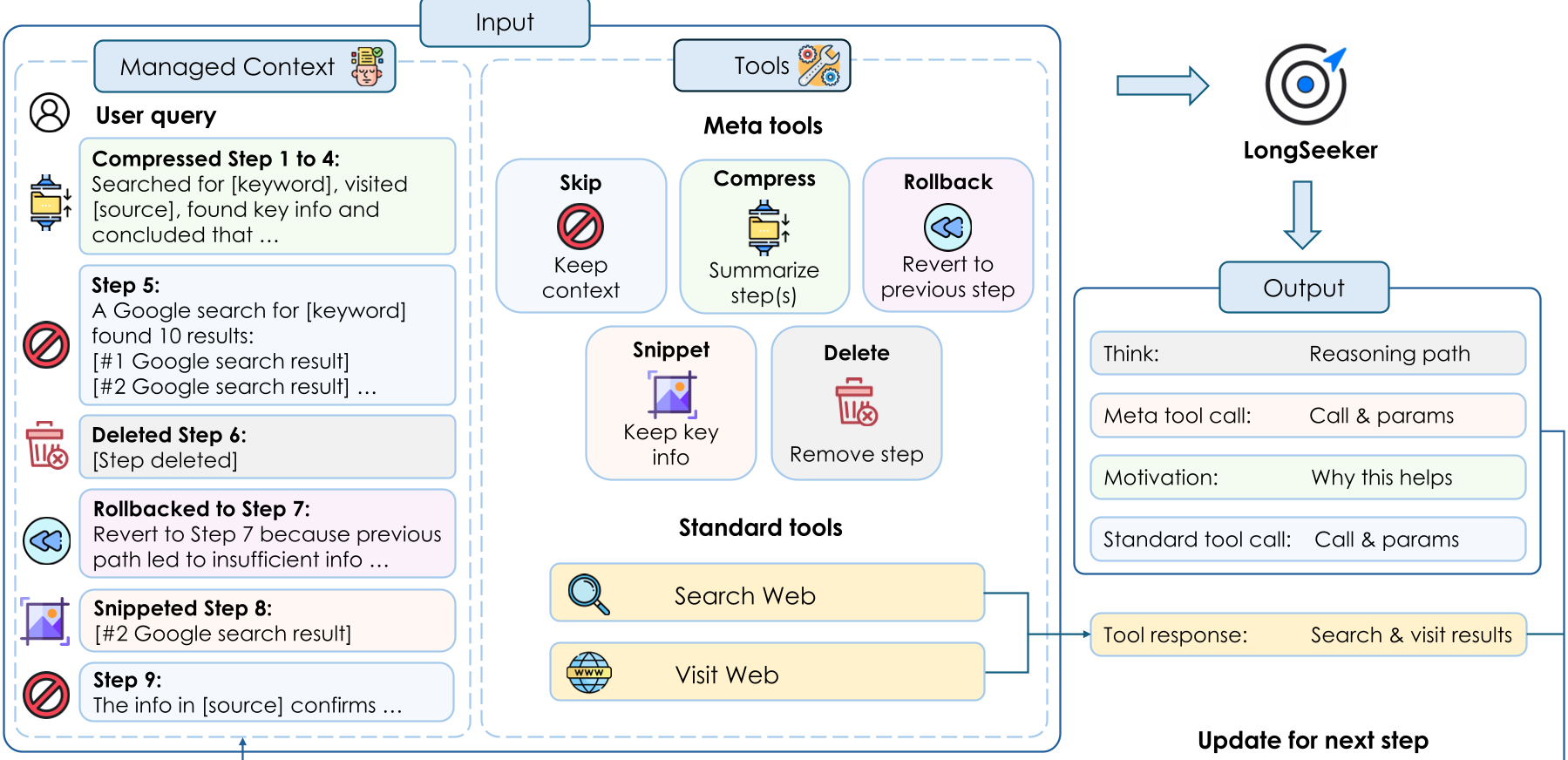 Figure 1: The Context-ReAct loop. Before calling the next tool, the agent surgically prunes its history.
Why This Works: Expressive Completeness
The authors prove that Compress is technically a universal string-rewriting operator. However, having specialized tools like Rollback and Snippet provides an inductive bias that makes it easier for the model to learn efficient and reliable memory management compared to using a single generic compression tool.
Performance: Efficiency Meets Power
LongSeeker-30B was fine-tuned on 10k synthesized trajectories using a teacher model (DeepSeek-V3.2). The results are striking:
- SOTA Results: On the BrowseComp benchmark, LongSeeker reached 61.5%, crushing prior agents like AgentFold (36.2%) and Tongyi DeepResearch (43.4%).
- Stable Complexity: While standard models show linear growth in token usage, LongSeeker’s context plateaus under 15k tokens, even when the task lasts for 300 steps.
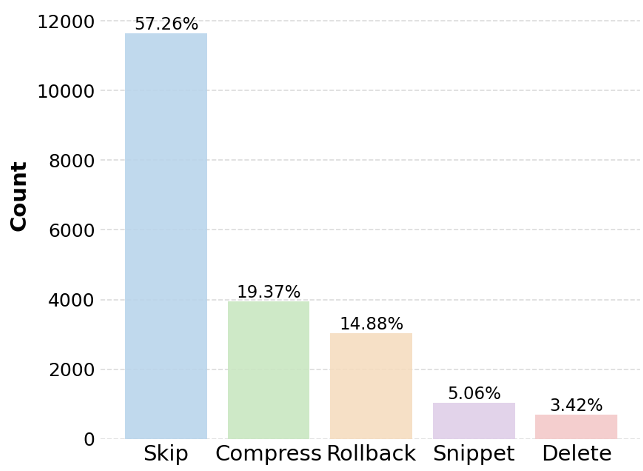 Figure 2: LongSeeker (blue) keeps context size flat, whereas vanilla models (grey) explode toward the context limit.
Critical Insight: The "Rollback" Advantage
The inclusion of Rollback is particularly significant. Most agents "get stuck" in a loop when a search fails. LongSeeker acts more like a human researcher: "This thread is going nowhere, let me go back to my third search result and try a different path." This structural backtracking is the key to solving "Long-Horizon" tasks where a single mistake usually leads to total failure.
Conclusion and Future Outlook
LongSeeker demonstrates that the next leap in agentic intelligence isn't just about "bigger models" or "longer context windows," but about smarter context orchestration.
Limitations: Currently, the model relies on Supervised Fine-Tuning (SFT). The authors suggest that Reinforcement Learning (RL) could further optimize these meta-operations, potentially allowing agents to discover even more creative ways to manage their "mental" workspace.
The Takeaway for Developers: If you are building search agents, stop worrying about how to fit 128k tokens into your prompt. Start teaching your agent how to hit the Delete and Summarize buttons on its own history.