
[DeepVision-VLA] Look Before Acting: Bridging the Visual Gap in Deep VLA Backbones
Look Before Acting: Enhancing Vision Foundation Representations for Vision-Language-Action Models
This paper introduces DeepVision-VLA, a Vision-Language-Action model that integrates multi-level features from a high-resolution Vision Expert (DINOv3) into the deeper layers of an LLM backbone. By utilizing a Vision-Language Mixture-of-Transformers (VL-MoT) framework and Action-Guided Visual Pruning (AGVP), it achieves state-of-the-art success rates, outperforming prior methods by 9.0% in simulation and 7.5% in real-world robotic tasks.
TL;DR
DeepVision-VLA addresses a critical flaw in current Vision-Language-Action models: the "fading" of visual awareness in deep LLM layers. By injecting high-resolution features from a Vision Expert (DINOv3) directly into the deeper layers via a Mixture-of-Transformers (MoT) architecture and using Action-Guided Pruning, it achieves a +9.0% boost in simulation and superior real-world precision for tasks like writing and pouring.
The "Black Box" Problem: Why Deep Layers Go Blind
Most VLA models follow a serial paradigm: extract visual features, prepend them to a language prompt, and feed the whole sequence into an LLM. However, this paper performs a fascinating "layer-wise autopsy" across models like OpenVLA and π0.
The findings are startling:
- Shallow layers have high attention on task-relevant objects (the "ROI").
- Deep layers show diffuse, scattered attention maps.
Through a Visual Token Dropout experiment, the authors proved that masking objects in deeper layers has almost zero impact on the predicted action, whereas masking them in shallow layers causes the model to fail. Essentially, the "visual signal" is lost in translation as it travels up the transformer stack, leaving the action-generation layers "blind."
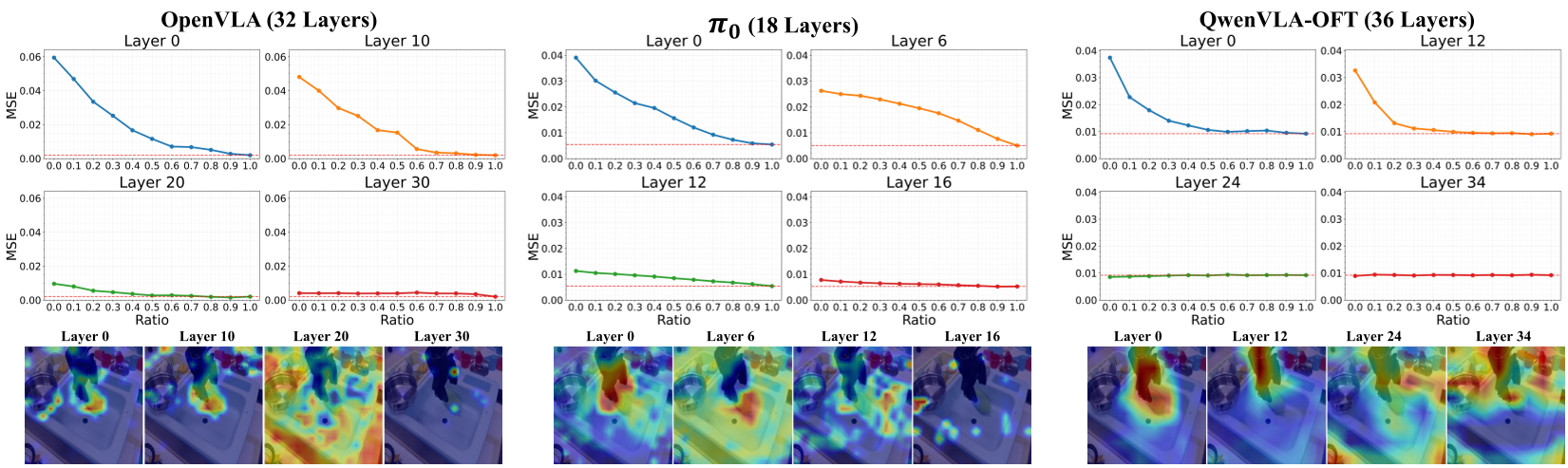 Figure: Quantitative evidence showing that deep layers become insensitive to the removal of task-relevant visual regions.
Methodology: VL-MoT and Action-Guided Pruning
To fix this, the authors don't just add more vision at the start; they re-inject it where it’s needed most.
1. Vision-Language Mixture-of-Transformers (VL-MoT)
Instead of simple concatenation, the framework introduces a Vision Expert (DINOv3-0.8B). The intermediate Query, Key, and Value (QKV) representations from the expert are fused with the VLA backbone's QKV via a shared-attention mechanism. Crucially, this injection only happens in the last n layers, providing a fresh "visual anchor" for the layers generating the final robot control signals.
2. Action-Guided Visual Pruning (AGVP)
High-resolution vision is computationally expensive. DeepVision-VLA solves this with a clever heuristic:
- It uses the attention maps from shallow layers (which are still visually grounded) to identify which tokens are important.
- It prunes the Vision Expert’s features by keeping only the top-K relevant tokens.
- This ensures the model focuses on the "banana" or the "bottle" without getting distracted by the background or wasted on empty space.
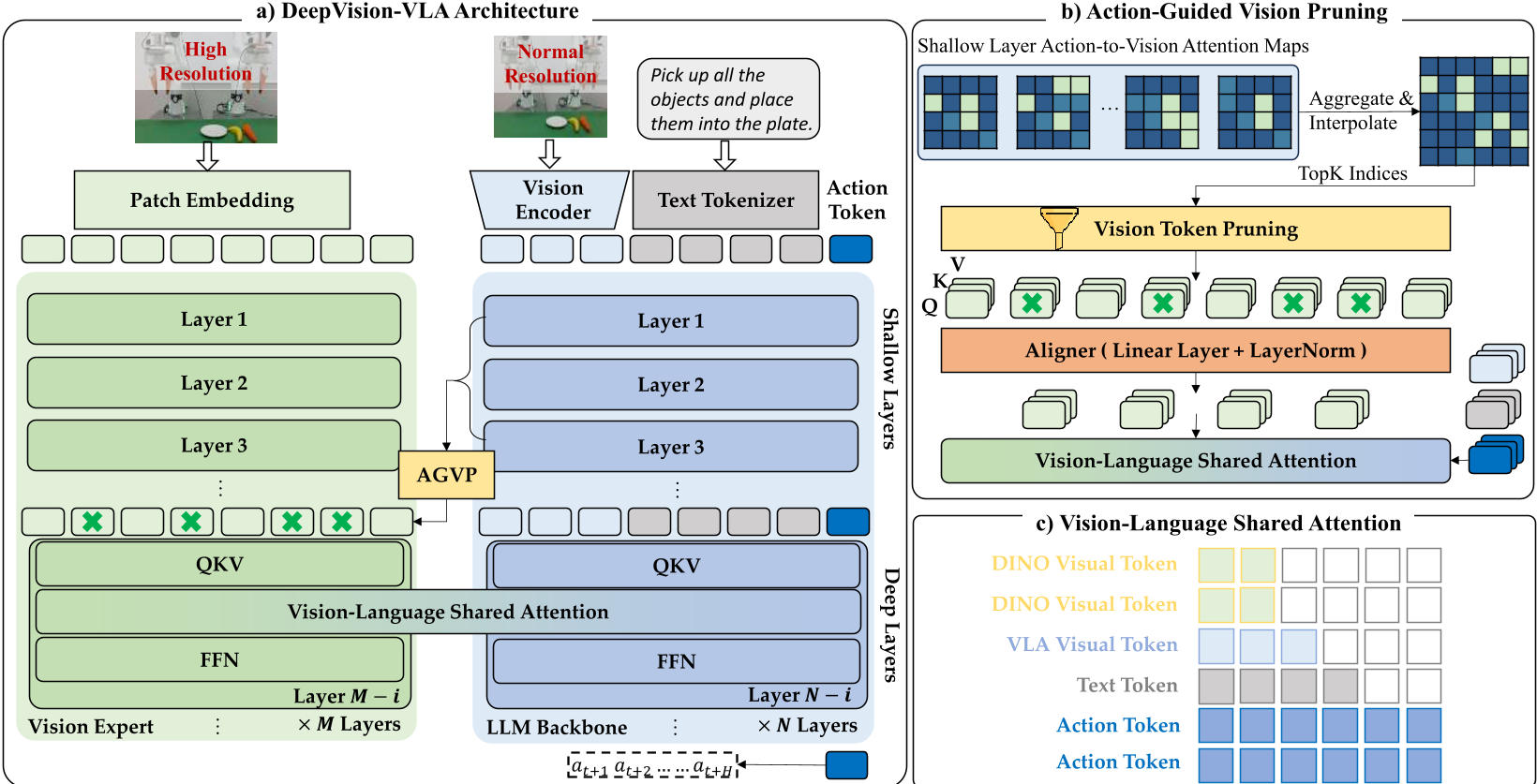 Figure: The VL-MoT framework showing how high-resolution expert tokens are pruned and fused with the LLM backbone.
Experimental Mastery: Simulation and Reality
DeepVision-VLA was tested against heavyweights like OpenVLA, π0.5, and HybridVLA.
- RLBench Simulation: It achieved an 83% success rate, a massive leap from the 69% of its own baseline (QwenVLA-OFT). In tasks like "Sweep to Dustpan," it skyrocketed from 15% to 95% success.
- Real-World Precision: Tested on a Franka Panda, the model showed incredible success in multi-stage tasks (e.g., "Pour Coke into Bottle"). It maintained 100% success across all stages, whereas prior SOTA models often failed during the second stage due to accumulated visual drift.
 Table: Comparison across 10 RLBench tasks showing DeepVision-VLA's dominance.
Critical Insight: Why Does This Work?
The genius of DeepVision-VLA lies in its Asymmetric Integration. The authors chose the last layers of the Vision Expert to feed into the last layers of the VLA. Why?
- The late-stage DINOv3 features are highly semantic and object-centric.
- The late-stage VLA layers need exactly this type of invariant, high-level structural information to map to continuous action spaces. By bypassing the middle-layer "noise" of the LLM, the model creates a "shortcut" for visual reality to reach the motor cortex of the robot.
Conclusion & Future Outlook
DeepVision-VLA proves that for embodied AI, more vision at the input is not enough. We must ensure visual features survive the deep reasoning process. The use of AGVP also highlights a path toward efficient high-resolution processing in VLAs without blowing up GFLOPS.
Limitations: While DINOv3 is a powerful expert, the model's reliance on a secondary 0.8B parameter encoder adds inference latency. Future work might explore "distilling" this expert knowledge directly into the LLM layers to achieve similar grounding with even lower overhead.