
Photometric Redshifts: From Black-Box Regression to Generative Physical Models
Machine Learning Techniques for Astrophysics and Cosmology: Photometric Redshifts
This paper provides a comprehensive review of AI applications in photometric redshift (photo-z) estimation, transitioning from traditional discriminative regression models to modern generative Bayesian frameworks. It highlights how these methods are essential for Stage IV cosmological surveys like Euclid and LSST to overcome spectroscopic limitations and achieve per-mille level accuracy in distance measurements.
TL;DR
In modern cosmology, measuring the distance to billions of galaxies is a logistical nightmare. Since we cannot obtain spectra for every star, we use Photometric Redshifts (photo-z)—predicting distance from simple colors. This review explores the paradigm shift from discriminative AI (predicting from flux) to generative AI (simulating galaxies to match observations), a move necessary to unlock the secrets of Dark Energy and solve the "S8 Tension."
The Distance Ladder vs. The Spectroscopic Bottleneck
The universe is expanding, and a galaxy's redshift () is our best yardstick for its history. While spectroscopy provides high-precision measurements by identifying spectral lines (e.g., H), it is agonizingly slow. For upcoming surveys like the Vera C. Rubin Observatory (LSST), we expect billions of galaxies—far exceeding the capacity of even the most advanced multi-object spectrographs like DESI.
Enter AI. For decades, researchers have used neural networks to bridge the gap: mapping broadband photometric colors to redshift labels. However, as this review argues, we have reached the "limit of discriminative AI." The bottleneck isn't the code; it's the training data.
Why Simple AI Fails: The "Unhappy" Estimator
Traditional machine learning approaches for photo-z are often "discriminative"—they try to learn the inverse mapping . The authors identify two primary failure modes:
- Type-Redshift Degerneracy: Different types of galaxies at different redshifts can look identical in broadband filters (e.g., the 4000Å break vs. the Lyman break).
- Selection Bias: Spectroscopic training sets are not representative. We find it easier to get redshifts for bright, clear galaxies, but our surveys are dominated by faint, "blended" (overlapping) sources.
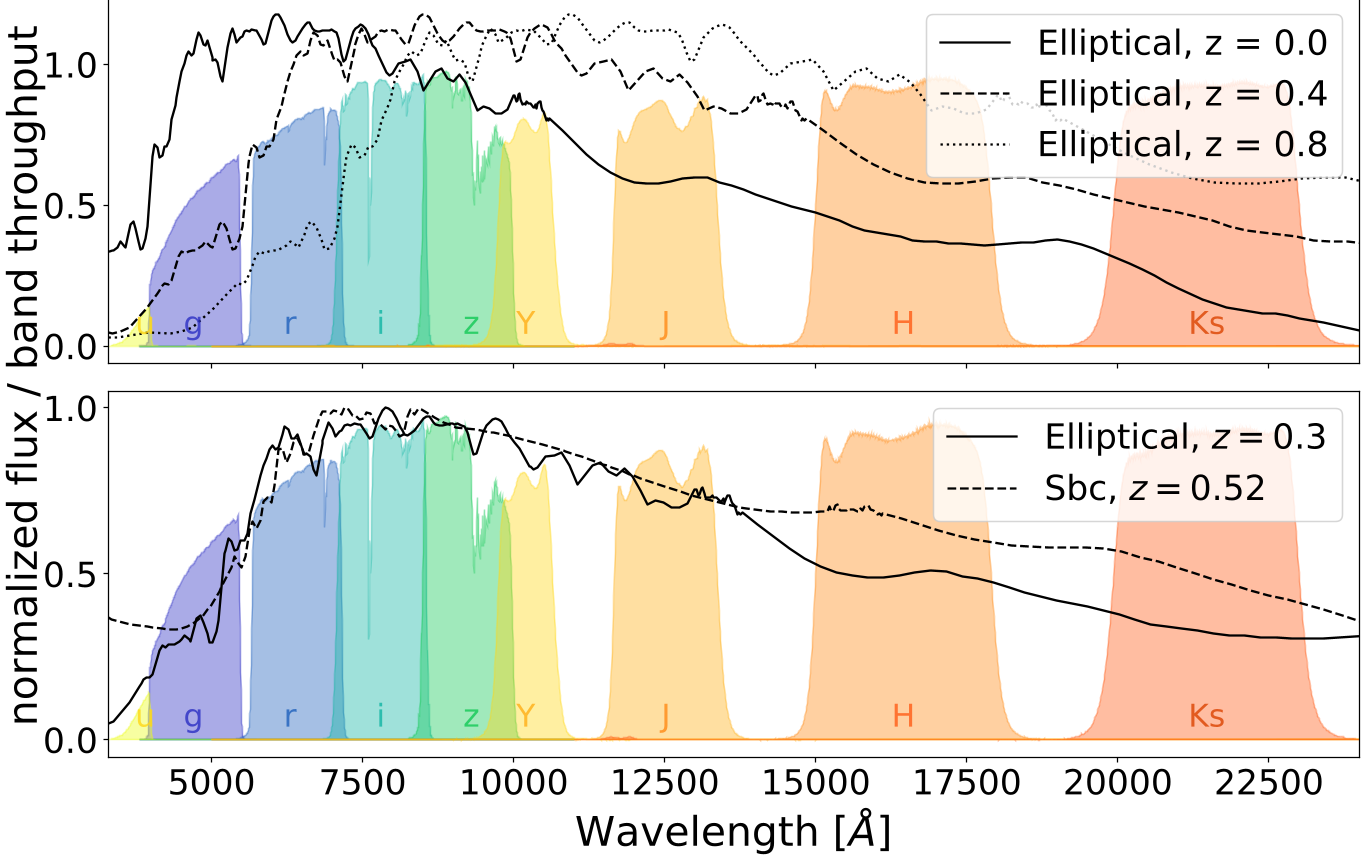 Figure 1: Illustration of why colors alone are ambiguous. A single color measurement can map to multiple redshifts depending on the galaxy's intrinsic spectral type.
The Generative Revolution: Modeling the "Why"
To hit the per-mille accuracy required for modern physics, we must move to Generative AI. Instead of asking "What is the redshift of this color?", we ask: "What kind of galaxy population and telescope setup would produce these observed pixels?"
The Bayesian Forward Model
The new gold standard is a hierarchical model:
In this framework:
- The Prior (): Uses AI (like Normalizing Flows) to represent the distribution of physical galaxy properties (stellar mass, dust, age).
- The Likelihood (): Uses Neural Emulators to replace expensive pixel-level simulations, modeling how the telescope's Point Spread Function (PSF) and noise distort the signal.
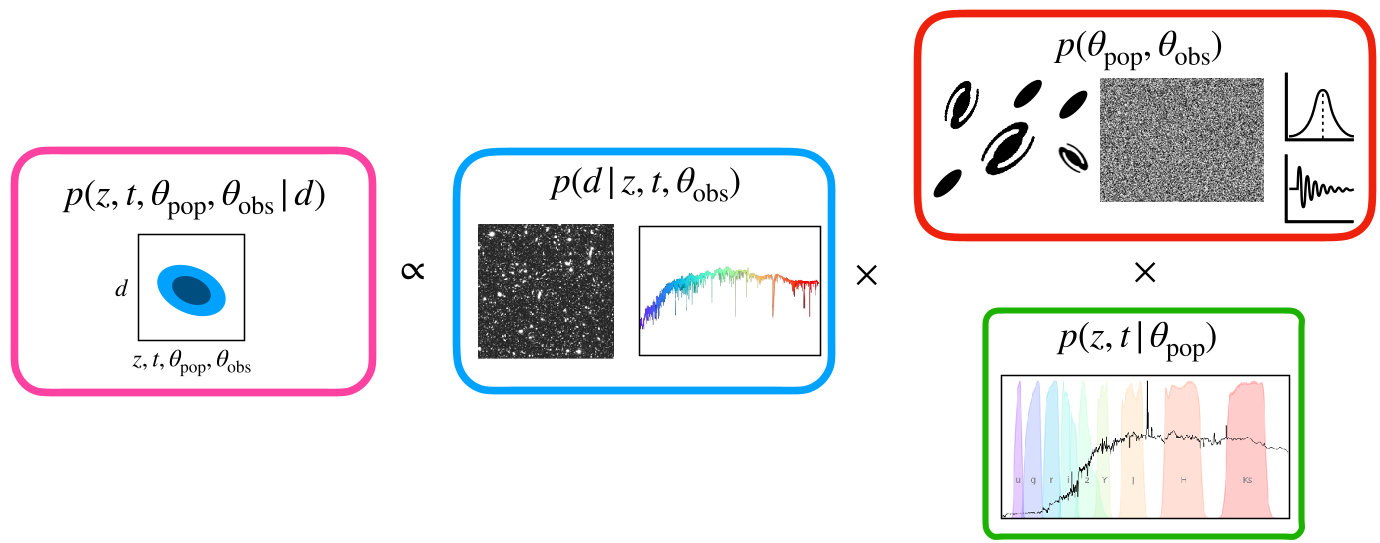 Figure 2: The generative workflow where physical parameters are mapped through emulators to create synthetic observations, which are then compared to real survey data.
High Stakes: Solving the S8 Tension
This isn't just academic. The so-called "S8 Tension"—a discrepancy between how "clumpy" the universe looks today vs. what the Early Universe (CMB) predicts—hinges on redshift accuracy.
Recent re-calibrations using advanced AI methods (like those used in the KiDS-Legacy survey) have shown that the tension might partially arise from systematic errors in old photo-z methods. By refining the redshift distribution (), the values shifted closer to the Planck CMB results, potentially "saving" our current cosmological model.
Conclusion: The Confluence of Physics and AI
The review concludes that we are entering an era of "Amortized Inference." We will use supercomputers to run expensive forward simulations once, use AI (VAEs, Diffusion Models) to "learn" the manifold of these simulations, and then deploy these emulators at scale to process billions of galaxies in real-time.
By treating AI as a physical modeling tool rather than a black-box regressor, astrophysicists are finally turning imaging surveys into high-precision cosmic maps.
Key Performance Targets:
- Target Accuracy: for LSST Year 10.
- Current Gap: Existing methods miss this by a factor of 10.
- The Solution: Generative Physical Models + Simulation-Based Inference.