
[ICML 2024] Manifold-Matching Autoencoders: Topology Preservation via Simple Distance Alignment
Manifold-Matching Autoencoders
The paper introduces Manifold-Matching Autoencoders (MMAE), an unsupervised regularization framework that aligns latent space pairwise distances with input or reference space distances using Mean Squared Error. By enforcing global distance preservation at the mini-batch level, MMAE achieves state-of-the-art topological and geometric preservation across synthetic and real-world benchmarks, outperforming complex persistent homology-based methods.
TL;DR
Manifold-Matching Autoencoder (MMAE) simplifies the complex task of "topological preservation" in latent spaces. Instead of expensive mathematical tools like persistent homology, it uses a simple Mean Squared Error (MSE) loss to align pairwise distances between the input and the latent space. The result? A highly scalable model that preserves global structure and nesting relationships better than topological methods, with the training speed of a vanilla Autoencoder.
The Problem: The "Geometry Gap" in Autoencoders
Dimensionality reduction is often a trade-off between local detail and global structure. Standard Autoencoders (AEs) are notorious for ignoring the underlying manifold geometry. For instance, if you have a dataset of "nested spheres" (spheres dentro de spheres), a standard AE often "unravels" them, placing the inner clusters outside the outer ones.
Prior works attempted to solve this using Topological Data Analysis (TDA). However, methods like TopoAE or RTD-AE require calculating persistent homology or minimum spanning trees at every training step. These operations are:
- Computationally Heavy: Complex to compute on CPUs/GPUs.
- Poorly Scalable: Training time explodes as batch sizes increase.
- Discontinuous: Small perturbations in data can lead to massive jumps in the topological loss, making training unstable.
The Insight: Distance Preservation Implies Topology
The core breakthrough of MMAE is grounded in the Stability Theorem. Mathematically, if you can bound the difference between distances in the input space () and the latent space (), you automatically bound the difference in their topological signatures (Persistence Diagrams).
Instead of explicitly forcing "loops" or "connected components" to stay the same, MMAE simply asks: "Can we make the distance between point A and B in the latent space the same as it was in the original space?"
Overall Architecture
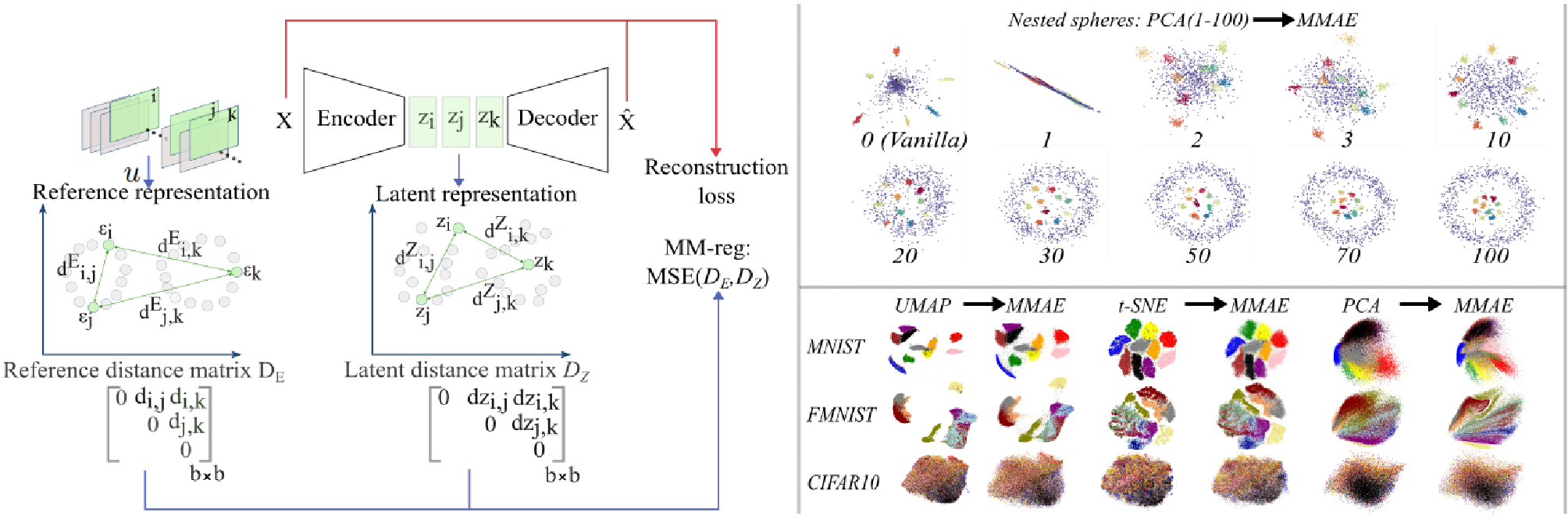 Figure 1: The MMAE framework replaces coordinates matching with distance matrix matching (MM-reg), allowing the model to learn from various reference spaces like PCA or even UMAP.
Methodology: Decoupling and Matching
MMAE introduces the Manifold-Matching Regularization (MM-reg): Where is the latent distance and is the reference distance.
Why is this powerful?
- Decoupled Dimensions: You can regularize a 2D latent space using distances from a 100D PCA projection. This helps "denoise" the distance signal, which is often messy in raw high-dimensional data.
- Arbitrary References: You can use the distances from UMAP or t-SNE as a target. This essentially allows an Autoencoder to "copy" the behavior of non-parametric methods, giving them the ability to handle new, unseen data (Out-of-sample extension).
Experiments: Recovering the "Impossible"
MMAE was tested on the Nested Spheres benchmark—a classic test where standard AEs, UMAP, and t-SNE typically fail.
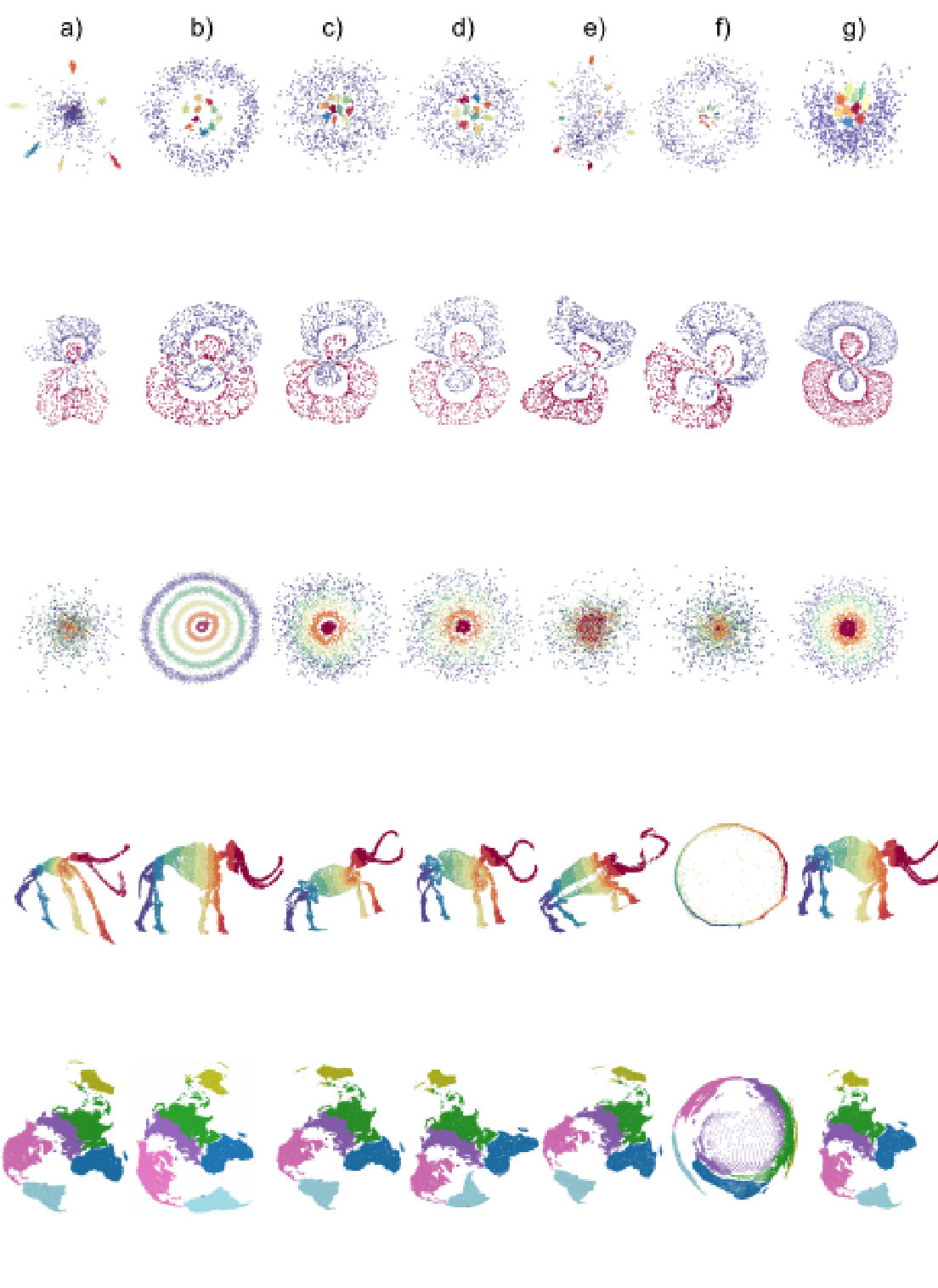 Figure 2: Visualization on synthetic shapes. Notice how MMAE (b) perfectly preserves the nested spheres and linked tori proportions compared to the "bowtie" distortions in TopoAE (c).
Key Results
- Distance Correlation (DC): In high-dimensional Concentric Spheres (1000D), MMAE achieved a DC of 0.61, matching the performance of the much slower RTD-AE.
- Efficiency: As shown in the training time analysis, MMAE scales linearly with batch size, while RTD-AE becomes prohibitive beyond 80 samples.
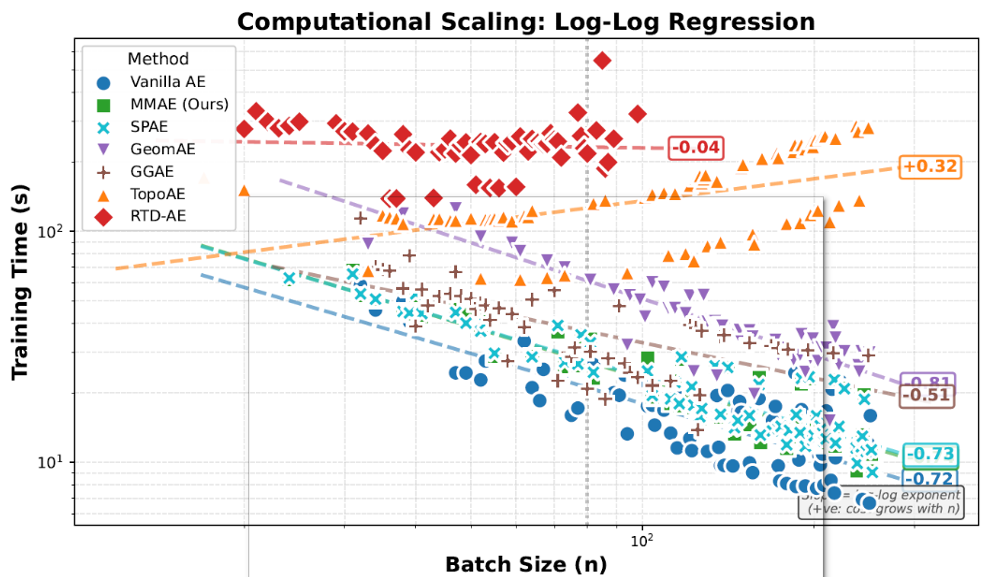 Figure 3: Training time vs. Batch size. MMAE (Ours) maintains the same efficiency as a Vanilla AE.
Critical Analysis & Conclusion
The beauty of MMAE lies in its simplicity. By returning to the roots of Multidimensional Scaling (MDS) but applying it via mini-batch SGD in an Autoencoder, the authors have created a "best of both worlds" solution. It provides the global geometric grounding of MDS with the non-linear flexibility of Deep Learning.
Limitations: Because it preserves global distances, MMAE doesn't necessarily "unfold" a manifold like Isomap or UMAP might. It focuses on proportion rather than stretching or flattening.
Future Outlook: This approach is particularly promising for Generative Models. If we can ensure the latent space of a VAE or Diffusion model is topologically "correct," we can expect much higher quality interpolation and fewer "dead zones" in the generated data. For practitioners in biology (single-cell analysis) or anomaly detection, MMAE offers a "plug-and-play" loss term to ensure your latent clusters actually mean something.