
MARCO: Mining Semantic Correspondence in the "Unseen Space"
MARCO: Navigating the Unseen Space of Semantic Correspondence
MARCO is a unified model for semantic correspondence that achieves state-of-the-art accuracy by building on a single DINOv2 backbone. It introduces a training framework that enhances fine-grained localization and semantic generalization, significantly outperforming diffusion-based models while being 3x smaller and 10x faster.
Executive Summary
In the world of computer vision, establishing Semantic Correspondence—the ability to match similar parts across different images (like the wing of a plane to the wing of another)—is a fundamental challenge. Historically, the best models were massive "dual-encoder" ensembles combining DINOv2 and Stable Diffusion, often reaching 1 billion parameters.
MARCO breaks this trend. By using a single DINOv2 backbone with clever training strategies, it achieves higher precision and better generalization than its heavyweight predecessors. It is 3x smaller and 10x faster, effectively proving that "more parameters" isn't always the answer to "more accuracy."
The Problem: Sparse Supervision and Geometric Collapse
Semantic correspondence datasets are notoriously difficult to annotate. Most images only have about 20 labeled keypoints (e.g., "left eye," "front wheel").
Typical models suffer from two main issues:
- Geometric Collapse: When fine-tuned on sparse points, the model "forgets" how to match the rest of the object. Features collapse around the few labeled points, leaving the "unseen space" between them incoherent.
- Precision vs. Speed: Prior SOTA methods (like Geo-SC) rely on Stable Diffusion for local detail, which makes inference painfully slow (less than 1 frame per second).
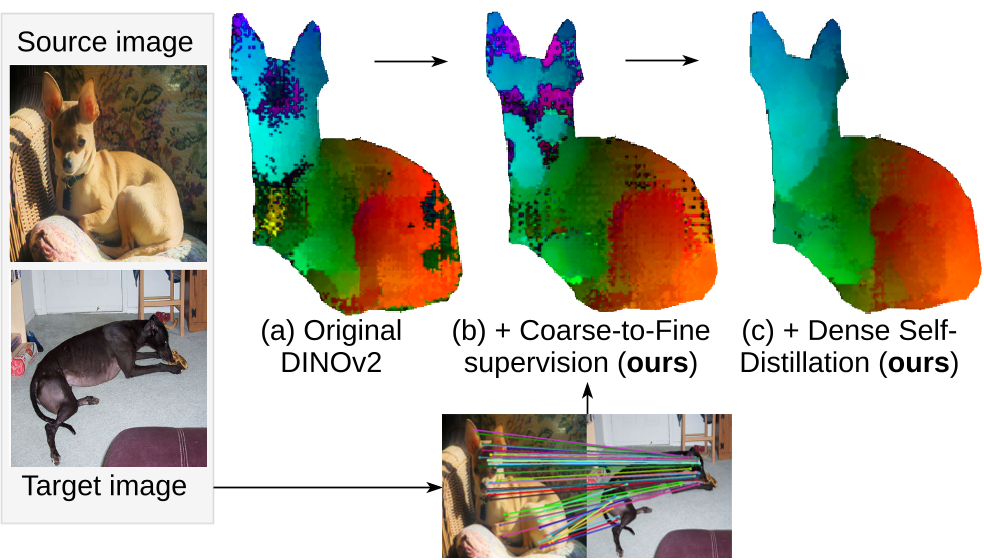 Figure 1: Notice how standard fine-tuning (b) destroys the global coherence of the flow compared to MARCO (c).
The MARCO Solution: Precision and Propagation
The researchers introduced three core innovations to bridge the gap between sparse labels and dense understanding.
1. The Minimalist Architecture
Rather than adding a second backbone, MARCO uses AdaptFormer modules (bottleneck adapters) and a ×4 upsampling head. This allows the model to refine the "coarse" 14x14 patches of DINOv2 into pixel-perfect localizations with less than 5% parameter overhead.
2. Coarse-to-Fine "Annealing"
Instead of a standard regression loss, MARCO uses a Gaussian RBF target. During training, the "spread" () of this Gaussian narrows.
- Early phase: Wide helps the model learn broad semantic regions.
- Late phase: Narrow forces the model to pinpoint exact sub-patch locations (e.g., resolving the pupil of an eye rather than just the eye region).
3. Dense Self-Distillation via Flow Anchoring
This is the "secret sauce." To prevent the model from ignoring unannotated regions, MARCO:
- Mines Mutual Nearest Neighbors (MNN) from the teacher network's features.
- Uses Delaunay Triangulation to warp these points into a dense flow field.
- Anchors these matches using Ground Truth (GT) points to filter out noise caused by symmetries (like confusing a plane's left wing for its right wing).
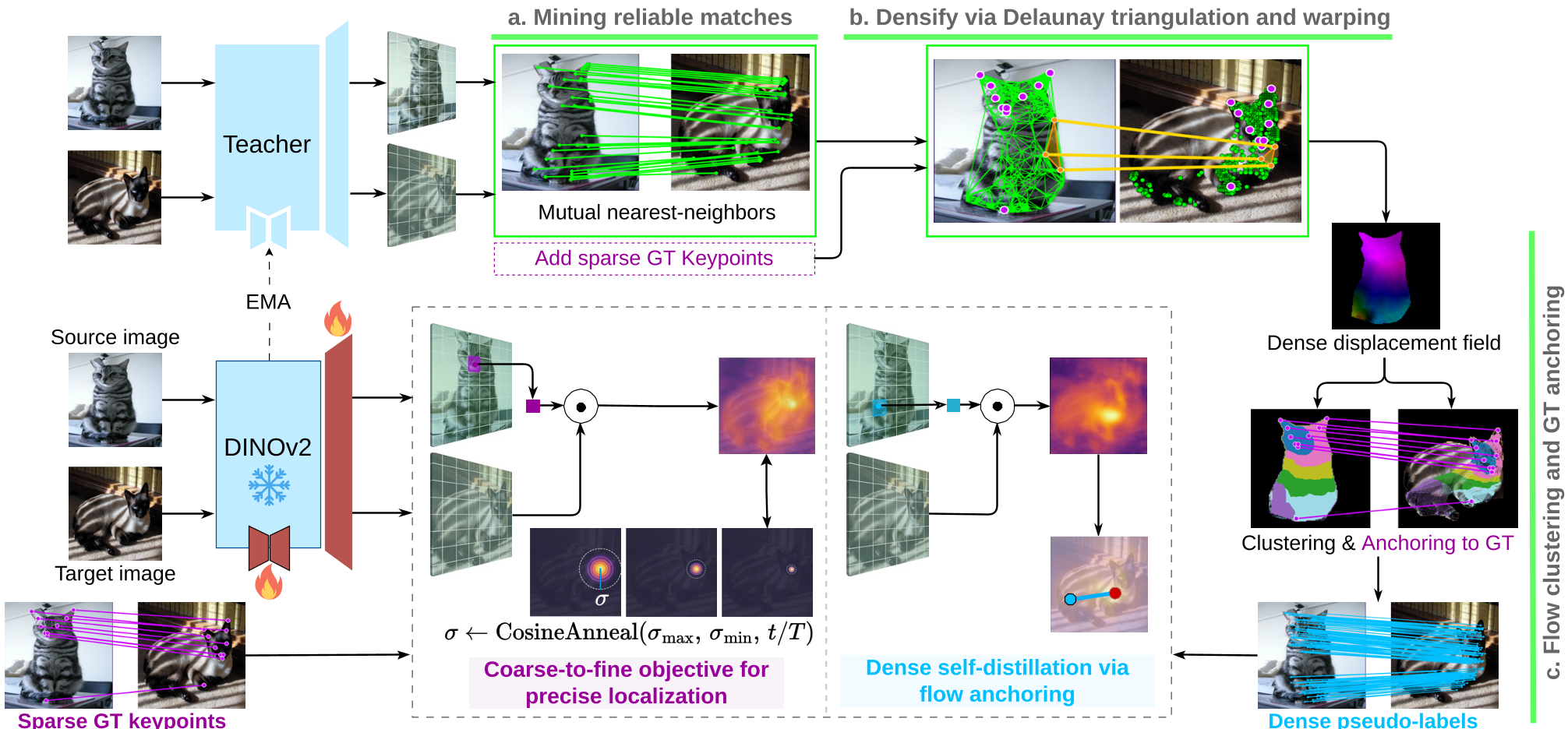 Figure 2: The MARCO pipeline, showing how point-level matches are expanded into dense self-supervision.
Performance: Small, Fast, and Generalizable
The results are definitive. MARCO doesn't just beat previous benchmarks; it defines a new frontier for Fine-Grained Localization.
- Precision: At the strictest threshold (PCK@0.01), it outperforms Geo-SC by +8.9 on AP-10K.
- Generalization: On the newly proposed MP-100 benchmark—which tests categories the model has never seen—MARCO outperforms dual-encoder models by significant margins (+10.2 on apparel items).
- Efficiency: Achieving 8.3 FPS vs. the 0.85 FPS of previous SOTAs, MARCO is finally fast enough for practical applications like image editing and pose estimation.
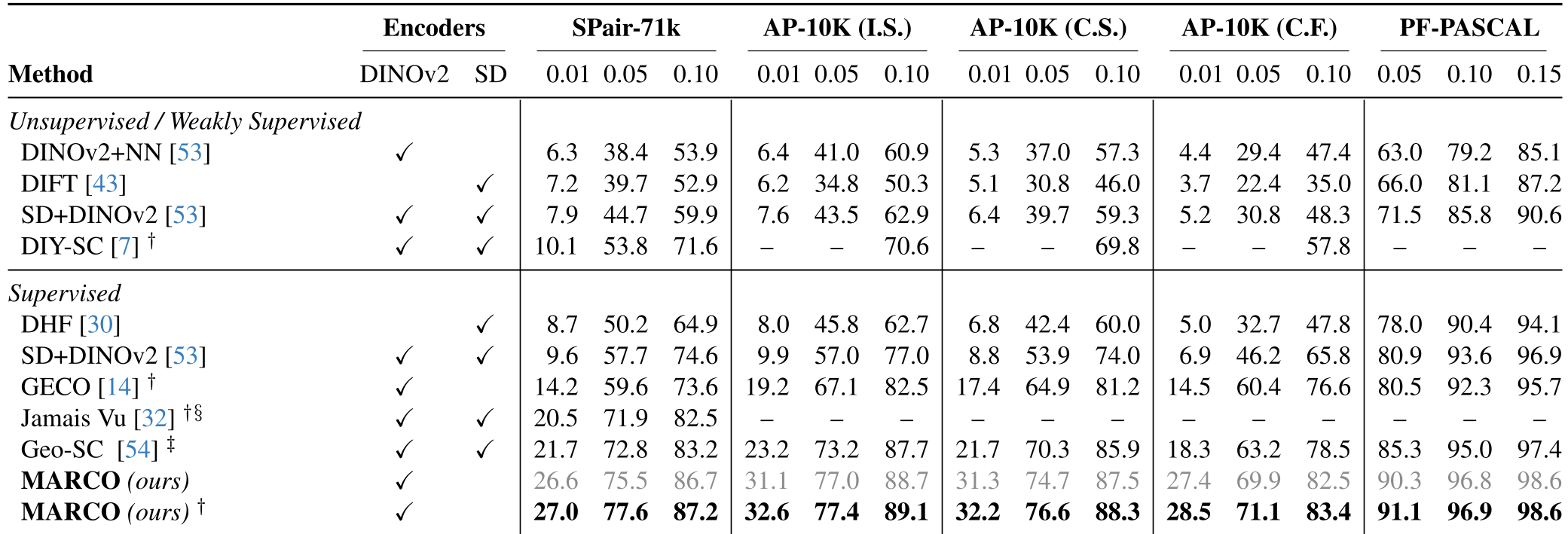 Figure 3: Benchmark comparisons showing MARCO's dominance across the board.
Conclusion and Future Outlook
MARCO proves that the "rich semantic space" of foundation models like DINOv2 is currently underutilized. By using dense self-distillation to navigate the "unseen space," we can achieve generalization that previously required massive ensembles.
The Takeaway: For researchers and engineers, MARCO signals a shift away from "ensemble-heavy" architectures toward "training-smart" single-backbone models. Future work will likely look at removing the need for sparse human-labeled keypoints entirely by leveraging web-scale video data.
Disclaimer: Analysis based on Cuttano et al., "MARCO: Navigating the Unseen Space of Semantic Correspondence."