
MASS-RAG: Mastering Noise and Ambiguity through Multi-Agent Synthesis
MASS-RAG: Multi-Agent Synthesis Retrieval-Augmented Generation
MASS-RAG is a training-free multi-agent framework for Retrieval-Augmented Generation that structures evidence processing through specialized roles. It utilizes distinct agents for summarization, extraction, and reasoning, achieving SOTA performance on benchmarks like TriviaQA, PopQA, and ARC-Challenge.
TL;DR
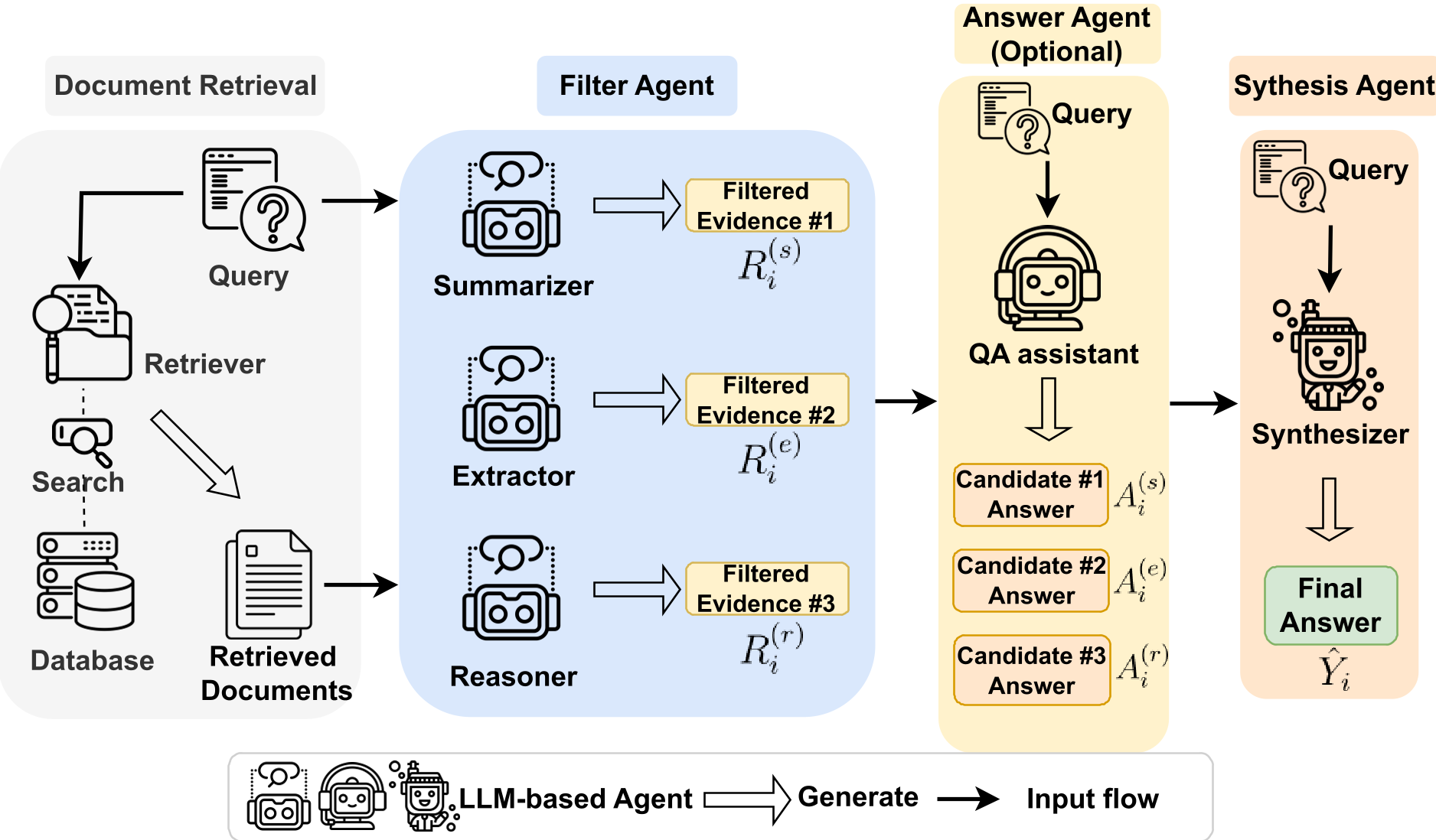
Standard Retrieval-Augmented Generation (RAG) often fails when the "gold" information is buried under noise or requires cross-document reasoning. MASS-RAG solves this by deploying a "team" of specialized LLM agents—a Summarizer, an Extractor, and a Reasoner—to filter evidence from different perspectives. By synthesizing these diverse viewpoints, it achieves significant accuracy boosts (up to 20.7%) without needing any additional fine-tuning.
The "Lost in the Middle" Problem: Why Single-Agent RAG Fails
Most RAG systems operate on a simple "Retrieve then Generate" pipeline. However, retrieval models are imperfect. They often return documents that are redundant, partially relevant, or even contradictory. When a single LLM tries to process this "wall of text," it suffers from cognitive overload—a phenomenon often called "Lost in the Middle."
The authors of MASS-RAG identified that a single monolithic judge cannot capture the nuance of heterogeneous evidence. Some questions require verbatim facts, others require semantic summaries, and some need logical inference across multiple snippets.
Methodology: The "Divide and Conquer" of Evidence
MASS-RAG structures the RAG process into three distinct stages: Evidence Distillation, Candidate Generation, and Final Synthesis.
1. Specialized Filter Agents
Instead of one prompt to "answer the question," three specialized agents look at the data:
- The Summarizer: Compresses documents into query-relevant summaries (Abstractive).
- The Extractor: Grabs exact spans and supporting sentences without changing a word (Extractive).
- The Reasoner: Identifies implicit connections and inference steps between documents (Logical).
2. The Synthesis Mechanism
After filtering, an optional Answer Agent proposes a local solution for each view. Finally, the Synthesis Agent acts as the "Editor-in-Chief," comparing the different views, resolving conflicts (e.g., if the Summarizer found X and the Extractor found Y), and producing a unified, factually grounded answer.
Performance: Dominating the Benchmarks
The experimental results prove that specialization pays off. On the ARC-Challenge (a difficult reasoning benchmark), MASS-RAG showed an absolute accuracy improvement of 20.7% over the standard Llama-2-7B RAG baseline.
Key Experimental Insights:
- Complementarity: The researchers found that many questions could only be answered by one specific agent (e.g., Case Study 6 showed the Reasoner found evidence the others missed). This proves that the multi-agent approach captures information a single pass would likely ignore.
- Robustness: MASS-RAG maintains high performance even as the number of retrieved documents increases, whereas traditional RAG often degrades as the noise-to-signal ratio rises.

Critical Analysis & Conclusion
MASS-RAG is a "plug-and-play" upgrade for any RAG system. Its greatest strength is its training-free nature; you don't need to spend thousands on GPU hours for fine-tuning. You simply change the orchestration logic.
Limitations: The primary trade-off is latency and cost. Since MASS-RAG requires multiple LLM calls (effectively 4x to 8x the computation of a single call), it may not be suitable for real-time applications with tight budgets. However, for high-stakes tasks where accuracy is paramount (medical, legal, or technical support), this is a price worth paying.
Future Outlook: We expect to see "distilled" versions of MASS-RAG where a single model is trained to mimic this multi-agent logic in one pass, potentially solving the latency bottleneck while preserving the reasoning quality.