
[CVPR 2025] Matrix-Game 3.0: Breaking the Limits of Real-Time Interactive World Models
Matrix-Game 3.0: Real-Time and Streaming Interactive World Model with Long-Horizon Memory
Matrix-Game 3.0 is a memory-augmented interactive world model designed for 720p real-time video generation. It achieves up to 40 FPS by combining an error-aware Diffusion Transformer (DiT) with camera-aware memory retrieval and multi-segment distillation (DMD), setting a new SOTA for long-horizon stability in open-source world models.
TL;DR
Matrix-Game 3.0 is a powerhouse interactive world model that finally bridges the gap between high-speed responsiveness (40 FPS at 720p) and long-term memory. By integrating a systematic industrial data engine with a self-correcting Diffusion Transformer (DiT), it allows users to navigate complex 3D environments—both synthetic and real—with unprecedented stability over minute-long sessions.
The Problem: The "Drift" in Digital Worlds
Building a world model isn't just about generating a pretty video; it's about maintaining a "persistent state." Most current diffusion models operate like short-term memory goldfish. If you turn around in a generated room and then turn back, the furniture has often shifted, or the lighting has changed. This happens because of exposure bias: the model is trained on perfect ground-truth data but must generate based on its own "imperfect" previous frames during inference. Small errors compound, leading to catastrophic visual drift.
Methodology: The Three Pillars of Persistence
1. Error-Aware Training (Self-Correction)
Instead of hiding mistakes, the authors embrace them. During training, they maintain an Error Buffer. They inject residuals (the difference between predicted and ground-truth frames) back into the historical context. This teaches the DiT backbone to recognize "noisy" history and counteract it, making the model inherently robust to its own generation artifacts.
2. Camera-Aware Long-Horizon Memory
Matrix-Game 3.0 doesn't just look at the last few frames. It uses a retrieval mechanism to find historical frames that share the most "visual overlap" with the current camera frustum.
- Unified Attention: Unlike models that use a separate "memory branch," Matrix-Game 3.0 feeds retrieved memory and local history into the same attention space.
- Relative Plücker Encoding: It encodes the geometric relationship between the current view and the memory view, helping the model "anchor" objects in 3D space.
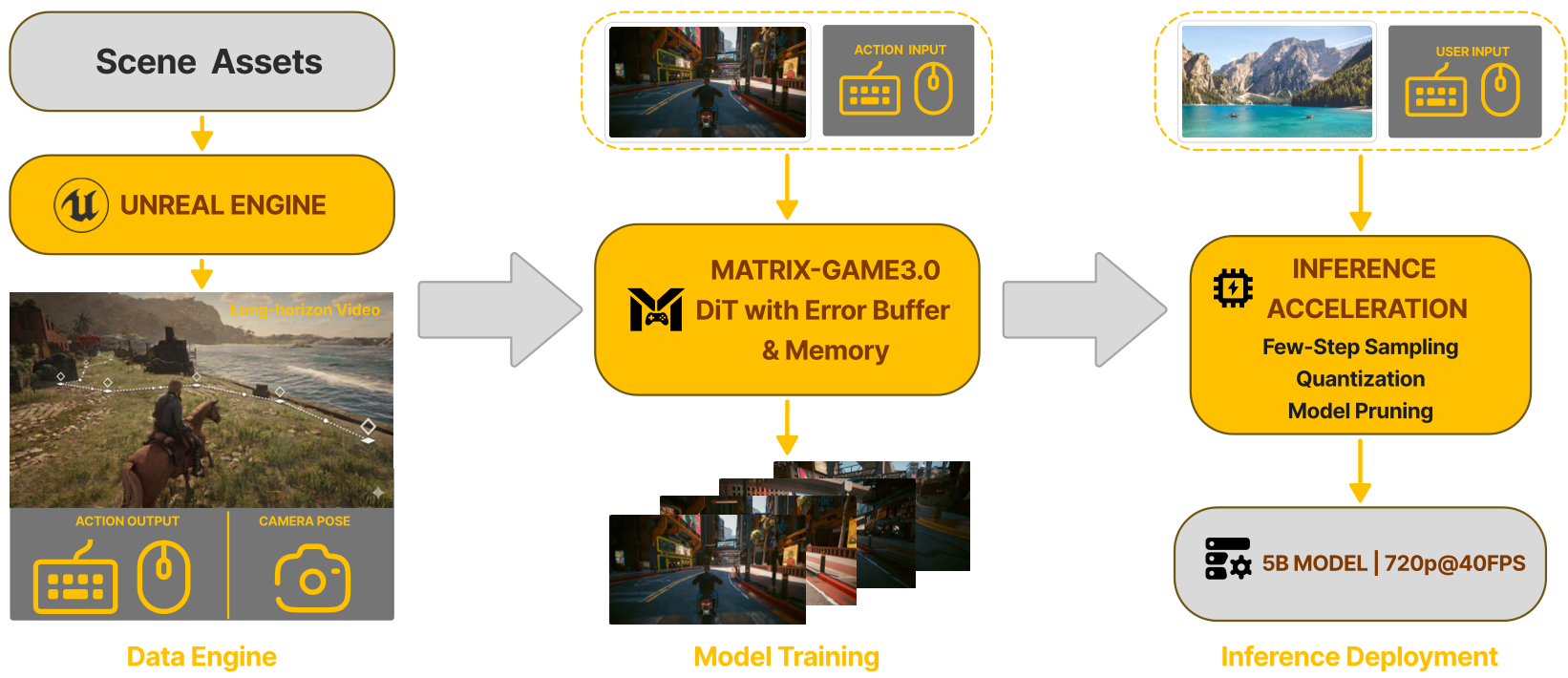 Figure: The unified framework combining Unreal-Gen data, memory-augmented DiT, and real-time deployment.
3. Systematic Real-Time Acceleration
To hit 40 FPS, the team didn't just optimize code; they redesigned the inference stack:
- Distillation: Using a multi-segment DMD strategy to reduce the sampling steps required from the teacher model.
- VAE Pruning: They found that VAE decoding was a massive bottleneck at 720p. By pruning the decoder by 50-75%, they achieved up to a 5.2x speedup with minimal quality loss.
- GPU Retrieval: Moving memory selection to the GPU reduced latency by over 30 FPS compared to CPU-based retrieval.
Experiments: Revisiting the Past
The most impressive validation of Matrix-Game 3.0 is the Scene Revisitation test. In these experiments, the agent moves forward and then reverses its exact path.
- Short-term models fail this as they "forget" the starting point.
- Matrix-Game 3.0 faithfully recovers fine-grained details—like specific textures on a building facade—even after a long sequence of movements.
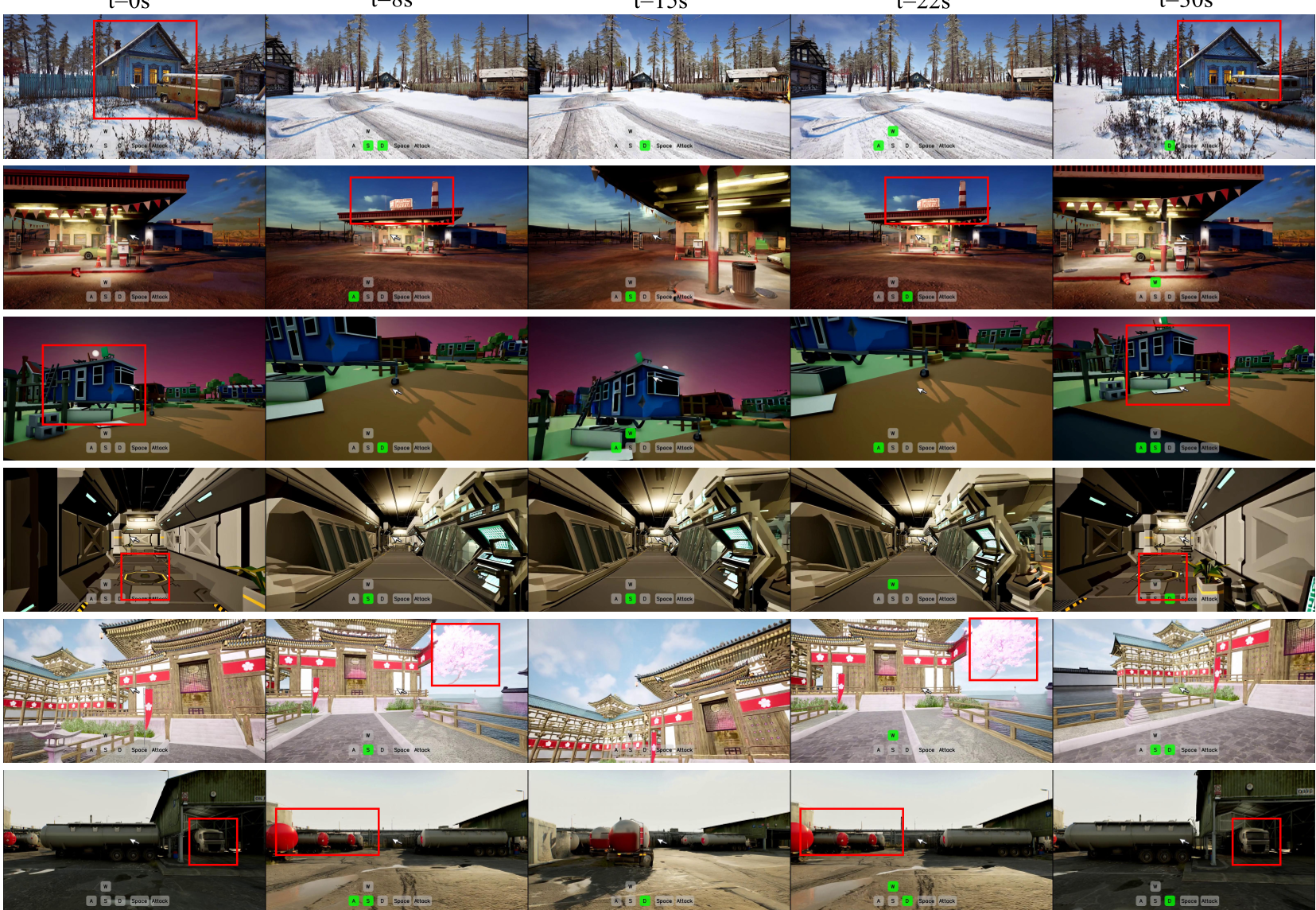 Figure: The model successfully revisits and reconstructs scene details after a long-horizon loop.
Scalability and Generalization
By scaling the backbone to a 28B MoE (Mixture of Experts) model, the framework demonstrates an incredible ability to generalize to AAA game titles (GTA V, Cyberpunk 2077) and real-world datasets. The separation of "high-noise" modules (responsible for action control) and "low-noise" modules (responsible for visual refinement) allows it to leverage massive amounts of unlabeled internet video to boost realism.
Critical Insight & Conclusion
Matrix-Game 3.0 demonstrates that the future of world models lies in System-Model Co-design. You cannot solve the interactive world problem with a better loss function alone; you need an infinite data engine (Unreal-Gen), a robust memory retrieval system, and a hardware-aware inference pipeline.
Takeaway: This work moves us closer to "The Matrix"—a truly explorable, photorealistic digital twin of reality that responds to actions in real-time without losing its structural integrity.
Disclaimer: This analysis is based on the technical report for Matrix-Game 3.0.