
[Quantum Topology] Breaking the Index: The Structure and Phase Classification of Matrix Product Quantum Channels
Structure and Classification of Matrix Product Quantum Channels
The paper develops a rigorous framework for Matrix Product Quantum Channels (MPQCs), specifically focusing on locally purifiable (LP) channels in one dimension. It proves that homogeneous LP channels always admit a depth-2 brickwork circuit representation and established that all such channels belong to a single topological phase.
TL;DR
In a significant leap for tensor network theory, researchers from the Max Planck Institute have decoded the structural DNA of 1D quantum channels. By shifting focus from unitaries to Matrix Product Quantum Channels (MPQCs), they discovered that while unitaries are locked into different "phases" by a mathematical index, all locally purified channels are essentially the same—they can all be smoothly morphed into one another. Furthermore, they've shown that even channels that create complex, long-range entanglement can be "tricked" into constant-depth execution using local measurements and feedforward.
Problem: The Rigid World of Unitaries
In the study of 1D quantum systems, Matrix Product Unitaries (MPUs) are the gold standard. We've known for years that MPUs are equivalent to Quantum Cellular Automata (QCA). These are governed by a "GNVW index"—a rational number that measures the net flow of info. If two QCAs have different indices (like a "shift" vs. "identity"), you can't deform one into the other.
But the real world is "open." Quantum systems leak information into an environment. This research asks: Do the same rigid rules of topology apply when we view these processes as quantum channels rather than closed unitaries?
Methodology: The Power of Local Purification
The authors define a subclass called Locally Purifiable (LP) channels. The core insight is to treat the channel not as a black box, but as a Matrix Product Isometry (MPI). By adding a "purification space" (ancilla legs in the tensor network), they can "dilute" the complexity of the channel.
The Structural Breakthrough
The first major result is Theorem 1: Any homogeneous MPI can be blocked and rewritten as a depth-two brickwork circuit of isometric gates. This physically proves that these channels only generate short-range correlations.
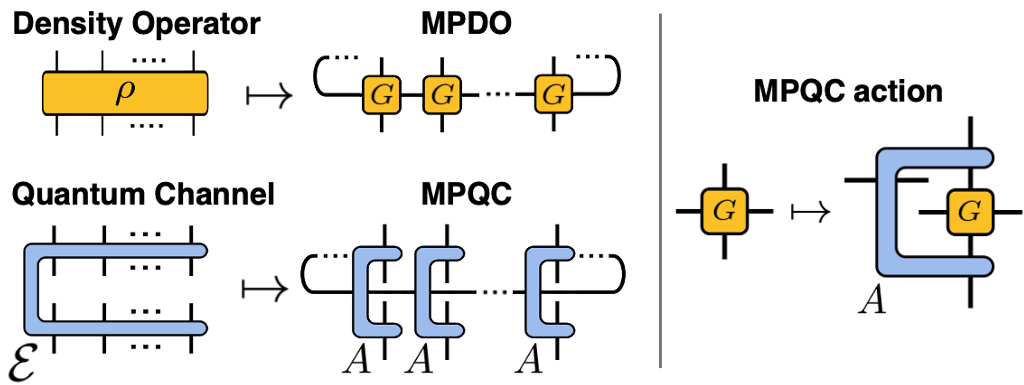 Figure 1: The MPQC acts on Matrix Product Density Operators (MPDOs), preserving their compact form.
Classification: Why Channels are "Trivial"
The most striking finding is Theorem 2: All homogeneous LP channels are equivalent. In the unitary world, a "Shift" and "Identity" are different phases. But in the channel world, if you have enough "junk space" (purification legs), you can rotate a Shift into an Identity continuously. The environment acts as a universal buffer that "trivializes" the GNVW index.
From Short-Range to Long-Range: sMPIs
The authors didn't stop at short-range correlations. They identified scaled MPIs (sMPIs)—tensors that need a normalization constant. These can generate long-range entanglement (like GHZ states).
Ordinarily, creating -qubit entanglement requires depth. However, Theorem 3 provides a "cheat code":
- Prepare a GHZ state on ancillas (constant depth via measurements).
- Control the local isometries using these ancillas.
- Measure the ancillas and apply a single-site correction.
This allows for deterministic preparation of long-range entangled channels in constant time.
 Figure 2: The protocol for implementing sMPIs using feedforward and measurement.
Critical Insight & Outlook
This paper effectively maps the boundary between Locality Preserving and Causality Preserving maps.
- Short-range channels (hLP) are easy to classify (only one phase).
- Long-range channels (sLP) are more complex but physically accessible via Dynamic Circuits (Measurement + Feedforward).
Limitations
The study focuses on 1D. A major open question remains: Does this index-free classification hold in 2D or 3D? In higher dimensions, topological order becomes much more "stubborn," and the environment might not be able to wash away the topological signatures as easily as it does in 1D.
Future Impact
For quantum engineers, this is a "How-to" guide for noise simulation. If you want to model correlated noise on a chip, you no longer need deep circuits; you can use the MPQC framework to represent that noise as a compact, constant-depth operation.