
[arXiv 2026] Matryoshka Gaussian Splatting: Continuous LoD without Quality Sacrifice
Matryoshka Gaussian Splatting
Matryoshka Gaussian Splatting (MGS) is a novel training framework that enables continuous Level-of-Detail (LoD) for 3D Gaussian Splatting. It allows a single model to be rendered at any splat budget by simply taking a prefix of an ordered Gaussian set, achieving SOTA quality-speed trade-offs across MipNeRF 360, Tanks & Temples, and other major benchmarks.
Executive Summary
TL;DR: Matryoshka Gaussian Splatting (MGS) solves the fundamental tension between high-fidelity neural rendering and varying computational budgets (mobile vs. desktop). By training Gaussians as a nested set—similar to Russian Matryoshka dolls—MGS enables a single model to be "truncated" at any point to meet real-time FPS targets without the "pop-in" artifacts of discrete LoD or the quality loss of pruning.
Background: Within the 3DGS ecosystem, MGS shifts the paradigm from "post-processing pruning" to "inherently ordered representation." It positions itself as a backbone-agnostic training framework that provides a continuous speed-quality trade-off frontier.
Motivation: The Cost of Scalability
Current 3D Gaussian Splatting (3DGS) models are "all-or-nothing." If you have 5 million Gaussians, you must render 5 million to get a coherent image. Removing primitives post-hoc usually leads to "black holes" or structural collapse because the model hasn't learned to prioritize specific splats.
Existing LoD methods usually rely on:
- Discrete Levels: Pre-baking 3-5 versions of a scene (wastes memory, causes visual jumps).
- Hierarchical Structures: Using Octrees (adds complexity to the rendering pipeline).
- Concurrent Continuous LoD: Often trades off the "peak" quality for the sake of the "low-end" speed.
MGS asks: Can we have our cake and eat it too? Can we reach SOTA peak quality while allowing the model to degrade gracefully to 5% of its size?
Methodology: The Core of MGS
1. The Ordered Representation
MGS ranks every Gaussian by an importance score. While several metrics were tested (Volume, SH energy), descending opacity () proved most effective. High-opacity Gaussians typically capture the "skeleton" of the scene, while low-opacity ones handle fine-grained residuals.
2. Stochastic Budget Training
The "secret sauce" is the training objective. In every iteration, the model performs two forward passes:
- Full Pass: Renders all splats to anchor the high-end quality.
- Random Prefix Pass: Renders a subset where is sampled randomly.
The loss function balances these two:
This forces the first splats to be "self-sufficient," capable of representing the scene even without the help of the remaining splats.
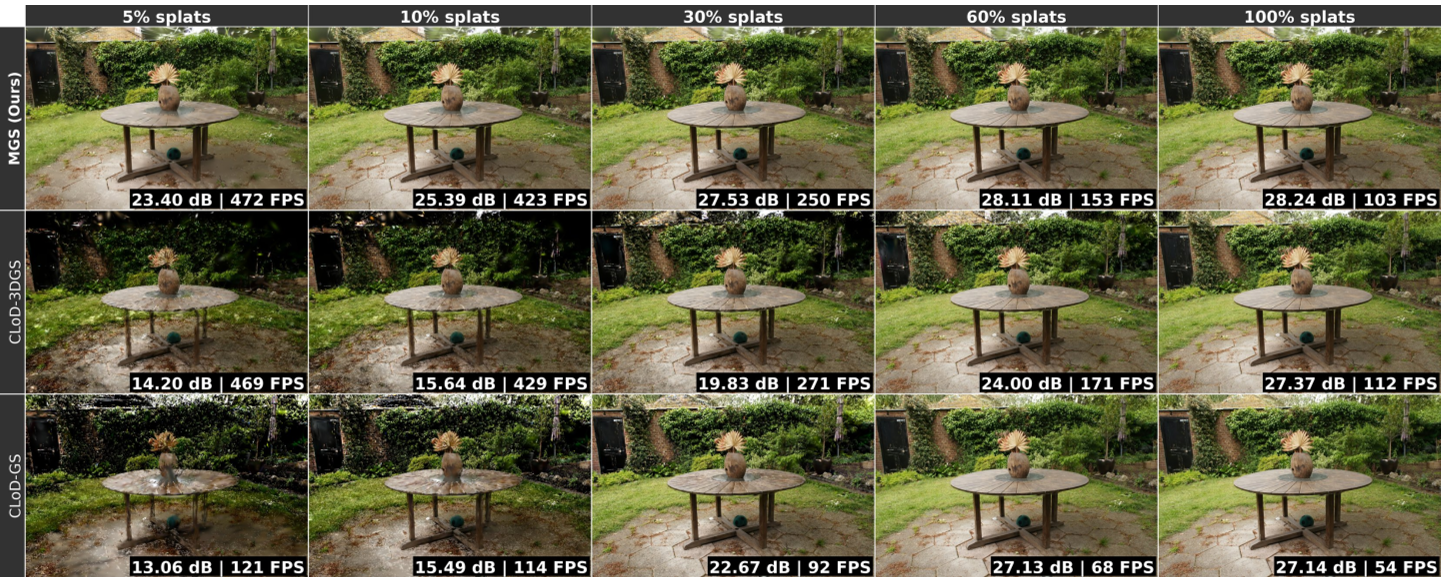 Figure 1: MGS enables a continuous spectrum of quality-speed operating points from a single model.
Experiments: SOTA Performance
MGS was tested on major benchmarks like MipNeRF 360 and Tanks & Temples. The results show that even at 10% of the splat budget, MGS remains visually coherent.
Key Results:
- Peak Quality: Matches or exceeds the 3DGS-MCMC baseline (e.g., reaching 28.20 dB PSNR on MipNeRF 360).
- Graceful Degradation: At 5% budget, MGS maintains ~21dB PSNR, while other continuous LoD methods collapse to ~11dB.
- AUC Metrics: MGS dominates in Area Under the Curve for both FPS and splat count, meaning it offers a better trade-off at every possible speed.
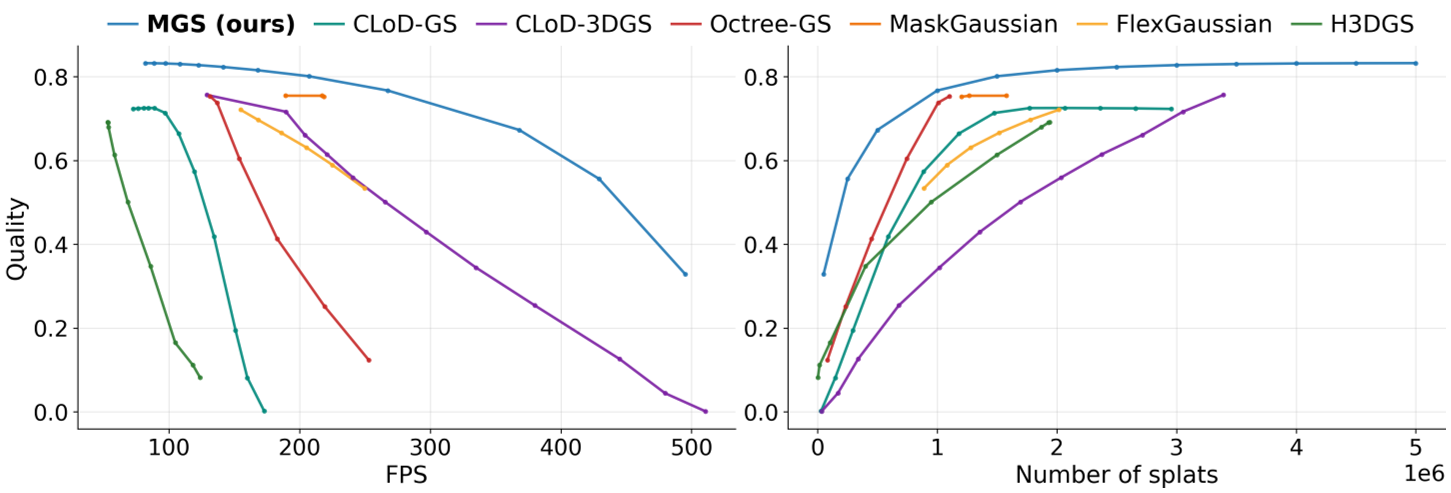 Figure 2: MGS (red line) consistently stays above baselines, showing superior quality at all splat counts and frame rates.
Critical Insight: Why Does Opacity Sorting Work?
The authors' ablation study reveals that sorting by opacity is superior to random or SH-energy sorting. This provides a deep insight into 3DGS: opacity is essentially the "visibility weight." By forcing the model to put high-opacity splats at the front of the "Matryoshka" sequence, the training naturally encourages these splats to cover the most critical geometric structures.
Conclusion & Future Work
MGS is a highly practical advancement. Its simplicity—requiring no architectural changes and only one extra forward pass during training—makes it an easy choice for production-grade 3D engines.
Limitations: While the budget is continuous, the current implementation uses a global prefix. Future iterations might benefit from view-dependent prefixes, where different values are chosen for background vs. foreground primitives to further optimize the rendering bitstream.
For more details, visit the project page: https://ZhilinGuo.github.io/MGS