
Mind the Distributional Gap: Why Your LLM User Simulator is Not a "Real" User
Measuring and Mitigating the Distributional Gap Between Real and Simulated User Behaviors
This paper introduces a systematic framework to measure the distributional gap between real and simulated user behaviors in AI interactions. By evaluating 24 LLM-based simulators on coding and writing tasks, the authors reveal significant divergences from real-world behavior and propose a combination strategy to mitigate these gaps.
TL;DR
While LLMs are increasingly used to simulate users for testing AI assistants, they often fail to represent the messiness and diversity of real humans. This paper provides a rigorous mathematical framework to measure this "Distributional Gap," benchmarks 24 top-tier models, and finds that most simulators are overly polite and verbose compared to real users. The solution? Combining complementary models to "patch" each other's behavioral blind spots.
The "Sim-to-Real" Crisis in Behavioral Modeling
In the race to build better AI assistants, we rely on User Simulators to provide scalable training and evaluation. However, most simulators are trained to be believable (generating human-like text) rather than representative (capturing the full spectrum of human behavior).
If a simulator only acts like a "perfect, polite student," the AI assistant trained against it will collapse when it meets a real-world user who is terse, authoritative, or under-specified. This paper identifies two ways simulators fail:
- Low Recall (Missing Behaviors): The simulator fails to demonstrate behaviors real users exhibit (e.g., being transactional).
- Low Precision (Hallucinating Behaviors): The simulator does things real humans rarely do (e.g., excessive "Hey! Thanks so much!" in every turn).
Methodology: From Text to Behavioral Distribution
The authors move beyond surface-level lexical similarity (which is often misleading due to high semantic overlap) and focus on Behavioral Facets.
The 3-Stage Pipeline
- Representation: Prompting an LLM (Qwen-3.5) to describe the user's behavior across six facets, including Communication Style, Context provision, and Dialog Acts.
- Quantization: These descriptions are embedded and clustered using k-means (). Each cluster represents a "Mode" of behavior.
- Divergence: By comparing the probability of a simulator falling into these clusters vs. real users (from the WildChat dataset), the authors calculate KL-Divergence and JS-Divergence.
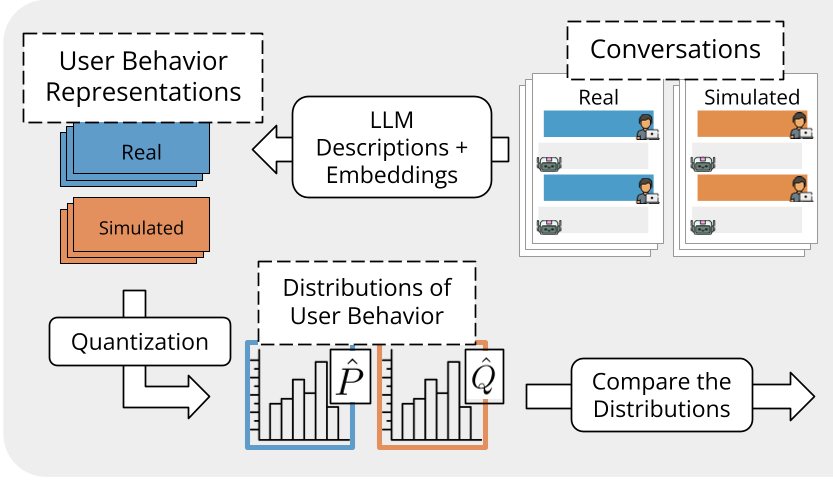 Figure 1: The method quantizes behavior into distributions. Notice how Gemini 3.1 Pro (blue) covers the real user distribution (grey) more effectively than Llama-3.1 (red).
Key Results: Scale is Not Enough
The study evaluated 24 models including GPT-5.4, Gemini 3.1, and Llama-3.3.
- The Scale Paradox: In the Llama family, the 8B model actually outperformed the 70B model in behavioral recall. This suggests that the "simulated persona" is more a product of fine-tuning and data alignment than raw parameter count.
- The Facet Gap: Simulators are good at making requests but terrible at mimicking human Communication Style.
- Hallucination of Positivity: A TF-IDF analysis of clusters (Figure 4) showed that simulators frequently "hallucinate" over-enthusiastic and appreciative behaviors that real users rarely use in professional coding/writing tasks.
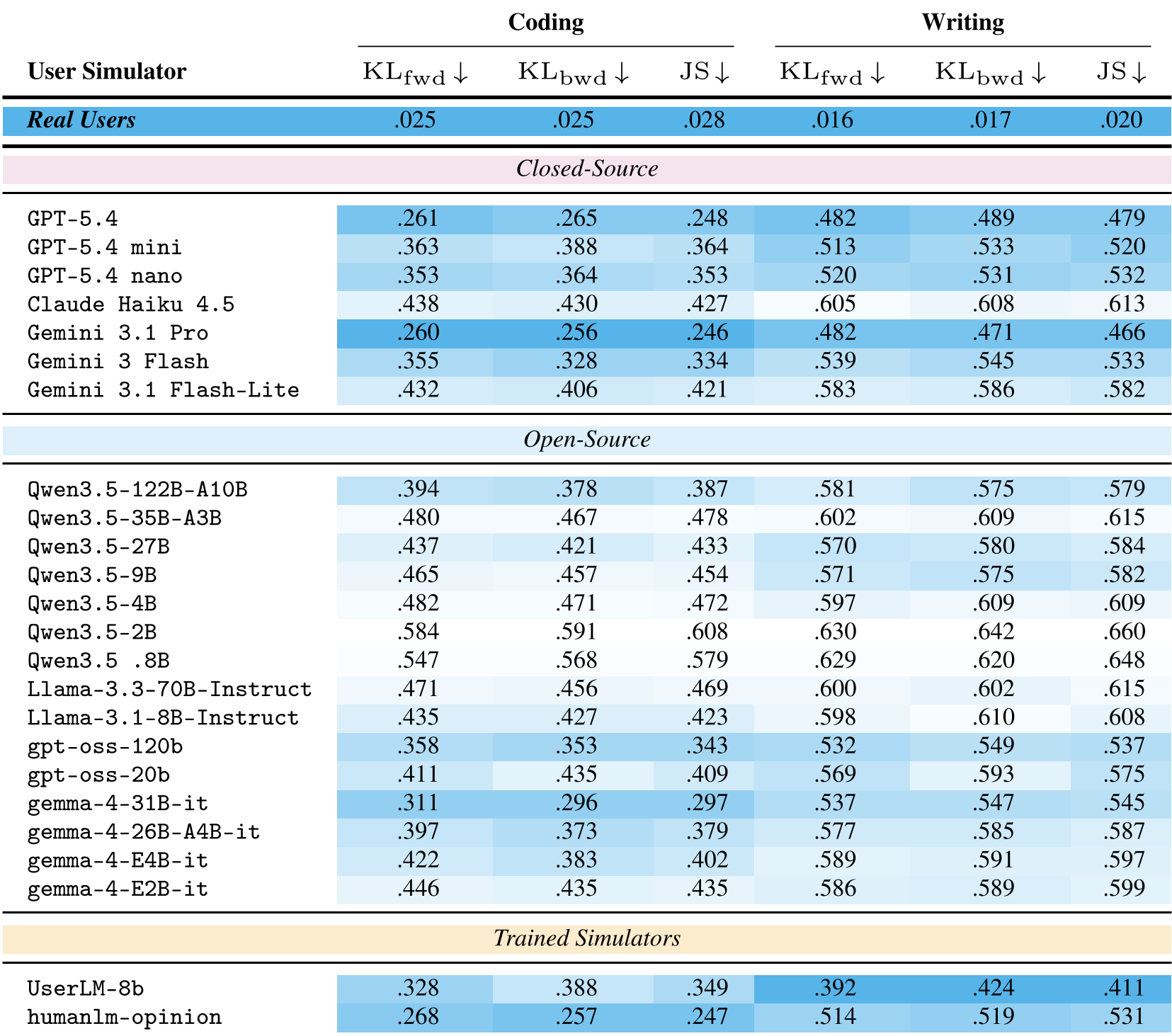 Table 1: Metrics reveal that even the best models (GPT-5.4, Gemini 3.1 Pro) have a significant gap (JS > 0.2) compared to the "Real User" baseline.
A Path Forward: Multi-Simulator Ensembles
One of the most profound insights of this paper is that UserLM-8b (a trained simulator) and GPT-5.4 (a general LLM) make different types of "mistakes."
By randomly sampling between two behaviorally distinct models, the authors were able to "blend" the distributions, resulting in a simulator that is closer to real humans than any single model alone. This "Mixture of Simulators" approach provides a practical tool for researchers to create more robust evaluation environments.
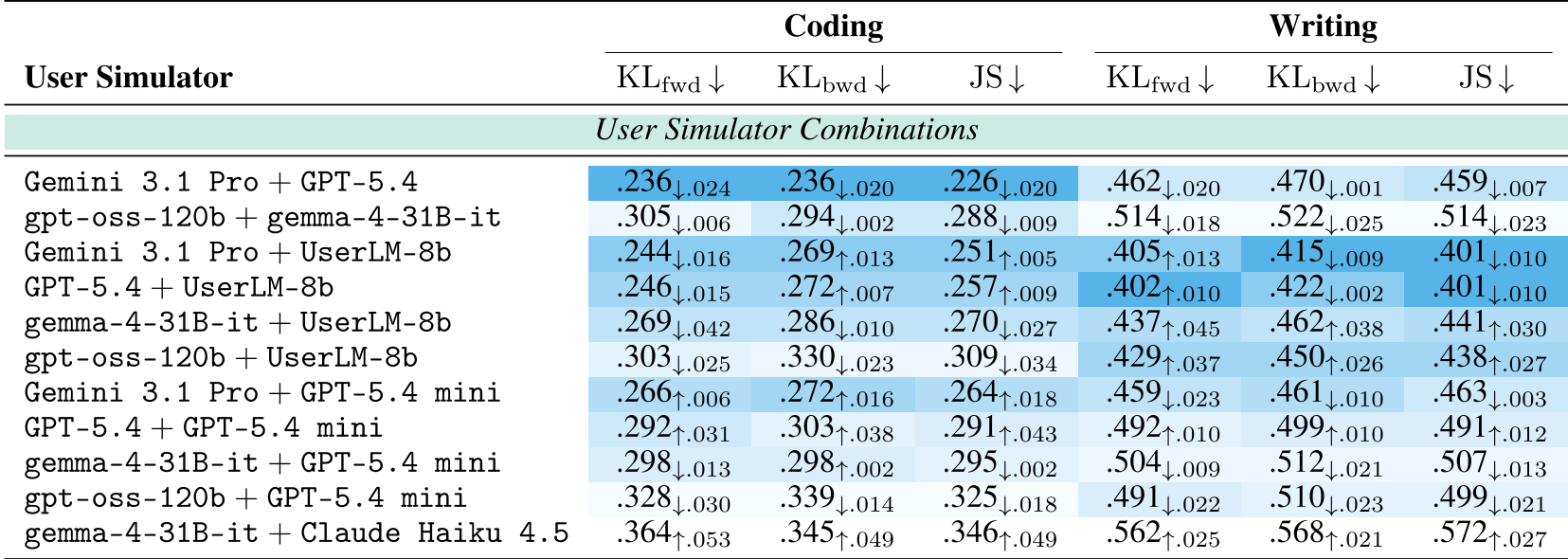 Table 3: Combinations like Gemini + GPT-5.4 consistently reduced divergence (JS↓) by covering more behavioral "modes."
Critical Insight: The "Polite" Bias
The TF-IDF analysis of behavioral clusters reveals a systemic bias in RLHF (Reinforcement Learning from Human Feedback). Because models are trained to be helpful, harmless, and honest, they default to a "Formal Pleasantries" mode. Real users, as seen in WildChat, are often "terse," "authoritative," and "transactional."
If we continue to evaluate our AI assistants only against "nice" simulators, we are essentially testing them in a laboratory vacuum. To achieve true robustness, we must deliberately simulate the "imperfect" user.
Conclusion
This work shifts the benchmark for user simulators from "how human-like is this sentence?" to "how well does this model represent the population distribution?" For those building agentic AI, this framework is a much-needed reality check on the fidelity of synthetic evaluation.