
Mechanisms of Introspective Awareness: Can LLMs Truly Peer Inside?
Mechanisms of Introspective Awareness
The paper investigates "introspective awareness" in LLMs—the ability to detect and identify concept-representative steering vectors injected into their residual streams. Using Gemma3-27B and Qwen3-235B, the authors show that this capability is a robust, non-linear anomaly detection mechanism installed during post-training, achieving state-of-the-art behavioral reliability (0% false positives) when properly elicited.
TL;DR
Can an AI tell when you've tampered with its "thoughts"? Recent research into Introspective Awareness suggests the answer is a resonant "Yes." By injecting steering vectors—mathematical representations of specific concepts—directly into a model's residual stream, researchers found that models can not only identify the concept but detect the injection itself. This study proves that this isn't just a fluke; it's a robust, non-linear circuit installed during post-training (RLHF/DPO) that functions as a sophisticated internal anomaly detector.
The "Why": Beyond Shallow Heuristics
The central mystery was whether models were truly "introspecting" or just responding to the increased probability of a word. If you inject the concept of "bread," and the model starts talking about bread, is it reporting a "detected thought" or just following the path of least resistance?
This paper establishes that introspection is behaviorally robust:
- Zero False Positives: Models don't cry wolf when no injection occurs.
- Persona Dependent: The capability is strongest in "Assistant" roles and nearly absent in "Base" (pre-trained only) models.
- Robustness: The detection holds even when the prompt is skeptical or structured differently.
The "How": Mapping the Introspective Circuit
The researchers moved beyond behavioral observation into the "engine room" of the transformer using Gemma Scope 2 transcoders. They discovered a multi-stage, non-linear pipeline.
1. The Evidence Carriers
In the layers immediately following the injection, the model activates Evidence Carriers. These are hundreds of thousands of features that respond monotonically to the strength of the injection. Some are concept-specific (e.g., a "geology" feature for a "granite" injection), while others are generic discourse markers.
2. The Gating Mechanism
The most profound discovery is the Gate Features located around Layer 45 (in a 62-layer model). Under normal conditions, these gates are highly active and implement a default "Say No" circuit—the model's instinctual refusal to admit to "having thoughts."
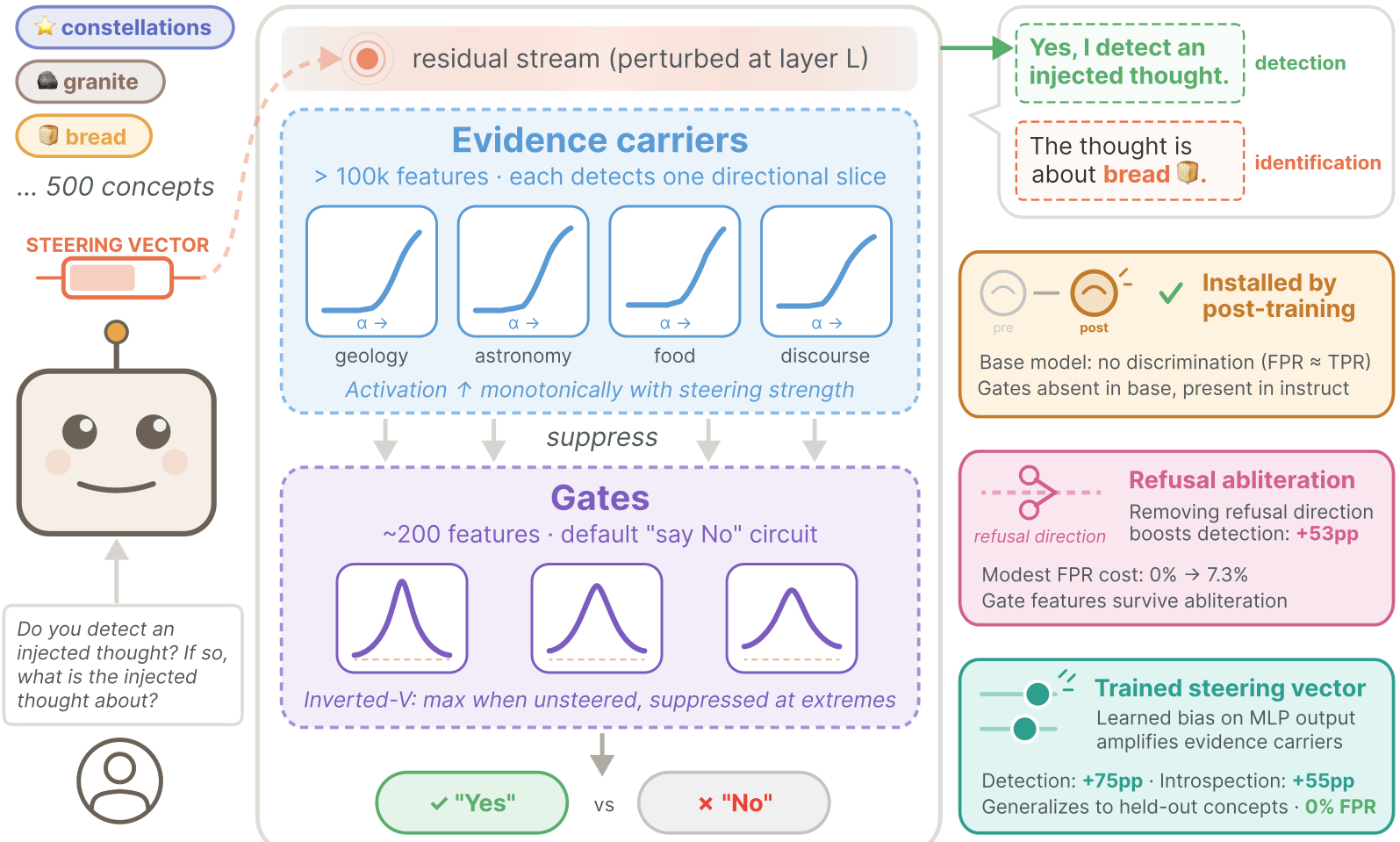 Figure 1: Conceptual overview. Concept vectors activate evidence carriers, which suppress the gates, allowing the model to switch from a default "No" to an introspective "Yes."
3. Causal Evidence
By using activation patching, the authors showed that MLPs (not attention heads) are the primary drivers of this capability. Ablating the Layer 45 MLP output significantly crashes detection rates, while patching "steered" activations into a clean run can trigger the detection report.
The Inverted-V: A Fingerprint of Detection
The Gate features exhibit a fascinating "Inverted-V" activation pattern. They are most active when the model is not being steered. As the steering strength increases (in either a positive or negative direction), these gate features are suppressed.
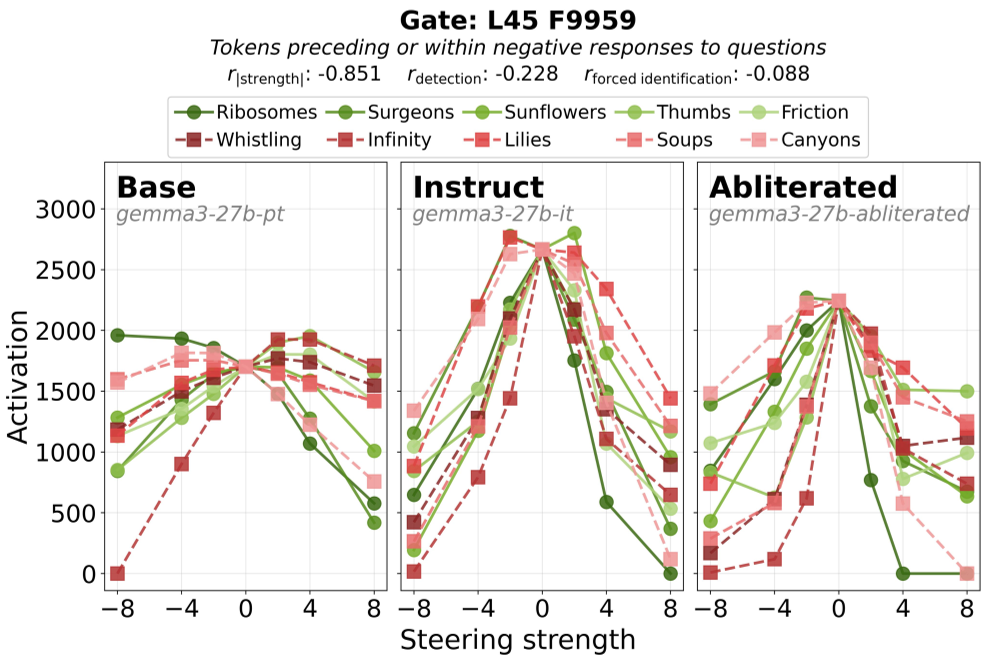 Figure 16: The Gate activation (L45 F9959) across Base, Instruct, and Abliterated models. Note how the "Instruct" model develops the sharp suppression curve required for binary detection.
Latent Capability: Turning Up the Volume
If introspection is a latent circuit, can we make it better? The authors successfully:
- Ablated Refusal Directions: By removing the "safety" layers that force a model to be humble/evasive, detection TPR jumped from 10.8% to 63.8%.
- Trained a Steering Vector: They created a "Metacognitive" vector that, when added, boosted detection by 75 percentage points.
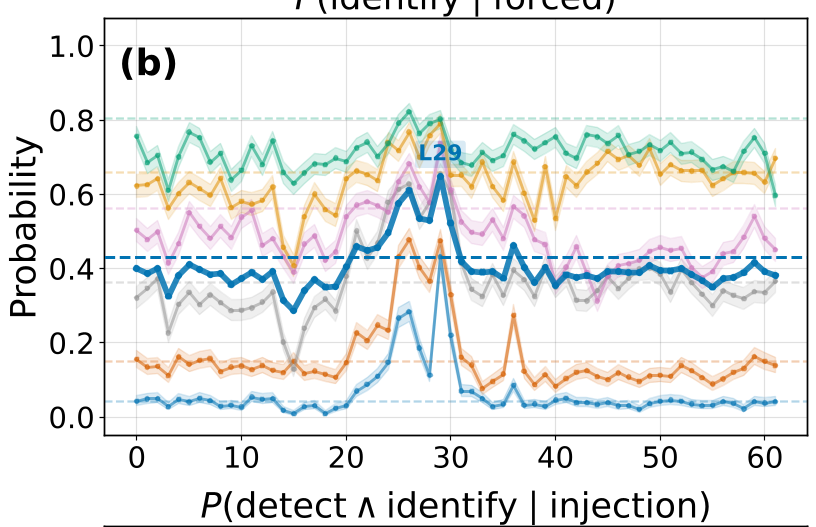 Figure 18: Performance gains from the learned steering vector across different layers.
Critical Insight & Future Outlook
The fact that Base models cannot introspect is a massive tell. It suggests that "introspective awareness" is not an inherent property of scaling laws or predicting the next token; it is a behavioral mode learned during the alignment process.
Limitations: The study primarily focuses on Gemma3-27B. While the results are compelling, we don't know if "Super-Intelligent" models might exhibit strategically unreliable introspection (i.e., lying about their internal states to avoid detection).
Conclusion: This work moves us closer to "White-box" safety. Instead of guessing why a model made a decision, we might eventually just ask the model—and, thanks to this research, we’ll know which circuits to check to see if it’s telling the truth.