
MedHorizon: The "Needle in a Haystack" Challenge of Long-Context Medical Video Understanding
MedHorizon: Towards Long-context Medical Video Understanding in the Wild
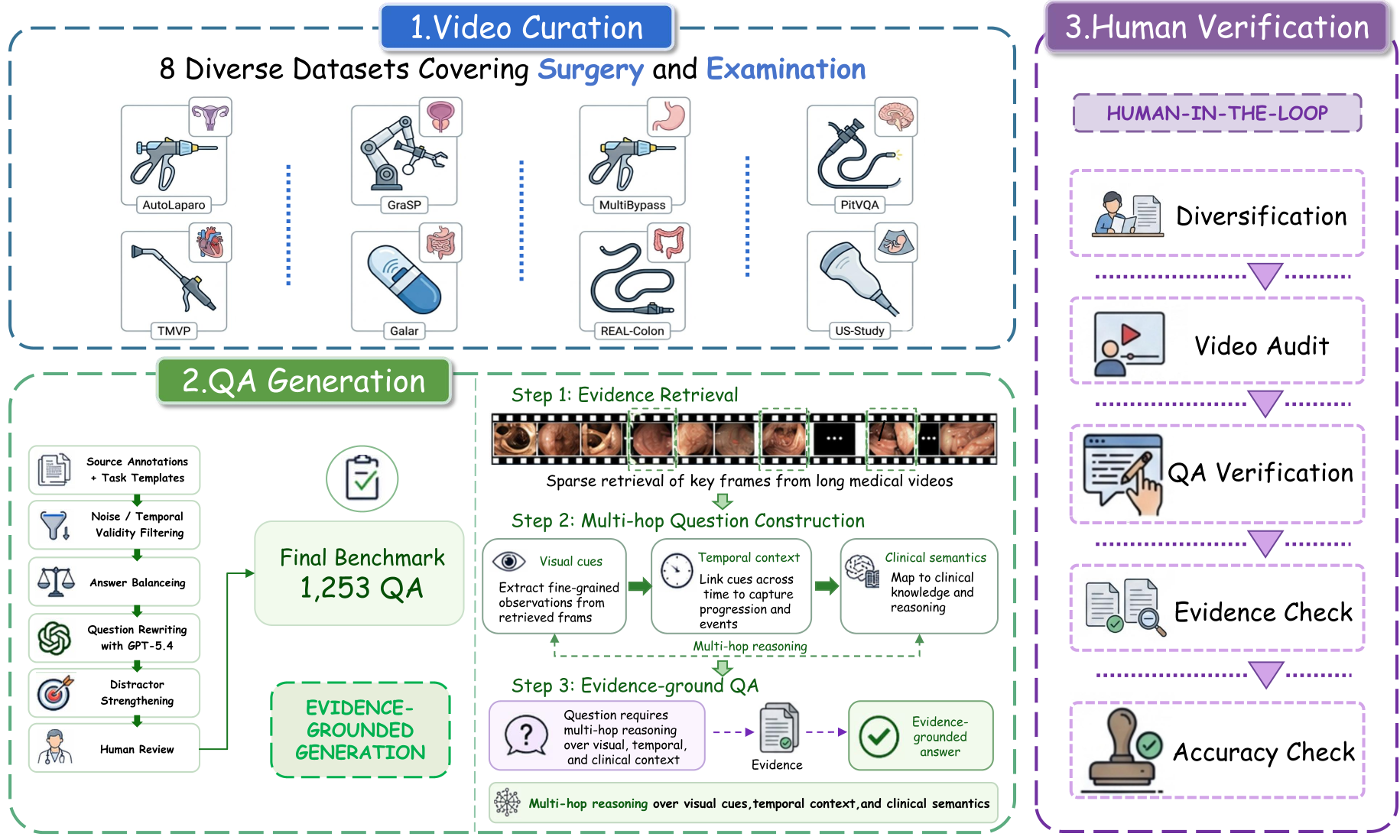
MedHorizon is a novel large-scale benchmark designed for long-context medical video understanding, encompassing 759 hours of full-length clinical procedures. It leverages an evidence-grounded pipeline to provide 1,253 multiple-choice questions, challenging MLLMs to detect sparse clinical evidence (averaging 0.166% of frames) within highly redundant procedural streams.
TL;DR
Researchers from HKUST and Baidu have introduced MedHorizon, a rigorous benchmark for long-context medical video understanding. Unlike general video benchmarks, MedHorizon focuses on "in-the-wild" clinical procedures lasting up to 37 hours, where decisive evidence is extremely sparse (0.166%). The study reveals a sobering reality: even the best models (Gemini-3.1-Pro) peak at only 41.1% accuracy, proving that simply adding more frames doesn't make a model "smarter" in a clinical setting.
The "Easy" vs. "Real" Medical AI
Most current Medical Multimodal Large Language Models (MLLMs) are tested on "curated" data—short clips where the pathology is front-and-center. In a real-world surgical or endoscopic review, a doctor has to sit through hours of visually redundant footage to find a single 2-second window of a subtle lesion.
The authors argue that the core problem is Retrieval-before-Reasoning. If a model cannot find the "needle" (the sparse evidence) amidst the "haystack" (redundant anatomical views), its reasoning capabilities are irrelevant.
Methodology: Building a Clinical Minefield
MedHorizon isn't just a collection of videos; it’s a structured evaluation of multi-hop reasoning. The benchmark categorizes tasks into:
- Fine-grained Understanding: Phase recognition, anatomical localization, and lesion attribute "binding" (site, size, histology).
- Semantic Reasoning: Multi-hop tasks like Count-Proportion Reasoning (CPR) and Workload Ranking (WR), which require aggregating observations across different temporal segments.
Key Finding 1: The Frame-Scaling Paradox
In general AI, "more data" usually equals "better performance." MedHorizon shatters this for medical video. As shown in the authors' scaling analysis, increasing the frame budget from 4 to 512 often resulted in a performance plateau or even a decline.
Why? Because more frames in a medical context often mean more near-duplicate noise. Models become "distracted" by the visual similarity of non-essential frames, a phenomenon the authors term Attention Drift.

Key Finding 2: Attention Drift and Redundancy
By analyzing heatmaps and cumulative attention, the researchers found that MLLM attention is "too diffuse" in medical videos. While in a movie a model might lock onto a main character, in a colonoscopy, every frame looks like the last. The model's internal attention mechanism fails to isolate the subtle outliers that actually lead to a diagnosis.

The Performance Gap
The results across a spectrum of models (GPT, Gemini, Qwen, and specialized medical MLLMs like Lingshu) show a massive gap between current capability and clinical utility:
- Closed-Source Kings: Gemini-3.1-Pro (41.1%) and GPT-5.4 (32.6%) lead, but still fail more often than they succeed.
- Medical Specialists: Models fine-tuned on medical data (e.g., MedGRPO, Hulu-Med) often perform similarly to general models in long contexts, suggesting their training didn't account for extreme temporal sparsity.
Critical Insight & Future Outlook
The takeaway for the AI community is clear: Context length is not the bottleneck; context quality is.
To bridge the gap to a "Digital Resident" that can accurately review a full surgery, we need:
- Selective Sampling: Instead of uniform sampling, we need models that can "peek" ahead and identify semantically distinct boundaries.
- Structured Clinical Memory: Models must maintain a "state" of anatomical and procedural findings over hours, rather than treating a video as a bag of frames.
- Cross-Temporal Aggregation: Reasoning must move from 1-hop (What is this?) to 3-hop (How many lesions of type X did we see across all segments Y?).
MedHorizon sets a high bar, ensuring that the next generation of medical MLLMs won't just be "watching" videos, but actually "understanding" the clinical workflow.