
[Nature 2024] Imaging the Meissner Effect: Unveiling the Superfluid Secrets of Graphene
Imaging the Meissner effect and local superfluid stiffness in a graphene superconductor
This study reports the first direct imaging of the Meissner effect in a rhombohedral graphene superconductor using scanning nanoSQUID-on-tip (nSOT) microscopy. The researchers observed a nanotesla-scale diamagnetic response (screening ~100 ppm of the applied field) and mapped the local superfluid stiffness , achieving a state-of-the-art thermodynamic characterization of ultra-low density 2D superconductors.
TL;DR
Researchers have achieved a breakthrough by directly imaging the Meissner effect—the expulsion of magnetic fields—in rhombohedral trilayer graphene (R3G). Using a nanoSQUID-on-tip, they mapped the superfluid stiffness () at the nanoscale, discovering that superconductivity in this system is intimately tied to a spin-canted ferromagnetic phase transition and follows a surprising linear relationship that defies standard BCS theory.
The Challenge: Hunting Nanoteslas in 2D
In 3D superconductors, the Meissner effect is robust. In 2D, however, it is "shy." Because the material is only atoms thick, the magnetic screening is incredibly weak, characterized by a Pearl length () that can be centimeters long—thousands of times larger than the sample itself.
In graphene, this is compounded by low carrier densities and flat-band physics. Previous studies mostly looked at "zero resistance" (transport), but resistance can lie. To truly understand the pairing mechanism, one must measure the superfluid stiffness, the "rigidity" of the superconducting wavefunction.
The Method: A Nano-Microscope for Magnetism
The team used a nanoSQUID-on-tip (nSOT). Imagine a quartz pipette pulled to a sharp point, with a superconducting loop evaporated onto the apex. This sensor can detect magnetic field changes on the scale of nanoteslas while scanned just 150nm above the graphene flake.
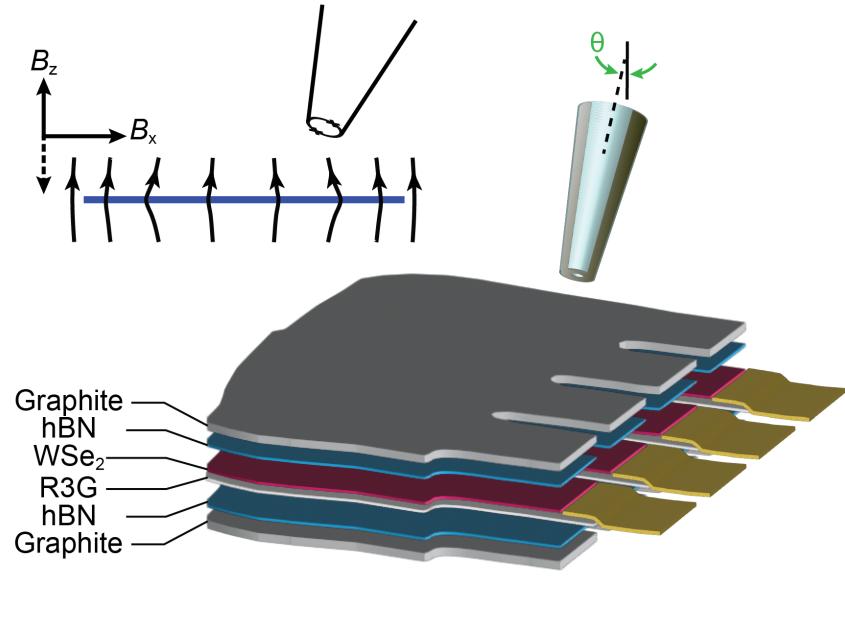 Fig 1. (a) Setup showing the nSOT scanning over the R3G/WSe2 heterostructure. (c-e) The transition from a ferromagnetic signal (red) to a diamagnetic Meissner signal (blue) as gates are tuned.
Key Insight 1: Superconductivity meets Spin-Canting
Graphene isn't just a superconductor; it's a playground for magnetism. By anti-symmetrizing the magnetic signal with respect to the applied field, the authors discovered that superconductivity lives right on the edge of a spin-canted ferromagnet.
As the system transitions from a "spin-valley locked" state to a "spin-canted" state, the magnetic fluctuations likely act as the "glue" that pairs the electrons. The nSOT allowed them to see this coexistence in real space for the first time.
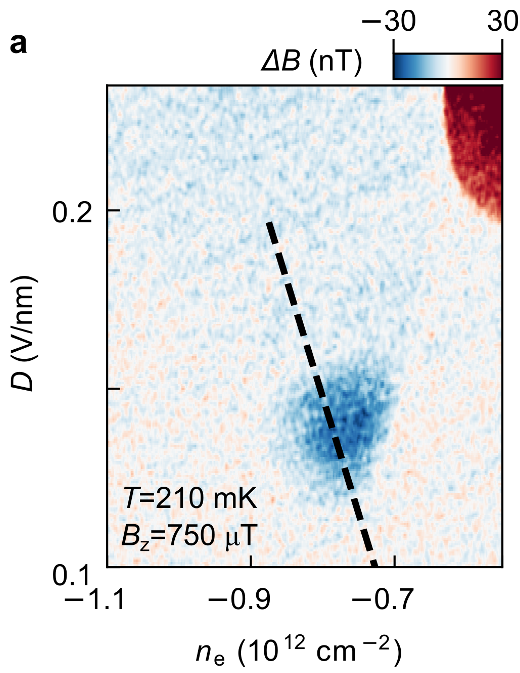 Fig 2. Symmetrizing the data reveals how the spin-canted magnetic order (orange) vanishes just as the superconducting Meissner signal (blue) emerges.
Key Insight 2: The Uemura Relation and BCS Deviations
By fitting the 2D magnetic images to the London equation, the team extracted the absolute value of . They found two striking things:
- Temperature Dependence: The stiffness follows a power law , which is inconsistent with simple isotropic s-wave pairing.
- Linear Scaling: Like high- cuprates, the zero-temperature stiffness is proportional to . However, the ratio is too high for the superconductivity to be purely "phase-fluctuation limited," yet the linear scaling is not expected in the "clean limit" of BCS theory.
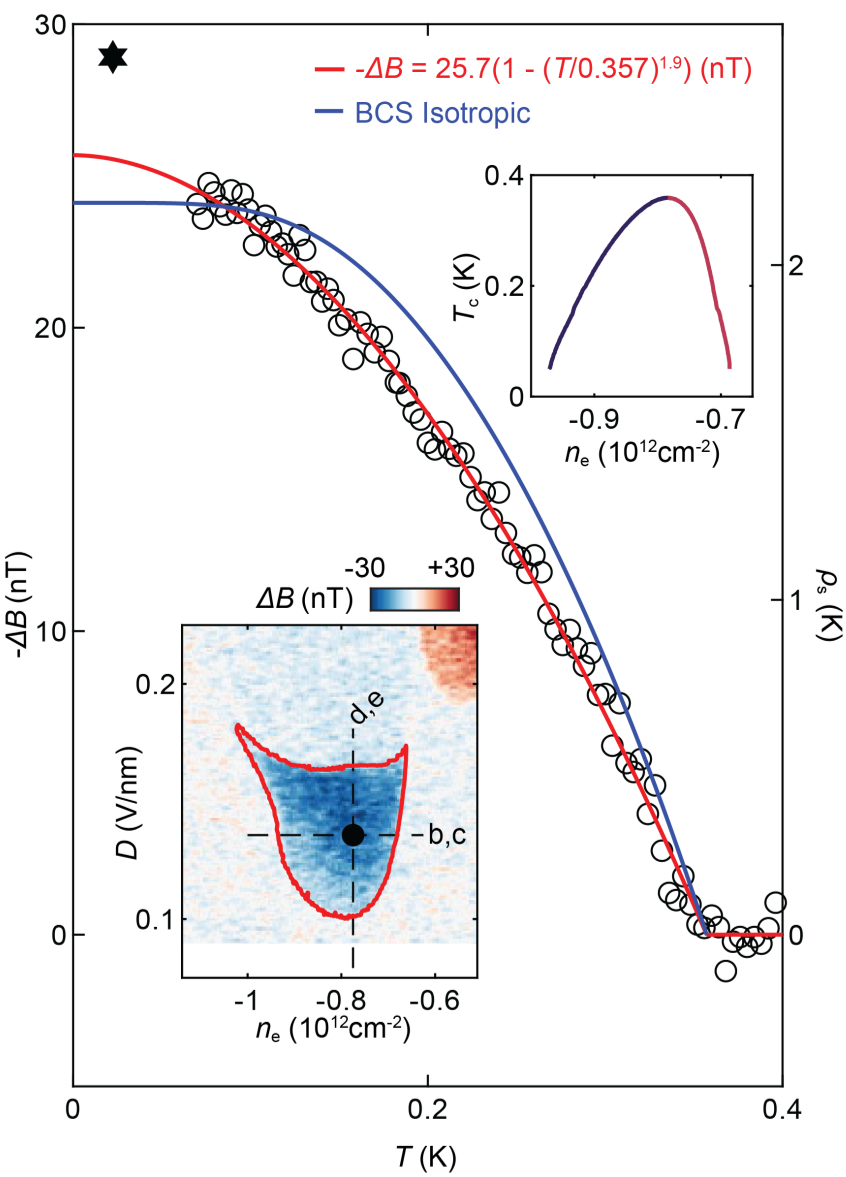 Fig 3. The "Uemura Plot" (d-e) showing the linear correlation between stiffness and transition temperature across different gate voltages.
Critical Analysis & Future Outlook
This work is a technical tour-de-force. It moves the study of graphene superconductivity from "does it conduct?" to "how does it screen?"—a much deeper thermodynamic question.
Limitations: The tip causes some local heating (calibrated to ~200mK), which might obscure physics at the absolute base temperature of the dilution fridge. Future Work: The local nature of this probe revealed significant mesoscopic disorder. Future studies will likely focus on "cleaning up" these interfaces to see if can be pushed even higher by optimizing the proximity to the spin-canted phase transition.
Takeaway for the Field
If you want to understand pairing in the flat-band era, you can't just measure Volts. You have to measure the field. This paper sets the standard for using local magnetometry to solve the puzzle of unconventional 2D superconductivity.