
[ACM MM 2026] MemCoT: Scaling Test-Time Compute via Memory-Driven Chain-of-Thought
MemCoT: Test-Time Scaling through Memory-Driven Chain-of-Thought
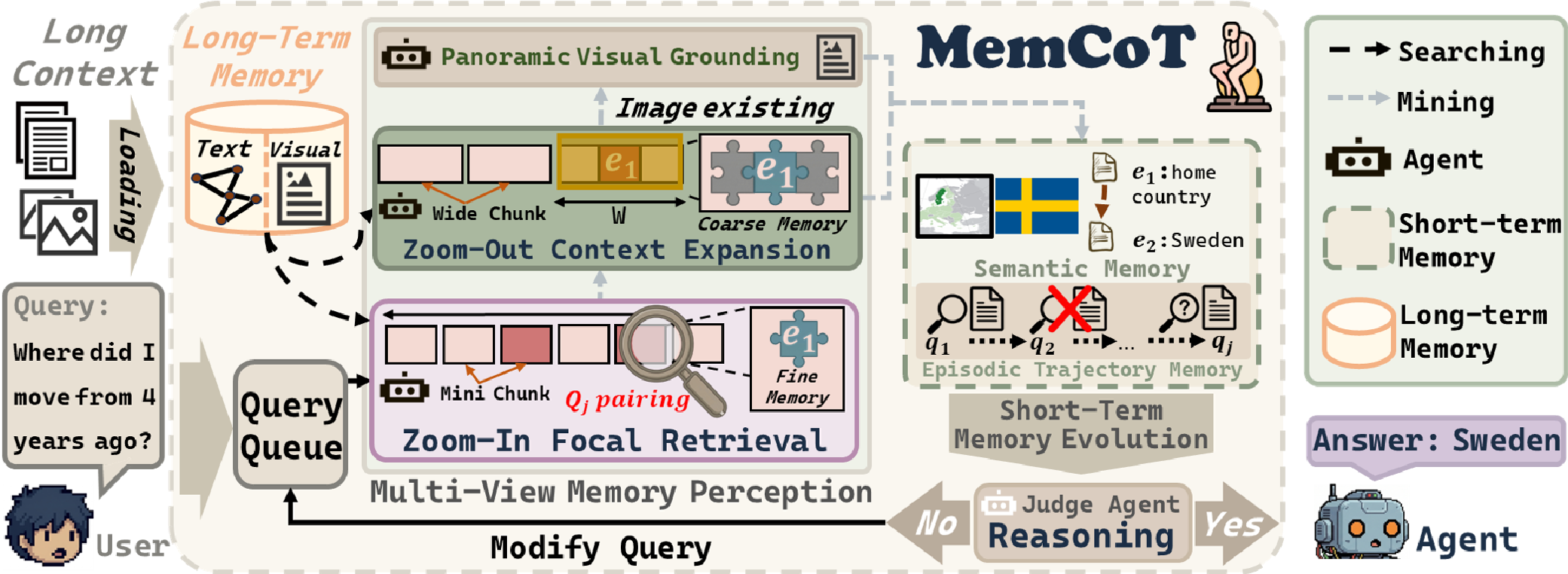
MemCoT is a test-time scaling framework that redefines long-context reasoning for LLMs by transforming static retrieval into an iterative, stateful memory-driven search. By coupling a multi-view perception module (Zoom-In/Zoom-Out) with a dual short-term memory system, it achieves SOTA F1 scores of 58.03% on the LoCoMo benchmark and 88.0 on LongMemEval-S.
TL;DR
MemCoT shifts the paradigm of AI memory from passive retrieval (RAG) to active reasoning. Instead of a single-shot search that often misses context or sinks in noise, MemCoT uses a "Memory-Reasoning Loop" to iteratively explore long contexts. It achieves SOTA results on LoCoMo and LongMemEval-S benchmarks, proving that how a model searches is more important than how much it can fit in its context window.
Problem: The "Passive Matching" Bottleneck
Despite the million-token windows of modern LLMs, they still fail at long-horizon reasoning. The paper identifies two "Search Modeling Dilemmas":
- Semantic Dilution: In massive contexts, high-frequency noise drowns out critical signals.
- Contextual Fragmentation: Standard RAG (chunking) creates a trade-off—small chunks provide precision but lose context (Zoom-in), while large chunks provide context but introduce noise (Zoom-out).
Most agents decide what to retrieve before reasoning, which is a fundamental catch-22 in multi-hop tasks.
Methodology: The Memory-Reasoning Loop
MemCoT treats memory not just as a database, but as a reasoning engine. It introduces two core innovations:
1. Multi-View Long-Term Memory Perception
To solve the fragmentation problem, MemCoT uses a hierarchical aggregation:
- Zoom-In (): Focal retrieval targeted at high-precision entities.
- Zoom-Out (): Context expansion that retrieves chunks adjacent to the focal hits to restore causal structure.
- Visual Grounding (): OCR-based integration for multimodal documents.
2. Stateful Short-Term Memory Evolution
MemCoT maintains a Dual Short-Term Memory that evolves at test-time:
- Semantic State Memory: Stores the factual evidence gathered so far.
- Episodic Trajectory Memory: Records failed search paths to prevent redundant cycles.
At each step, a Judge Agent decides: "Do I have enough info?" If not, it performs Decomposition (breaking the query down) or Pruning (removing already answered parts) to refine the next search.
Evaluation: Small Models, Big Reasoning
The strength of MemCoT is most evident in "smaller" models. By using this iterative loop, Qwen2.5-7B outperformed several larger models, reaching an F1 of 52.01 on LoCoMo—a massive jump from the 33.79 baseline.
Key Results on LoCoMo (F1 Score)
| Model | Method | Single-hop | Multi-hop | Temporal | Overall |
|---|---|---|---|---|---|
| GPT-4o-mini | CompassMem | 57.36 | 38.84 | 57.96 | 52.18 |
| GPT-4o-mini | MemCoT | 64.81 | 40.43 | 60.31 | 58.03 |
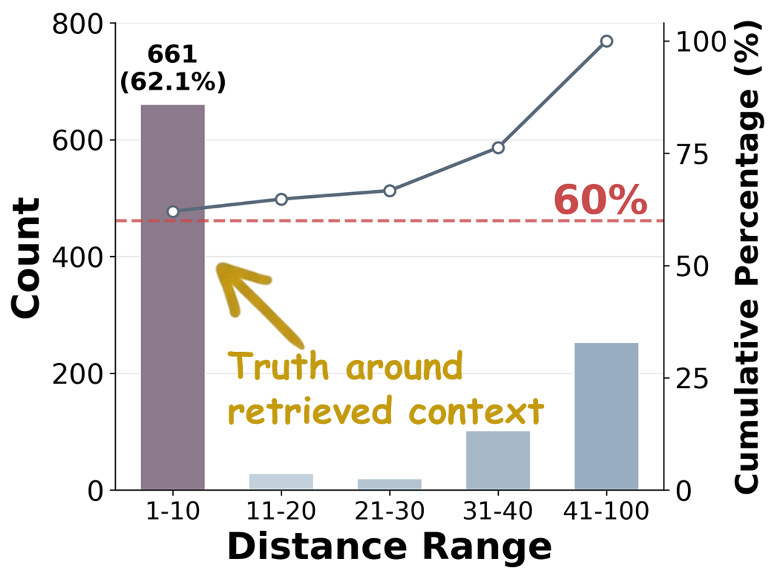 Insight: An analysis of failure cases (Fig 2b/2c) shows that 60% of correct answers are within a 10-chunk radius of the initial search hit, justifying the "Zoom-Out" expansion strategy.
The Scaling Efficiency
A common criticism of iterative methods is high token cost. MemCoT addresses this by showing that even with multiple iterations, the average token usage (~2.4k to 2.7k) is far lower than the "Full Context" approach (~16.9k), proving that active search is more efficient than massive ingestion.
Deep Insights & Conclusion
MemCoT proves that the future of long-context AI isn't just "bigger windows," but "smarter agents." By mathematically unifying single-hop and multi-hop reasoning into a Markovian search process, it provides a stable framework for self-evolving agents.
Limitations: While training-free, the framework relies on the "Judge" agent's ability to identify knowledge gaps accurately. Smaller foundational models might struggle with the "Self-Correction" aspect of the loop compared to GPT-4 class models.
Takeaway: If you want your agent to remember and reason across 100 interaction turns, stop building better databases and start building better search trajectories.