
MELT: Decoupling Reasoning Depth from the Memory Wall
Memory-Efficient Looped Transformer: Decoupling Compute from Memory in Looped Language Models
The paper introduces Memory-Efficient Looped Transformer (MELT), a recurrent LLM architecture that decouples reasoning depth from memory usage. By replacing the linear-growth KV cache found in latent reasoning models like Ouro with a single, gated KV cache shared across loops, MELT achieves O(1) memory complexity relative to loop depth while maintaining SOTA-level reasoning performance.
TL;DR
The Memory-Efficient Looped Transformer (MELT) is a breakthrough in "latent reasoning" models. While previous looped models (like Ouro) saw their memory usage explode as they "thought" longer, MELT uses a learnable gating mechanism to keep memory constant regardless of how many reasoning loops it performs. The result? A 1.6B model that uses 4x less memory than its predecessors while crushing standard 2B-class models on math and coding benchmarks.
The "Thinking" Tax: Why Looped Models Stall
Recent trends in LLMs have shifted toward Inference-Time Compute. Instead of just predicting the next token, models like Ouro "loop" hidden states through their layers multiple times to refine their "thoughts" (latent reasoning).
The catch? The KV Cache. In standard looped models, every loop generates a new set of Keys and Values. If you loop 4 times, your KV cache is 4x larger. For a 32k token generation, Ouro requires ~28GB of VRAM—a massive footprint for a "small" 1.4B model. This linear growth creates a hard ceiling on how much "thinking" a model can do before running out of memory.
The MELT Insight: Gated Recurrence as Memory
The authors of MELT asked a fundamental question: Can we update existing memory instead of appending new memory?
The Architecture
MELT introduces a latent state that evolves across loops. Instead of saving a KV pair for every loop, MELT uses a Gating Mechanism:
- Selectivity: For each dimension, the gate decides whether to keep the previous "thought" or update it with new computation.
- Projection: Only after the update is the state projected into Key () and Value () space.
- Constant Footprint: There is only ever one KV entry per token per layer, regardless of whether the model loops 2 times or 200 times.
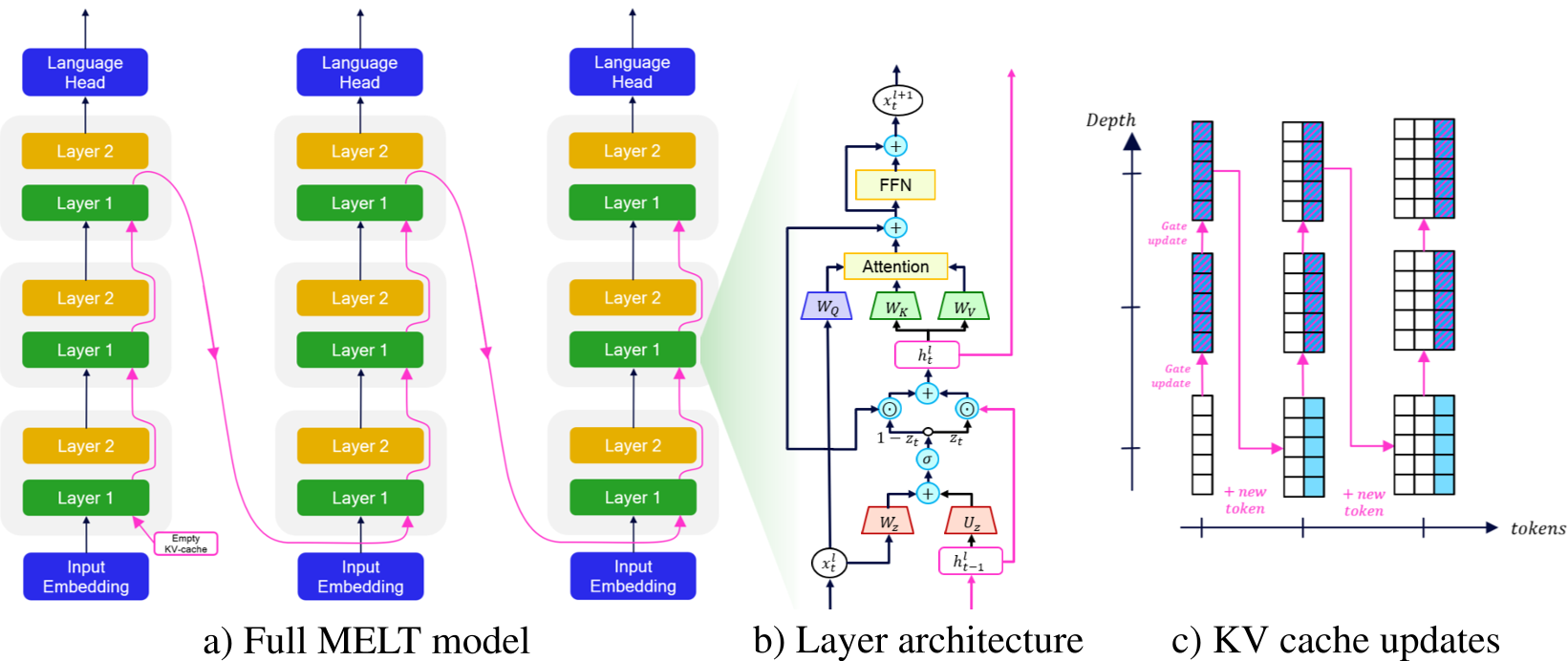 Figure: MELT updates a single shared KV cache row per token across loops, unlike standard models that append new rows.
Overcoming the Training Challenge
You can't just take a pretrained model and change its memory structure; the model will "break." The MELT team developed a sophisticated two-phase adaptation recipe:
- Interpolated Transition: They start with the original LoopLM behavior and slowly "fade in" the MELT gated behavior using a coefficient that goes from 0 to 1.
- Attention-Aligned Distillation: To prevent "representation drift," they use a frozen teacher model. They don't just match the final output; they force MELT's attention outputs to match the teacher's at every single loop.
Experimental Results: Performance vs. Efficiency
MELT proves that efficiency doesn't have to come at the cost of intelligence.
- Math Power: On the brutal AIME24 benchmark, MELT-1.6B achieved 46.7% (pass@1), significantly higher than Qwen3-1.7B (43.1%) and DeepSeek-R1-1.5B (32.1%).
- Memory Magic: For 32k contexts, MELT requires 9.49 GB of total VRAM, whereas Ouro requires 27.97 GB.
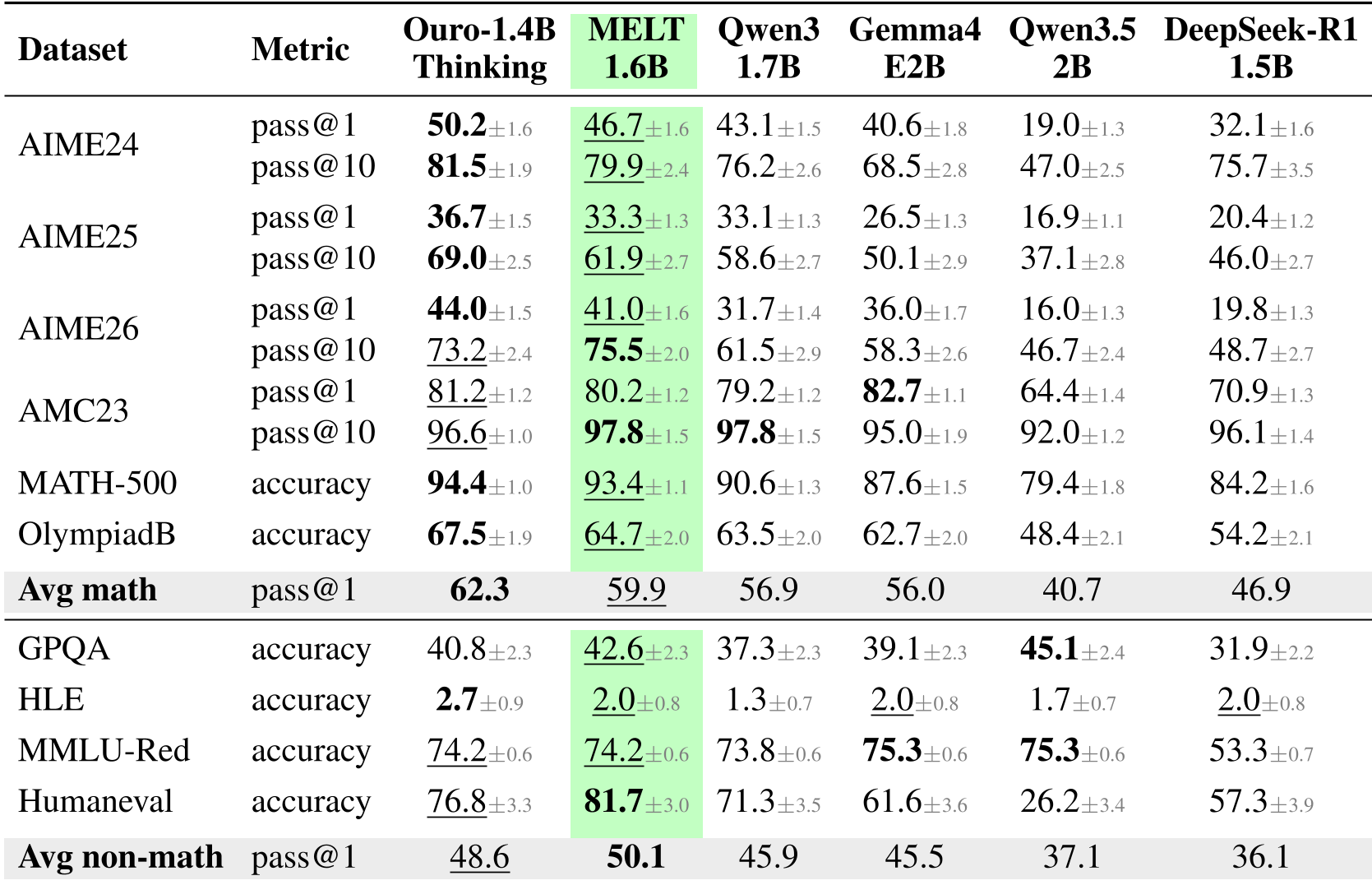 Table: MELT consistently occupies the SOTA position for its parameter class while maintaining a Transformer-equivalent memory footprint.
Critical Analysis & The "Gradient Superhighway"
The most impressive theoretical contribution is the Spectral Stability proof. The authors show that when the gate , the Jacobian becomes the identity matrix. This creates a "Gradient Superhighway," allowing training signals to flow through dozens of loops without vanishing.
Limitations:
- Sequential Dependency: Because the KV cache is updated, tokens must be processed more "sequentially" during training, which can slow down throughput compared to pure parallel SFT.
- Fixed Loops: Currently, the model uses a fixed number of loops. The next frontier is Adaptive Depth—letting the model decide to loop twice for "2+2" and 20 times for a complex calculus problem.
Conclusion: A New Blueprint for Reasoning
MELT represents a paradigm shift for on-device AI and scalable reasoning. It proves that we can decouple "thinking time" (compute) from "storage space" (memory). As LLMs move toward deeper reasoning, MELT’s gated KV architecture provides a scalable path to models that can think longer without demanding a data center's worth of RAM.