
[CVPR 2025] MeshOn: Revolutionizing 3D Asset Assembly with Intersection-Free Composition
MeshOn: Intersection-Free Mesh-to-Mesh Composition
MeshOn is a multi-step optimization framework designed for the realistic, intersection-free composition of accessory meshes onto base character meshes. By combining Vision-Language Models (VLM) for semantic alignment with physics-based barrier losses and a diffusion prior, it achieves SOTA results in fitting diverse 3D objects (e.g., hats, glasses, rings) while maintaining 0% intersection rates.
TL;DR
MeshOn is an advanced optimization framework that automates the "fitting" of 3D accessories onto base meshes. Unlike generative AI that recreates geometry from scratch, MeshOn preserves the original mesh's topology, rigs, and textures while ensuring a tight, semantically correct, and—most importantly—physically valid (intersection-free) fit using a blend of VLM guidance and physics-inspired losses.
Problem & Motivation: The "Friction" in 3D Workflows
In professional 3D pipelines, "composition" is a manual, tedious task. An artist must take a pre-modeled accessory (like a helmet) and manually rotate, scale, and deform it to fit a specific character.
Current AI solutions fall into two problematic camps:
- Generative Methods (e.g., Instant3dit): These often merge geometries into a single "blob," losing the ability to animate the accessory or skin it separately.
- Registration Algorithms (e.g., ICP): These are purely geometric. They don't know that glasses go over eyes or that a hat shouldn't "sink" into a skull. They frequently result in ugly surface intersections.
MeshOn's core insight is that mesh composition must be treated as a constrained optimization problem where semantic "intent" (from VLMs) meets physical "reality" (collision avoidance).
Methodology: The Four-Step Precision Fit
The authors break down the complexity of the task into four sequential stages, ensuring that early semantic mistakes don't ruin the final physical fit.
1. Semantic Initialization (VLM)
The system uses a Multi-Agent VLM (like Gemini) to define a "canonical frame" for both objects. It identifies the "front" of a hat and the "top" of a head, scoring different random rotations to find the most semantically plausible starting point.
2. Tight Fit & Trajectory Clearing
Once coarsely aligned, the model uses a proximity loss to pull the meshes together. To resolve the inevitable intersections, MeshOn draws inspiration from how humans put on clothes: it searches for an intersection-free trajectory (a path) that moves the accessory from a detached state to a snug fit.
3. Rigid Fine-tuning with IPC
Using the Incremental Potential Contact (IPC) barrier energy, the model refines the position. This "barrier loss" acts like a magnetic repulsion field that becomes infinitely strong as surfaces approach, mathematically guaranteeing no faces will penetrate each other.
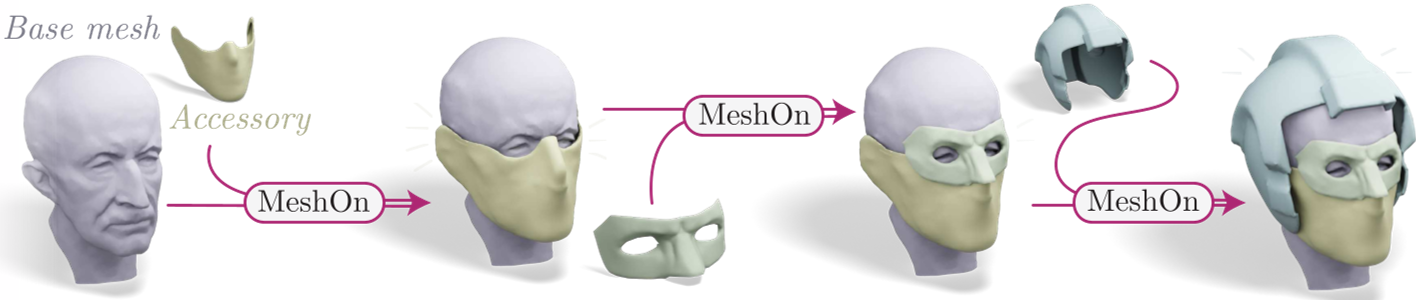 Fig 1: The MeshOn pipeline ensures accessories fit tightly without clipping through the base geometry.
4. Elastic Deformation (The SNUG Step)
Finally, the model allows the accessory to deform. It uses Jacobian Fields to maintain surface integrity and Score Distillation Sampling (SDS) from 2D diffusion priors to ensure the deformation "looks right" (e.g., a necklace draping naturally).
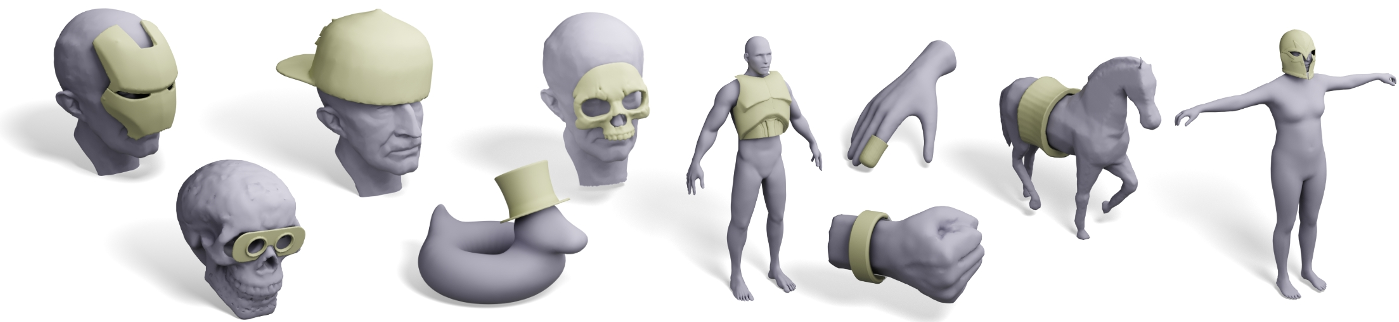 Fig 2: A GPU-optimized Bounding Volume Hierarchy (BVH) allows these complex distance calculations to run efficiently.
Experiments & Results: Perfection in Placement
The performance gains are most evident in physical validity. While state-of-the-art registration methods (RANSAC+ICP) resulted in an average of 544 intersecting faces, MeshOn achieved zero intersections across its test suite.
- Semantic Accuracy: Outperformed baselines in CLIP and VQA scores, proving the VLM agent successfully understands 3D orientation.
- Material Control: By specifying text prompts like "soft cloth" or "hard plastic," the system automatically adjusts Neo-Hookean elastic parameters, allowing for stiffer or more compliant fits.
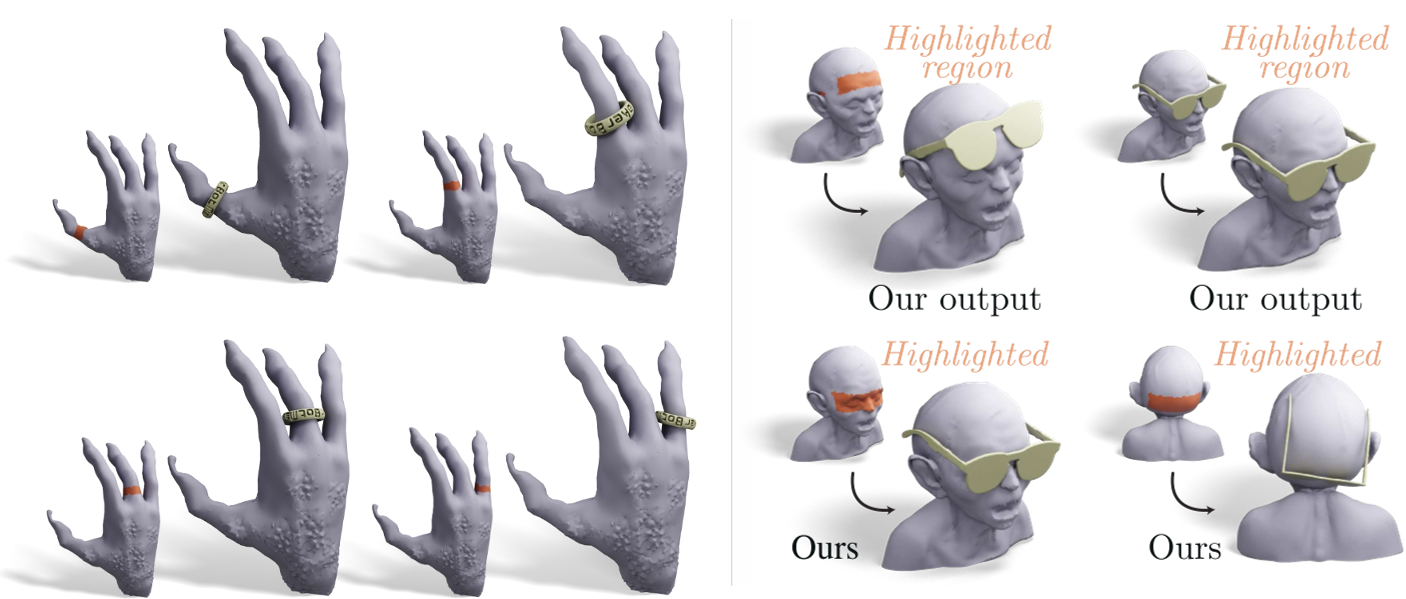 Fig 3: Qualitative comparison showing MeshOn's ability to preserve high-res details while avoiding the "gluing" artifacts of generative baselines.
Critical Analysis & Conclusion
Takeaway
MeshOn effectively bridges the gap between the wild creativity of generative AI and the strict requirements of professional graphics engines. By preserving the mesh's original metadata (uvs, rigs), it is a "production-ready" tool.
Limitations
The primary bottleneck is compute time. Even with a custom BVH, the optimization takes 15-30 minutes per pair. It is currently suitable for offline asset preparation rather than real-time interactive modeling.
Future Outlook
The marriage of differentiable physics (IPC) and diffusion priors (SDS) suggests a future where 3D "smart assets" know how to interact with their environment autonomously. MeshOn is a major step toward a world where 3D characters "dress themselves."