
[Nature Physics Insight] The Chern Mosaic: Decoding the Topological "Circuitry" of Moiré Materials
Mesoscopic transport in a Chern mosaic
The paper introduces a semi-classical framework for calculating mesoscopic transport in "Chern mosaics"—lattices of domains with varying local Chern numbers, typical in moiré heterostructures like twisted bilayer graphene. Using a Landauer-Büttiker network model, the authors derive various transport signatures including zero, integer, and fractional Hall resistances across different domain geometries.
TL;DR
Researchers from Stanford and UT Dallas have pioneered a theoretical framework to explain a long-standing mystery in moiré physics: why do seemingly "topological" materials often yield unquantized or "messy" transport data? By treating the material as a Chern Mosaic—a patchwork of domains with different Chern numbers—they show that the resulting network of chiral edge modes acts like a complex diode circuit, producing signatures that range from pseudo-superconductivity to fractional resistance.
Background: Beyond the Single-Chern Paradigm
In the idealized world of the Quantum Anomalous Hall (QAH) effect, a material has a single, global Chern number (), and its resistance is beautifully quantized to . But nature is rarely that tidy. In moiré heterostructures like Magic-Angle Twisted Bilayer Graphene (MATBG), local strain and "supermoiré" interference create a spatial "mosaic" of domains where the local Chern number flips.
The core insight of this paper is that transport isn't just about the bulk; it's about the geometry of the domain walls. These walls host chiral modes that intersect at junctions, creating a mesoscopic "traffic system" for electrons.
Methodology: The Auxiliary Lead Trick
To solve this, the authors leveraged the Landauer-Büttiker formalism, but with a clever twist. Typical calculations are hard when current paths traverse multiple junctions. The authors inserted "fictitious" or auxiliary leads on every internal domain wall.
By enforcing charge conservation and assuming that edge modes fully "mix" (equilibrate) along each wall, they transformed the physical sample into a matrix problem.
 Figure 1: Schematic of the Hall bar and the auxiliary lead network used to compute the conductance matrix.
Key Findings: A Comparative Catalog
The results are a "wild west" of transport anomalies:
- The Superconductor Mimic: In certain even-numbered square or triangular mosaics (like an grid), the Hall and longitudinal resistances can both vanish (). To an unwary experimentalist, this looks like superconductivity, but it's actually "topological cancelation" at the junctions.
- Fractional Hall Resistance: In a striped mosaic with odd rows, . Unlike the Fractional Quantum Hall effect which requires strong interactions, this is a purely geometric effect of domains.
- High Internal Resistance: Even with domains, the longitudinal resistance can grow much larger than the quantum of resistance (), governed by the ratio of domain columns to rows ().
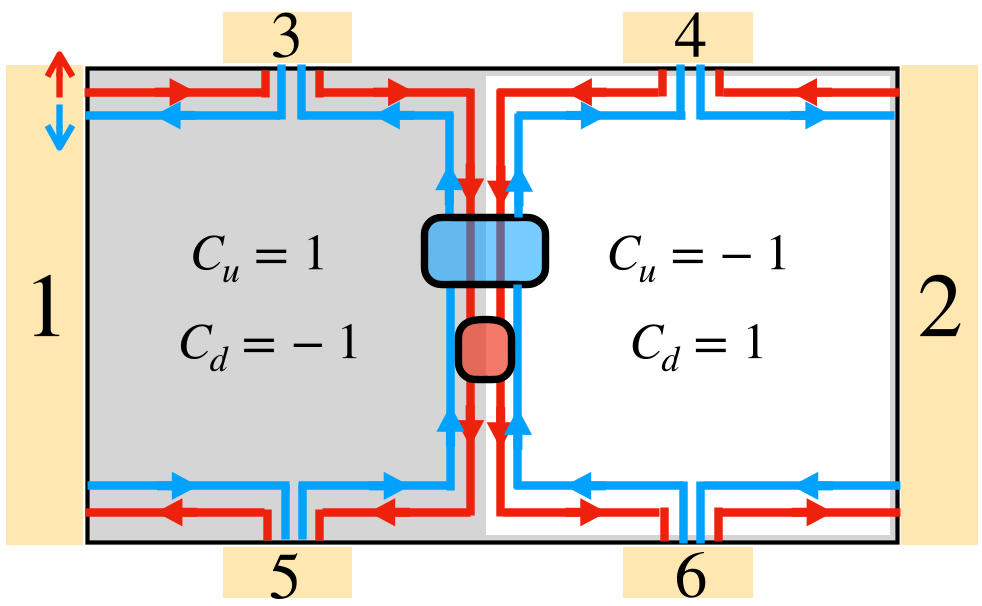 Figure 2: Voltage maps of square and triangular Chern mosaics, showing how potential drops across the internal "diode" network.
Deep Insight: A Chiral Diode Network
The authors conclude that a Chern mosaic is effectively a chiral diode network. Because the edge modes are chiral (one-way streets), the network discretizes Laplace’s equation in a way that respects the "handedness" of the domains.
Limitations & Future Work
While the model is robust, it assumes complete mode equilibration. In very clean, high-mobility samples, phase coherence might lead to Aharonov-Bohm oscillations, which would require a quantum-mechanical "Chalker-Coddington" treatment rather than this semi-classical approach.
Conclusion
This paper provides the "missing manual" for interpreting transport in 2D van der Waals materials. It warns us that a zero-resistance state isn't always a superconductor, and a fractional Hall plateau isn't always a Laughlin state. Sometimes, it's just the beautiful, complex geometry of a Chern mosaic.
Ref: Bhattacharjee et al., "Mesoscopic transport in a Chern mosaic," arXiv (2025).