
[2026] MetaClaw: The "Living" LLM Agent That Meta-Learns During Your Sleep
MetaClaw: Just Talk – An Agent That Meta-Learns and Evolves in the Wild
MetaClaw is a continual meta-learning framework for LLM agents deployed "in the wild." It combines gradient-free skill synthesis with opportunistic RL weight updates (Cloud LoRA) to allow agents to evolve alongside shifting task distributions, achieving up to 32% relative accuracy improvements and 8.25x higher task completion rates.
TL;DR
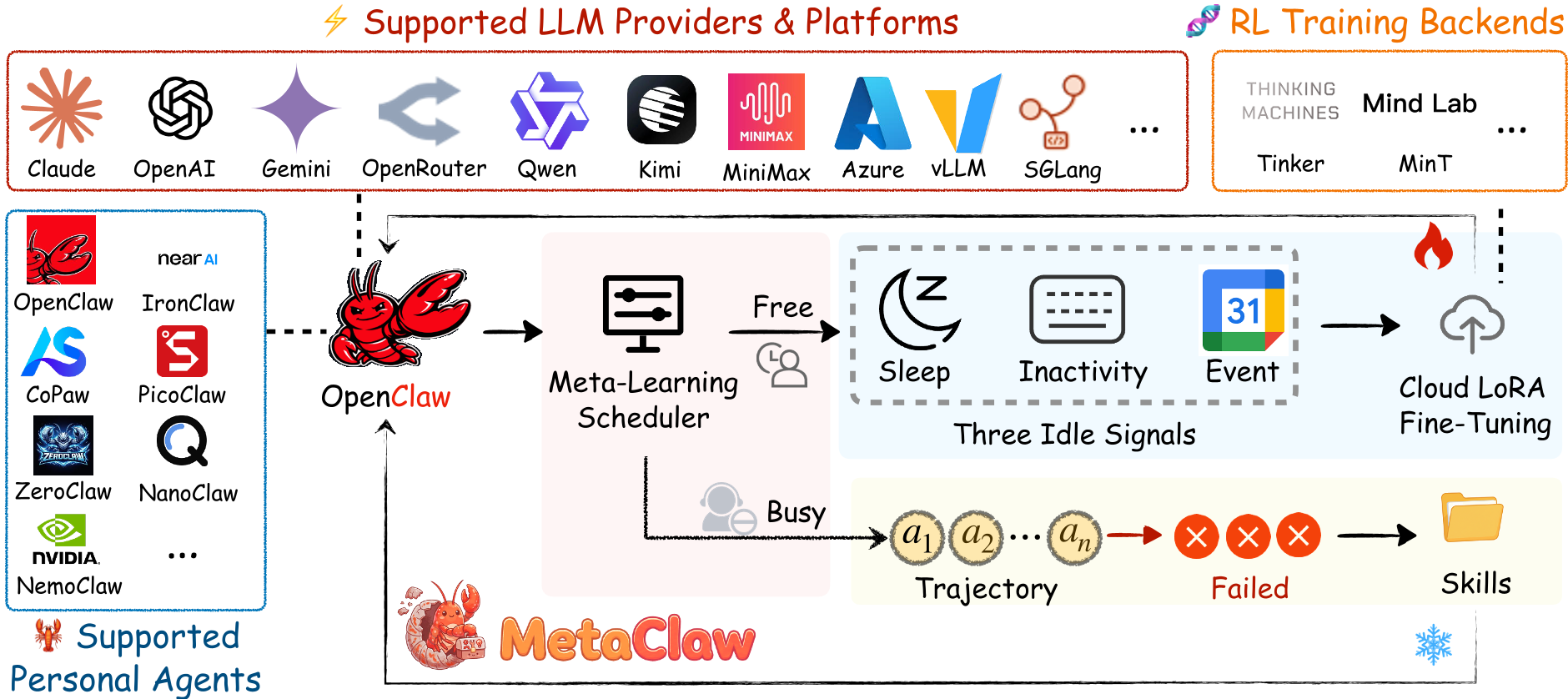
Most LLM agents are "frozen in time," failing repeatedly on the same types of new tasks because their weights are static. MetaClaw breaks this paradigm by introducing a continual meta-learning framework. It uses an LLM-based "evolver" to create new skills in seconds and a background scheduler that triggers Cloud LoRA fine-tuning only when the user is idle (monitored via keyboard activity and Google Calendar). The result is an agent that literally gets smarter the more you use it.
The Motivation: The "Static Agent" Problem
In the real world, user needs drift. An agent used for file system operations today might be used for multi-agent messaging tomorrow. Current architectures fail here because:
- Memory is too verbose: Storing raw trajectories doesn't extract transferable "rules."
- RL is too slow/disruptive: You can't take an agent offline for 5 hours of retraining every time a user changes their workflow.
- The Stale Reward Paradox: If you update an agent's skills, the old failure data (support data) shouldn't be used to train the new policy (query data), or the gradient will penalize the model for mistakes it has already learned to fix via skills.
Methodology: Fast Skills, Slow Weights
MetaClaw operates on two distinct timescales, mimicking the human "System 1" (fast intuition) and "System 2" (slow reasoning) dichotomy.
1. Skill-Driven Fast Adaptation (Gradient-Free)
When an agent fails, the Skill Evolver analyzes the failure and synthesizes a behavioral instruction (e.g., "Always verify a file path before reading"). This is injected into the system prompt immediately. There is zero downtime.
2. Opportunistic Policy Optimization (Gradient-Based)
For tasks that require deeper change than a simple prompt rule, MetaClaw uses RL with a Process Reward Model (PRM).
- The Scheduler (OMLS): It acts like a "sleep cycle" for the AI. It checks if you are in a meeting (Google Calendar), if your keyboard is idle, or if it's late at night to start weight updates.
- Versioning: It stamps every trajectory with a "Skill Generation Index." Only data collected after a skill update is used for RL, preventing the "Stale Reward" contamination.
Experimental Results: Closing the Gap
The researchers tested MetaClaw on a 44-day simulation of complex CLI tasks.
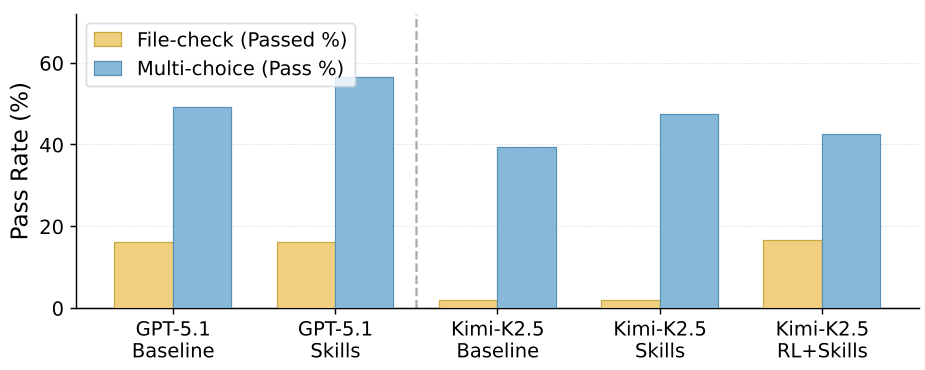
- Bridging Capability Gaps: A weaker base model (Kimi-K2.5) equipped with MetaClaw soared from 21.4% to 40.6% accuracy—essentially matching the performance of a static GPT-5.2 baseline.
- The "Inflection Point": As seen in the RL dynamics, the model performance shows a sharp upward curve around Day 8. This marks the moment where the "Slow" RL update finally internalizes the procedural rules that were previously just "Skills" in the prompt.
Deep Insight: Beyond CLI
MetaClaw isn't just for terminal commands. The authors applied it to AutoResearchClaw, a 23-stage pipeline for writing scientific papers. Even without weight updates, the Skill Injection reduced refinement cycles by 40%. This suggests that "meta-learning" via skill distillation is a universal layer that can be slapped onto any multi-stage agentic workflow.
Critical Analysis & Future Work
Strengths:
- Hardware Agnostic: Uses a proxy-based Cloud LoRA approach, meaning your laptop doesn't need a massive GPU to "evolve" its personal assistant.
- Principled Meta-Learning: The separation of Support and Query data is a sophisticated solution to a problem many "self-evolving" agent papers ignore.
Limitations:
- OMLS Dependency: The system relies on the user effectively configuring their "idle" signals. Unexpected interruptions may fragment training.
- Discrete vs. Continuous: While natural language skills are powerful, there is still a "jump" between prompt-based skills and weight-based policy. Smoothly transitioning knowledge from the prompt into the weights remains an open challenge.
Conclusion
MetaClaw provides a blueprint for the next generation of LLM applications: agents that are not products, but processes. By treating usage as the primary data source for evolution and leveraging idle time for optimization, we move closer to AI that authentically adapts to the "wild" complexity of human life.
Technical Keywords: Continual Meta-Learning, LoRA, Process Reward Model (PRM), Skill Evolution, OMLS Scheduler, Zero-Downtime Adaptation.