
De-coding the Black Hole Shadow: Why de Vries Beats Bardeen at Finite Distances
A note on methods for computing the critical curve of Kerr-like black holes
This paper presents a systematic comparative analysis of three major celestial coordinate definitions (Bardeen, de Vries, and Grenzebach et al.) used to compute the critical curves, or "shadows," of Kerr-like black holes. The study reveals significant discrepancies between these methods for observers at finite distances and in the presence of homogeneous plasma, identifying de Vries's definition as the most physically consistent.
TL;DR
Not all "shadow" definitions are created equal. This paper identifies a critical flaw in the classic Bardeen definition of black hole critical curves: it fails in the presence of plasma and at close range. By comparing it with the de Vries and Grenzebach methods, the authors prove that de Vries's definition is the superior standard for modern astrophysics, especially when dealing with the complex environments surrounding M87* and Sgr A*.
Background: The Limits of Infinity
Since the Event Horizon Telescope (EHT) released the iconic images of M87*, the "shadow" or critical curve has become a primary tool for testing General Relativity. Traditionally, researchers used Bardeen’s definitions, which were built on the assumption of a stationary observer at an infinite distance.
However, as we move toward higher-precision simulations and models that include plasma environments, the "infinite distance" approximation breaks down. If an observer is near the event horizon or if the black hole is embedded in a homogeneous medium, the math used to define the sky coordinates (X, Y) starts to diverge.
The Refractive Problem: Plasma Inconsistency
One of the most striking findings in this study is the "Plasma Paradox." In a homogeneous plasma, physics dictates that the black hole shadow should appear larger due to refractive magnification.
- The Bardeen Failure: Using Bardeen's coordinates, the shadow actually appears to contract as plasma density increases.
- The de Vries/Grenzebach Success: These methods correctly predict shadow expansion.
The authors pinpoint the issue: Bardeen’s definition relies on the ratio of local momenta in a way that is only valid when , a condition that fails the moment you add a dispersive medium like plasma or move the observer closer to the source.
Methodology: A Tale of Three Definitions
The authors拆解 (dissected) three distinct approaches to the observer's sky plane:
- Bardeen (1973): Relates celestial coordinates to the ratios of tetrad momenta against energy.
- de Vries (2000): Uses the ratio of transverse momenta to radial momentum ().
- Grenzebach et al. (2014): Uses celestial angles () and a stereographic projection.
The Geometry of the Skymap
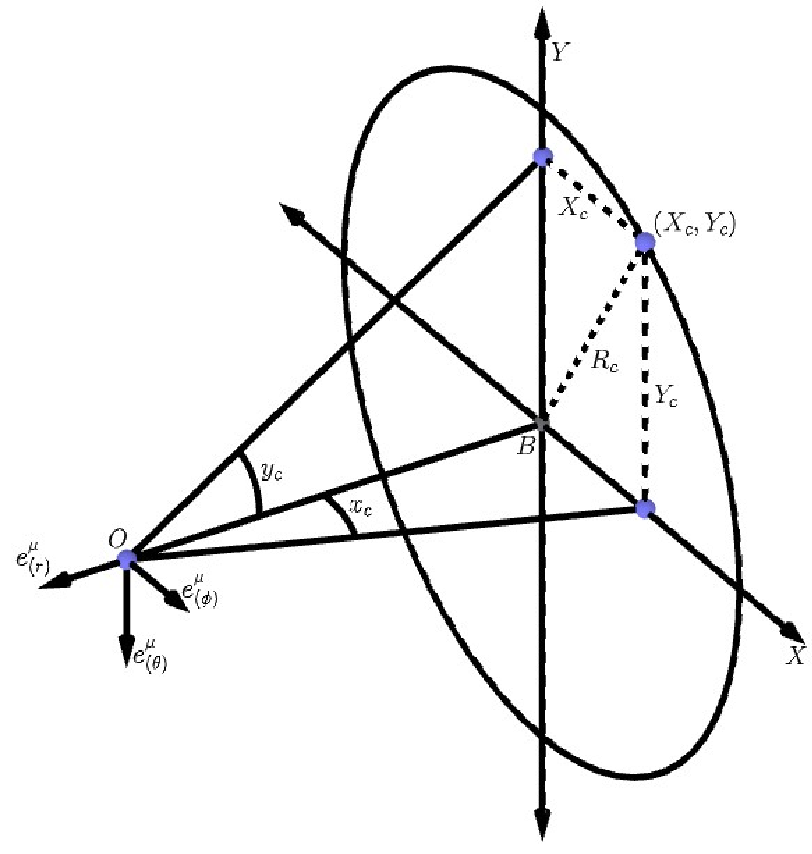 In the figure above, the authors define as the angle between the line of sight and the light ray tangent. The mismatch occurs because stereographic projection (Grenzebach) maps these angles differently than raw tangent extensions (de Vries).
Experimental Evidence: Visualizing the Dissonance
The study provides rigorous visual proof using Schwarzschild and Kerr black hole models.
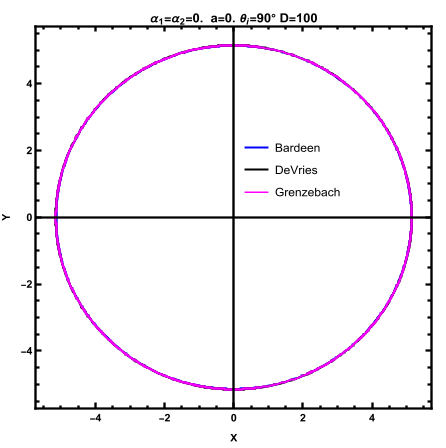 Row 1: Vacuum. Row 2: Inhomogeneous plasma. Row 3: Homogeneous plasma. Columns move from far distance (D=100) to near horizon (D=5).
Key Observations:
- At : All definitions nearly coincide (except Bardeen in homogeneous plasma).
- At : Significant separation occurs. The black line (de Vries) provides the largest, most accurate boundary, while the blue line (Bardeen) significantly underestimates the shadow size.
- Tetrad Shift: By switching between Bardeen and Carter tetrads, the authors show that while the shape remains consistent, tetrad choices introduce a horizontal shift in rotating Kerr holes—a crucial detail for aligning theoretical models with EHT data.
Deep Insight: Why de Vries Wins
The authors mathematically prove that de Vries's definition is equivalent to a direct projection of the light ray's tangent vector onto a physical Euclidean plane at distance . Conversely, the Grenzebach method's use of stereographic projection is "unphysical" for observers at finite distances because the projection point does not lie on the actual tangent line of the light ray.
Conclusion
This paper serves as a vital "calibration" for black hole physics. As we enter an era of high-resolution VLBI, precisely defining the celestial coordinates of the shadow is no longer a theoretical luxury—it is a requirement.
The Takeaway: Stop using Bardeen's formulas for plasma environments. If your observer has a coordinate, and your space has a refractive index, de Vries is the only way to go.
Disclaimer: This analysis is based on "A note on methods for computing the critical curve of Kerr-like black holes" by Sahoo and Banerjee (2026).