
[Tech Deep Dive] Mi:dm K 2.5 Pro: Architecting an Enterprise-Grade Reasoning Powerhouse
Mi:dm K 2.5 Pro
KT introduces Mi:dm K 2.5 Pro, a 32B parameter flagship LLM optimized for enterprise-grade reasoning, long-context (128K) processing, and agentic workflows. It achieves state-of-the-art performance on Korean-specific benchmarks while remaining globally competitive in STEM and coding.
TL;DR
KT's latest flagship, Mi:dm K 2.5 Pro (32B), represents a strategic shift from "bigger is better" to "smarter is better." By integrating Depth Upscaling (DuS), a 128K context window, and a sophisticated Fusion Training pipeline, it bridges the gap between raw reasoning power (STEM, coding) and the nuanced demands of enterprise-grade Korean conversational AI.
Problem & Motivation: The "Enterprise Gap"
While many LLMs can generate fluent text, enterprise environments require more: multi-step reasoning, reliable tool use, and long-document synthesis. Standard scaling often fails to capture the cultural/linguistic nuances of the Korean market or the structural complexity of domain-specific data (like Law or STEM). KT identified that heuristic filters for data were no longer enough; they needed a data foundation that understood the logic of the content.
Methodology: The Core Innovations
1. Robust Data Foundations
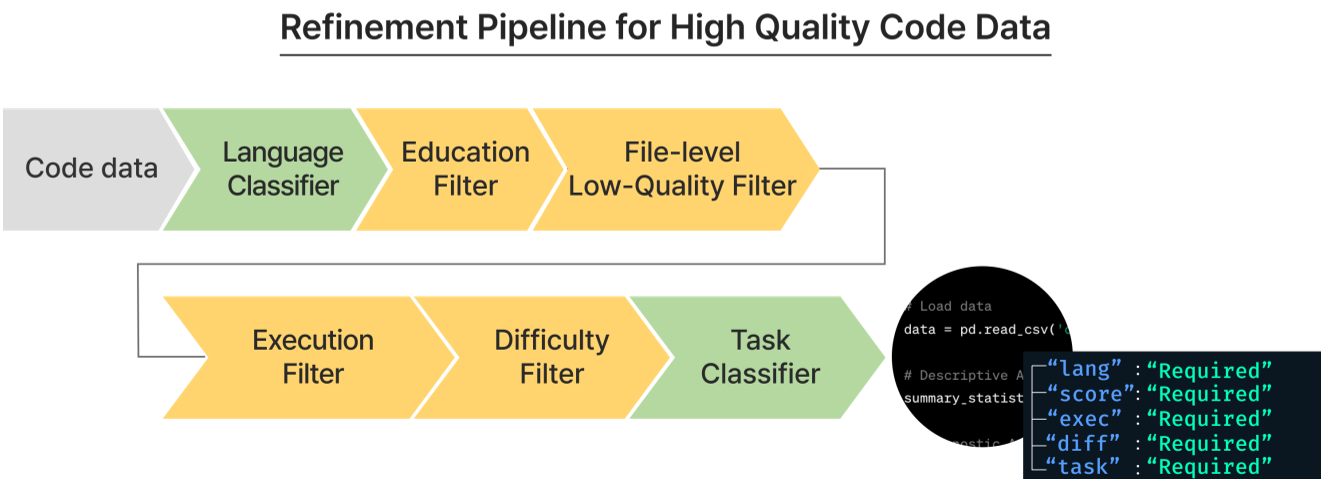
Unlike previous iterations, Mi:dm K 2.5 Pro employs a quality-centric curation pipeline:
- Code: Uses Abstract Syntax Tree (AST) analysis for structural validation rather than simple keyword filtering.
- Math: Implements gap-filling synthesis that targets under-represented reasoning depths (e.g., Geometry & Topology at undergraduate levels).
- Style: Enforces "Response Style Principles" (15 elements like bullet usage and indentation) to ensure service-level consistency.
2. Efficient Scaling via Depth Upscaling (DuS)
To jump from a base model to a 32B flagship efficiently, KT used Layer Predictor-based DuS. Unlike random layer duplication, this method predicts parameters for new layers, ensuring structural continuity and significantly reducing performance degradation post-expansion.
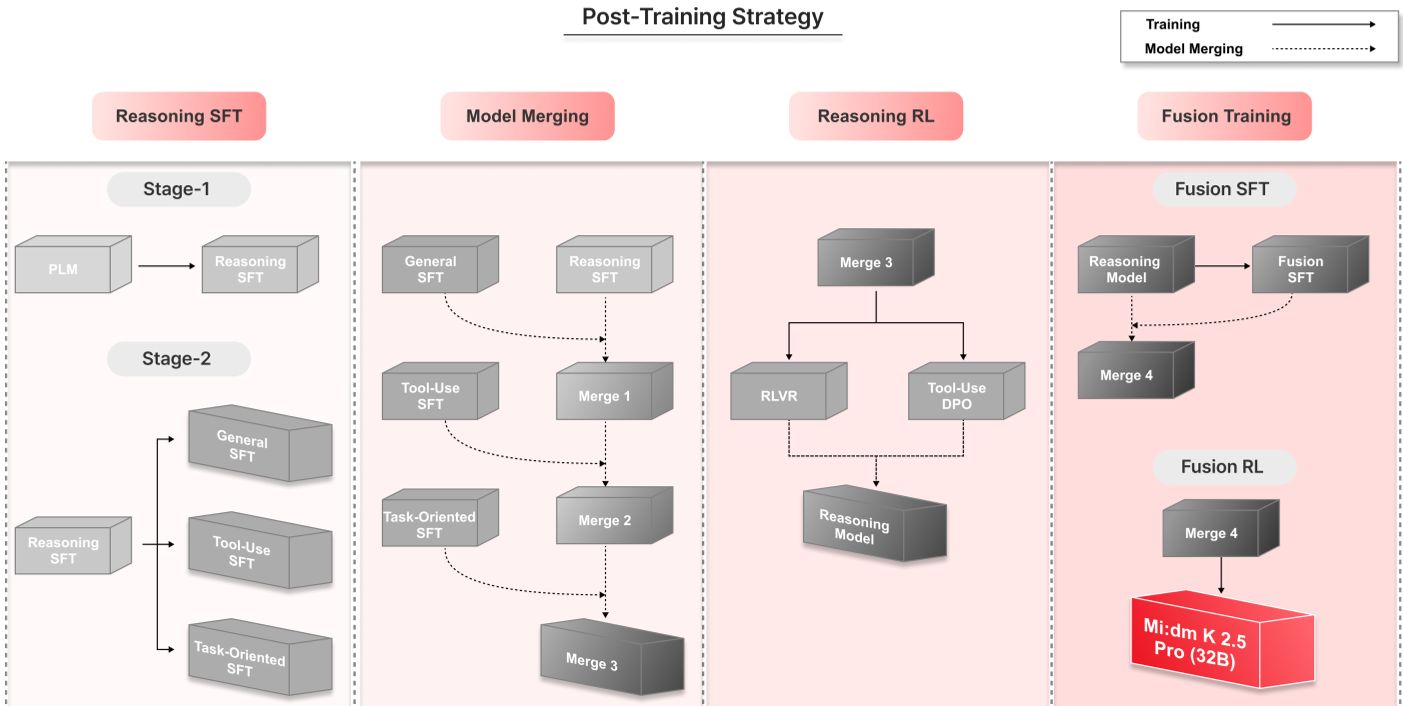
3. The Fusion Training Pipeline
The most critical innovation is Fusion Training. The model undergoes specialized tracks (Reasoning SFT, Agent Track, STEM Track) and then uses Model Merging to consolidate these strengths without additional optimization costs. The final Reinforcement Learning (RL) stage uses an asynchronous architecture, decoupling generation from training to maximize GPU throughput.
Performance: Breaking Benchmarks
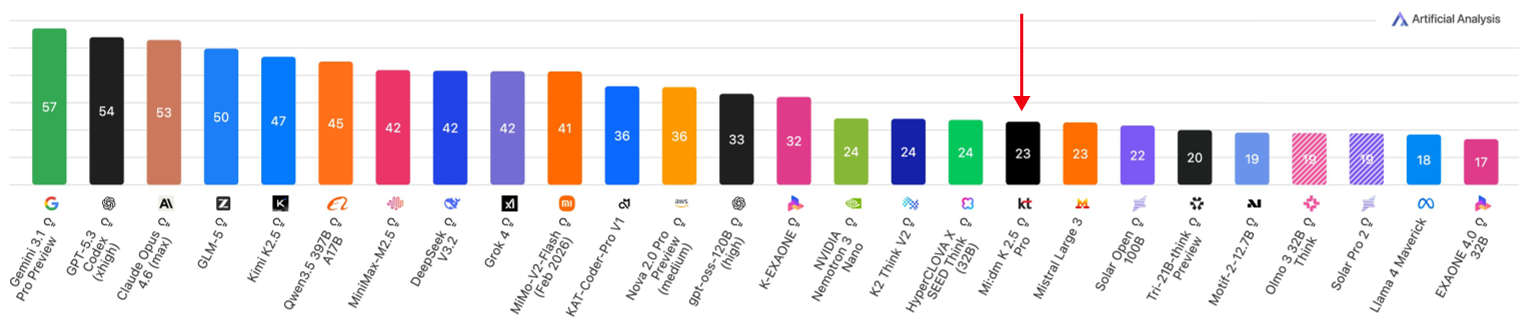
Mi:dm K 2.5 Pro doesn't just dominate domestic benchmarks; it holds its own against global giants:
- Korean Context: Achieved SOTA on Ko-Sovereign and KoBALT, proving deep cultural alignment.
- Reasoning: Hits 72% on GPQA-Diamond and 81.8% on MMLU-Pro, outperforming several models twice its size.
- Human Preference: In blind tests, its "Information Accuracy" in Korean OpenQA outperformed competitors by over 10 points.
Critical Insight: Why it Works
The success of Mi:dm K 2.5 Pro lies in its Asynchronous GSPO (Group Sequence Policy Optimization). By treating RL at the sequence level rather than the token level, it stabilizes long-horizon reasoning. Furthermore, by applying difficulty-aware prompt selection, it prevents the model from wasting compute on "already mastered" easy tasks, focusing RL resources on "Hard" reasoning paths.
Conclusion & Future Outlook
Mi:dm K 2.5 Pro proves that a mid-sized model (32B), when trained with surgical precision on data quality and architecture, can rival much larger dense models. Its ability to balance harmlessness with responsiveness (RAI) sets a new standard for safe enterprise deployment. As KT moves forward, expect this "Mi:dm lineup" strategy to serve as a blueprint for specialized AX (AI Transformation) across industries.
Limitations: While the focus on Korean is a strength, the controlled multilingual inclusion (3-10%) may limit global-only applications. However, for its target enterprise market, it is a formidable contender.