
MiA-Signature: Bridging "Global Ignition" and Local Retrieval in Long-Context LLMs
MiA-Signature: Approximating Global Activation for Long-Context Understanding
MiA-Signature introduces a cognitively-inspired memory interface for Large Language Models (LLMs) called Mindscape Activation Signature. This method approximates global query-induced activation through submodular-based selection of high-level concepts, achieving SOTA performance in long-context tasks by bridging the gap between local retrieval and global semantic awareness.
TL;DR
Current LLM systems treat memory like a keyword search: find a few chunks and hope for the best. MiA-Signature changes the game by mimicking human "global ignition"—a cognitive process where a query activates a broad internal "mindscape." By compressing this global activation into a compact "signature," the researchers achieved significant gains in long-context reasoning, particularly in complex domains like detective novels where local evidence isn't enough.
The Problem: The "Locality" Trap in RAG
Most Retrieval-Augmented Generation (RAG) systems operate on a flawed assumption: that the answer to any complex query can be found by looking at 5-10 isolated text fragments.
In reality, many tasks—especially narrative reasoning—require Global Awareness. For example, in a 10-book detective series, identifying a killer might require linking a minor character's alias mentioned in Book 2 to a specific poison used in Book 9. Standard retrievers often miss these "global bindings" because they only look for surface-level matches to the immediate query.
The Core Insight: Mindscape Activation
The authors, drawing from Global Neuronal Workspace (GNW) theory, suggest that human memory access is a two-stage process:
- Global Activation: A query triggers a broad, non-linear "ignition" across the entire memory.
- Compact Representation: Since we can't process everything at once, we condense this activation into a "signature"—a usable internal state.
Methodology: How MiA-Signature Works
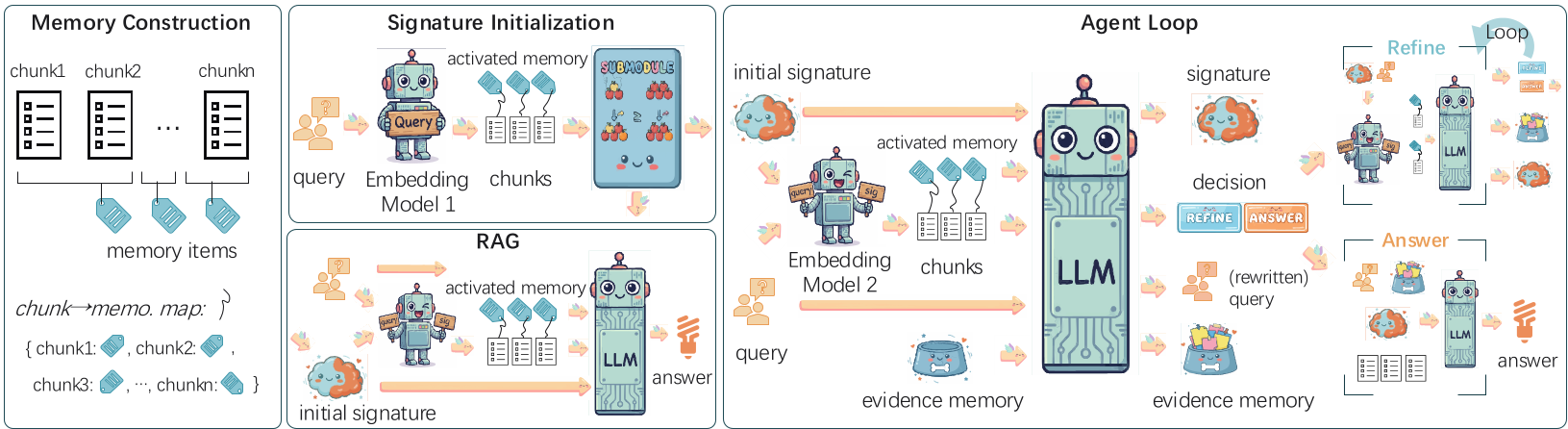
The system introduces three key components:
- The Mindscape: An organized memory pool featuring both fine-grained chunks and high-level session summaries.
- Submodular Selection: To build the signature, the model doesn't just take the top-ranked summaries. It uses a submodular objective that balances relevance, coverage, and diversity. This ensures the signature covers the entire "activated region" without being redundant.
- Mindscape-Aware Retriever: A specialized dual-signal retriever that weighs both the local query and the global signature.
Experiments: Solving the Unsolvable
The researchers tested MiA-Signature on grueling benchmarks like DetectiveQA (reasoning over multi-book series) and NoCha (claim verification).
Key Findings:
- Retrieval Boost: Conditioning retrieval on a signature improved Recall@10 by over 10%.
- Agentic Evolution: In an agent loop, the signature isn't static. It evolves at each step as the agent learns more, serving as a "narrative compass" that keeps the agent from getting lost in the weeds of long documents.

Case Study: The "Miss Marple" Success
In a specific DetectiveQA case, standard agents failed because they couldn't link a "hostess" to a "hidden identity." The MiA-Agent, however, used its signature to maintain the global binding: Hostess = Charlotte-as-Letitia. While local chunks focused on the poisoning mechanism, the global signature provided the who and why that led to the correct answer.
Critical Analysis & Conclusion
The Takeaway: MiA-Signature proves that as context windows grow, we need "smarter" retrieval, not just "more" retrieval. By providing a global semantic prior, we can steer LLMs towards the right information even in "overcomplete" and redundant memory spaces.
Limitations:
- Domain Specificity: The current focus is heavily on narrative/literary content. Its efficacy in unstructured technical data or code is yet to be fully validated.
- Pre-computation: Offline summarization of the mindscape adds an initial indexing cost, though it saves query-time LLM calls.
Future Outlook: The next frontier is End-to-End Signature Optimization, where the signature isn't just selected but is actively learned to maximize the downstream generator's performance.
This work serves as a vital bridge between cognitive science and practical AI engineering, suggesting that for LLMs to truly "understand," they must first have a sense of the whole before diving into the parts.