
[Annals of Probability] Microergodicity Implies Orthogonality: Settling the d=4 Matérn Mystery
Microergodicity implies orthogonality of Matérn fields on bounded domains in $\mathbb{R}^4$
This paper resolves a long-standing open problem in spatial statistics by proving that for stationary Matérn Gaussian random fields in , the variance and range parameters are consistently identifiable under fixed-domain asymptotics. The author introduces a localized spectral probing framework to demonstrate that microergodicity implies the orthogonality of measures in this critical dimension.
TL;DR
In the world of spatial statistics, the Matérn covariance is king. But a mathematical mystery has persisted for years: in exactly four dimensions, can we tell the difference between a field that is "very bumpy but short-ranged" and one that is "smooth but long-ranged" if we only have one densifying patch of data? This paper finally says yes. By looking at the "faint echoes" in the high-frequency spectrum, the author proves that these models are fundamentally different (mutually singular), completing the dimensional map of Matérn identifiability.
Context: The Identifiability Phase Transition
When we observe a Gaussian Random Field (GRF) on a fixed domain (like a square in ) and take more and more samples within that same square—a process called infill asymptotics—we face a limit. For years, we've known a strange truth:
- : You cannot distinguish variance () from range (). They are tangled in a single "microergodic" parameter.
- : You can distinguish them perfectly as the sample density goes to infinity.
- : The "Critical Case." The math was too close to call—until now.
The "Why": Why is Dimension 4 so Special?
The difference between two Matérn models with the same microergodic parameter appears in the high-frequency tail of their spectral densities.
In lower dimensions, the "mismatch" between two models is so small that it's essentially noise—the measures are equivalent. In higher dimensions (), the mismatch is huge. In , the mismatch accumulates logarithmically. Like a slow leak in a bucket, it takes a long time to notice, but eventually, the difference becomes infinite.
Methodology: Probing the Spectrum
The author doesn't just look at the raw data. He uses localized Fourier coefficients. By applying a smooth "window" (cutoff function ) to the field and then taking a Fourier Transform, we can isolate specific frequency bands.
 The localized coefficient acts as a "probe" for frequency .
The core of the proof lies in constructing a statistic :
This is a "score-type" statistic. Under Model 1, its average is 0. Under Model 2, its average is 1. Because the variance of this statistic shrinks as we look at more frequencies (at a rate of ), the two models eventually drift apart until they no longer overlap.
Experimental Evidence
The author validates this theory with simulations in . Even when the parameters and are very close, the empirical distribution of the statistic shows a clear separation as the frequency shell increases.
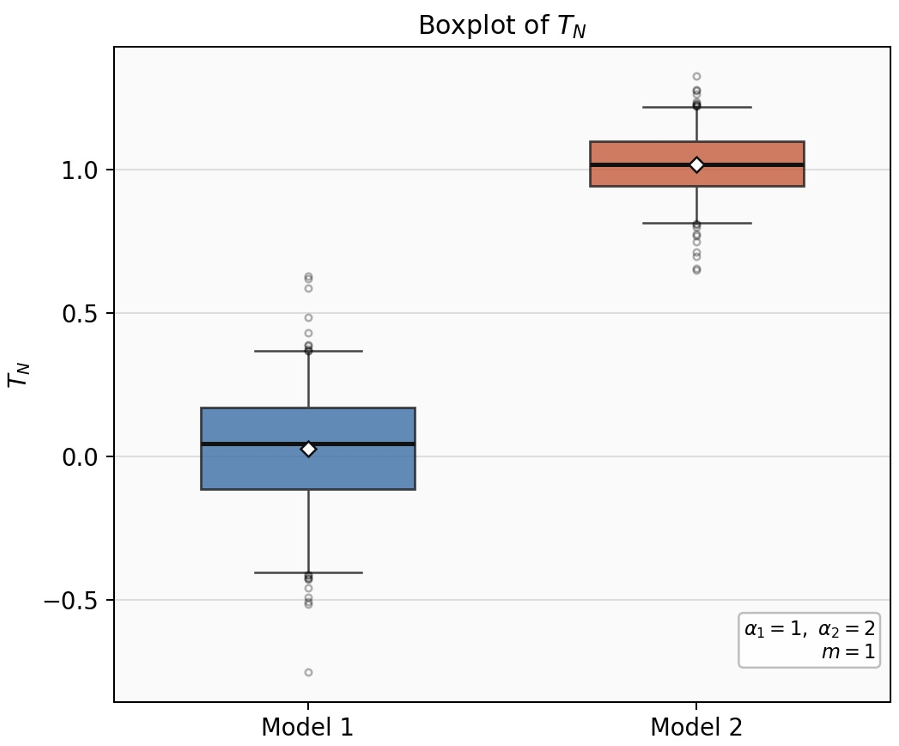 Figure 1: Distribution of showing clear separation between Model 1 (centered at 0) and Model 2 (centered at 1).
Deep Insights & Takeaways
The most profound takeaway is the Spectral Probing Framework. While previous attempts (like Anderes' higher-order increments) focused on physical space, this spectral approach provides a much cleaner environment to manage the "off-diagonal" correlations that usually plague spatial data.
Is it useful for AI? Absolutely. As we move toward Physics-Informed Neural Networks (PINNs) and large-scale spatial modeling (like climate AI or medical imaging in 3D/4D), understanding whether our models are over-parameterized is crucial. This paper tells us that in 4D (spacetime!), the range and variance parameters are not just "theoretical constructs"—they are physically distinct and estimable.
Conclusion
By settling the case, this work provides a rigorous mathematical closing to a decades-old question. It reminds us that in the "borderline" cases of mathematics, the signal might be weak (logarithmic), but with the right spectral "microscope," it is undeniable.