
MIND: Beyond Gaussian Assumptions in Generative Model Evaluation
MIND: Monge Inception Distance for Generative Models Evaluation
The paper introduces Monge Inception Distance (MIND), a novel metric for evaluating generative models based on the sliced Wasserstein distance. It computes the average of one-dimensional optimal transport distances across random projections, effectively achieving SOTA results in sample efficiency and computational speed.
TL;DR
Researchers from Google DeepMind have introduced Monge Inception Distance (MIND), a replacement for the ubiquitous FID. By leveraging Optimal Transport theory and 1D "sorting" tricks, MIND is 10x more sample-efficient, 100x faster, and significantly more robust to adversarial hacking than FID.
The Problem: The "Gaussian Trap" of FID
For years, the Fréchet Inception Distance (FID) has been the king of metrics. However, it harbors a dirty secret: it assumes your data follows a multidimensional Gaussian distribution.
- Sample Hunger: To estimate a stable covariance matrix, you need at least 50,000 samples. This makes iteration cycles painfully slow.
- Vulnerability: Because FID only looks at the mean and covariance, it's possible to "hack" the metric. A model can produce garbage images that happen to have the same first two moments as the training set, resulting in a "perfect" FID score of 0.
- Computational Heaviness: Matrix square roots and inversions in high dimensions are not cheap.
Methodology: The Monge Intuition
MIND honors Gaspard Monge, the father of Optimal Transport. Instead of fitting a Gaussian, it uses the Sliced Wasserstein Distance.
How it works:
- Projection: Take the high-dimensional Inception embeddings and project them onto random 1D unit directions.
- Sorting: In 1D, the "Optimal Transport" distance is trivial—you just sort the points and calculate the average distance between corresponding pairs.
- Averaging: Average these distances over all projections.
This captures the actual shape of the distribution, not just an ellipsoidal approximation.
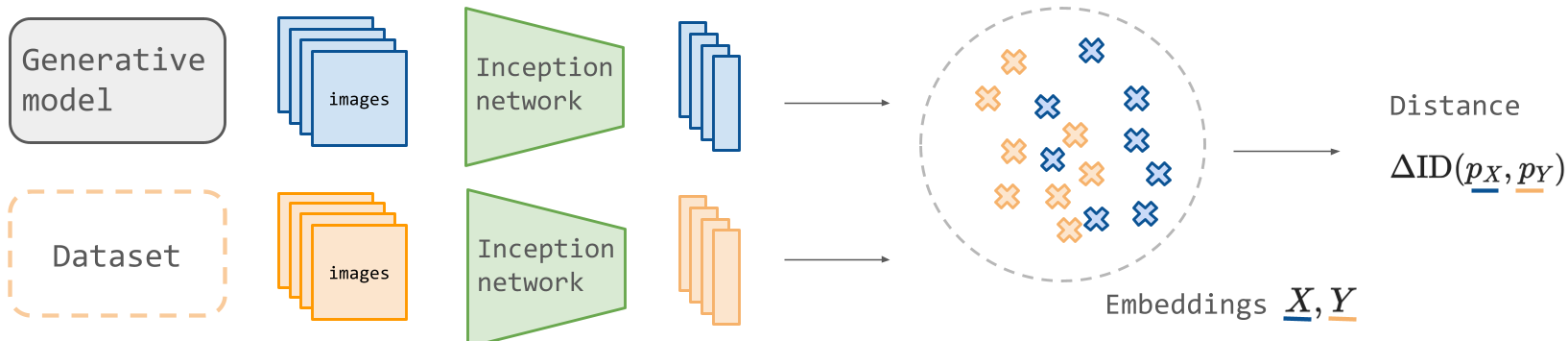 Figure 1: The general pipeline for evaluating generative model distance using projected 1D distributions.
Why it Works: Mathematical Robustness
Unlike FID, MIND is a proper distance. This means if and only if .
In the paper's "Moment Matching" experiment, the authors used an optimization trick to force the generated images to match the mean and covariance of the target dataset.
- FID Result: Drops by nearly 89% (hacked).
- MIND Result: Remains significantly higher ( ratio), proving it sees through the "moment-matching" facade to the underlying distributional differences.
Results: Efficiency at Scale
The empirical evidence is striking. The authors demonstrate that MIND with 5,000 samples (MIND5k) is as reliable as FID with 50,000 samples (FID50k).
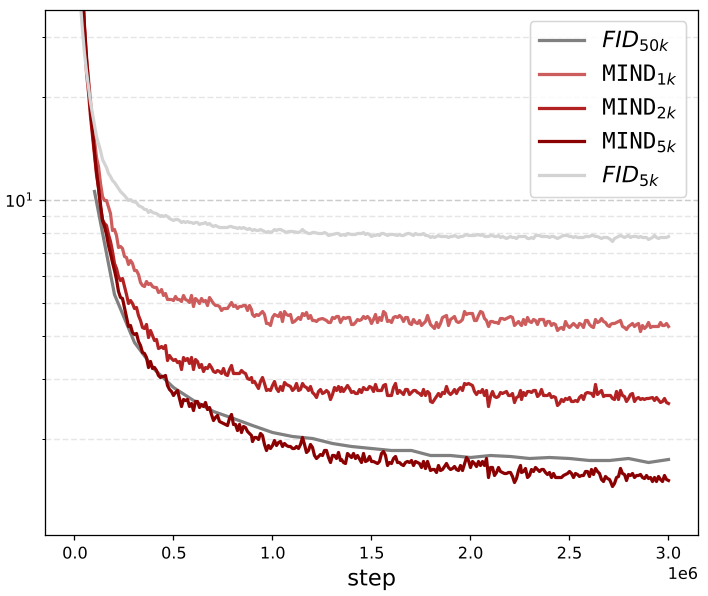 Figure 2: MIND5k tracks the progress of a diffusion model training run much more cleanly than FID at lower sample sizes.
Key Performance Gains:
- Speed: Over 100x faster than FID on TPUv4.
- Memory: Over 10x less peak memory.
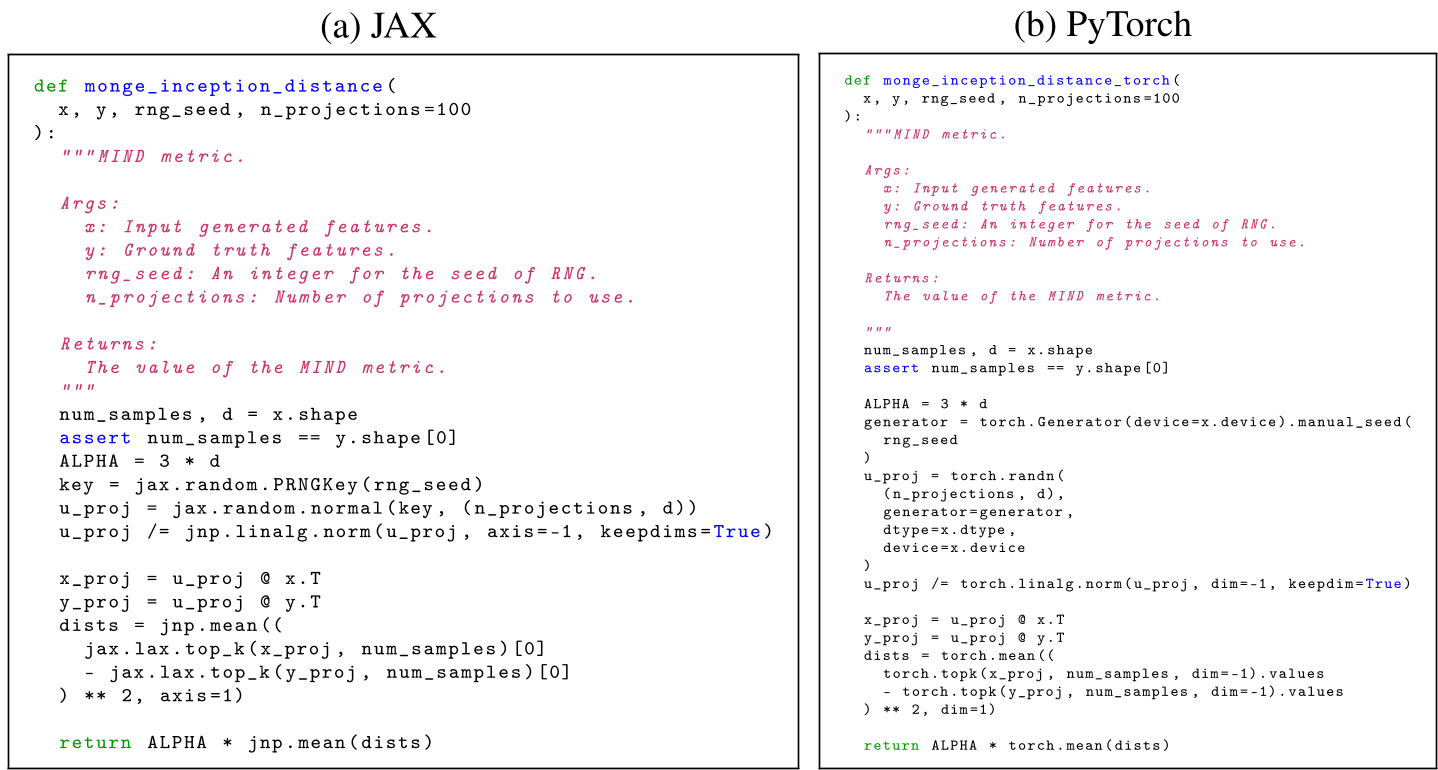
- Implementability: The core logic is just a few lines of JAX or PyTorch code involving
sort()andeinsum.
Critical Analysis & Future Outlook
While MIND solves the statistical and computational issues of FID, it remains a feature-dependent metric. If your Inception-v3 backbone is biased, MIND will inherit those biases. However, the authors emphasize that MIND is embedding-agnostic. It can be used with CLIP, DINOv2, or even audio-specific embeddings.
The Verdict: MIND is a rare "free lunch" in machine learning—it is faster, cheaper, and more accurate. For any researcher training large-scale diffusion models, switching from FID50k to MIND5k should be an immediate priority to accelerate the R&D loop.
Takeaway for Practitioners
If you are tired of waiting for 50k image generations just to see if your model is improving, check out the provided PyTorch snippet. MIND allows for high-frequency evaluation during the training bottleneck, potentially catching divergence much earlier than traditional methods.