
Mind the Gap: Why Synthetic Tabular Data Doesn't Need to Be "Real" to Work
Mind the Gap? A Distributional Comparison of Real and Synthetic Priors for Tabular Foundation Models
This paper presents a distributional comparison of three tabular foundation model (TFM) corpora: web-scraped (T4), curated (TabFM), and synthetic (TabICL). Using discriminator AUCs and k-NN metrics, it reveals that current synthetic priors are significantly OOD (out-of-distribution), covering less than 25% of real-world table space despite exhaustive hyperparameter optimization.
TL;DR
A new study from the University of Bristol reveals a shocking paradox in Tabular Foundation Models (TFMs): the synthetic data we use to train them is distributionally "fake" and occupies only a tiny fraction of the real-world table space. Yet, this massive distributional gap has zero measurable impact on how well these models perform on real-world tasks. This suggests that the secret sauce of models like TabPFN or TabICL isn't matching reality, but rather the structural logic they learn during pre-training.
The "Reality Gap" in Tabular Data
Unlike images or text, tabular data has no "natural" structure. To train Foundation Models for tables, researchers typically use one of three sources:
- Curated Benchmarks: Gold-standard datasets from Kaggle or OpenML.
- Web-Scraped Tables: Massive, noisy crawls from the open web (like T4).
- Synthetic Priors: Infinite tables generated via Structural Causal Models (SCMs).
The industry has pivoted toward Synthetic Priors because they are easy to scale and license-free. But a critical question remained: Do these synthetic tables actually look like real ones?
Methodology: Testing the "Un-optimizable" Prior
The authors used a suite of aggregate features (skewness, kurtosis, correlation histograms) to compare the TabICL synthetic prior against real-world corpora. They didn't just check default settings; they ran an 86,000-configuration grid search—one of the most extensive hyperparameter sweeps in the field—to see if the synthetic prior could be tuned to "cover" the real data distribution.
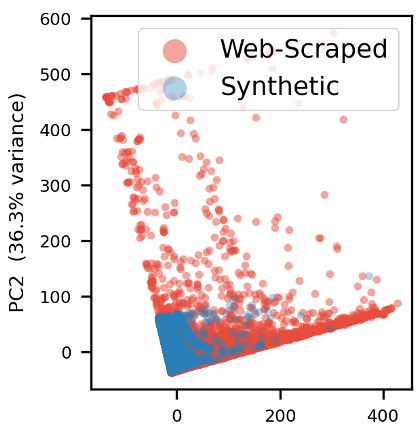 Above: PCA projections showing the narrow space occupied by synthetic ICL data (red) compared to the vast spread of real-world tables (blue/yellow).
Key Findings
1. The Synthetic Space is a "Narrow Island"
Synthetic data is highly identifiable. A simple XGBoost discriminator can tell a synthetic table from a real one with nearly 100% accuracy (AUC > 0.99). Even after exhaustive optimization, the synthetic prior refused to overlap with real data. The "Reality Gap" isn't a tuning problem; it's a structural one.
2. Scraped vs. Curated: Two Sides of the Same Coin
In a win for Large Language Model-style scaling, the study found that web-scraped tables (T4) and curated Kaggle tables (FM) are distributionally interchangeable. If you have enough scraped data, you don't necessarily need hand-picked benchmarks for pre-training.
3. The Performance Paradox
This is the most "PhD-level" insight: You would expect that as a table gets "further" from the training prior, the model's performance would drop. It doesn't.
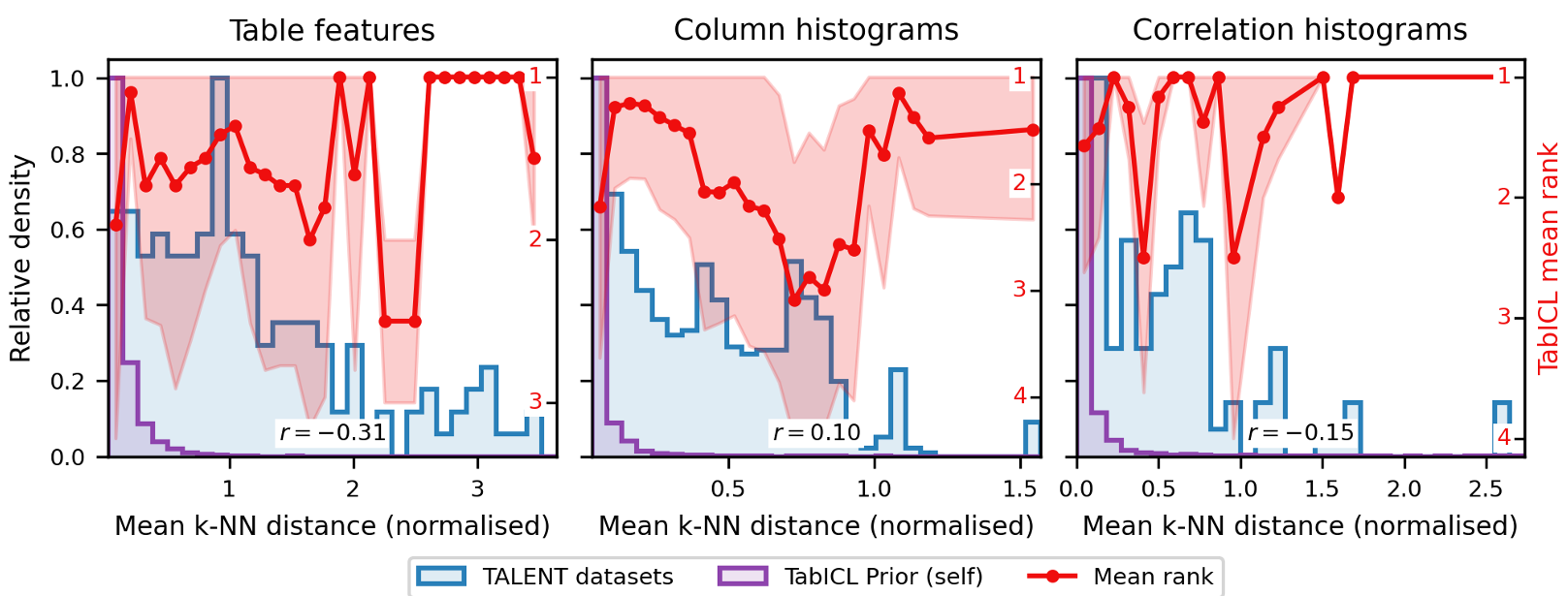 Experimental evidence shows no correlation (r < 0.14) between how "real" a table is and how well the model predicts it.
The model’s internal representations (column and row embeddings) show that even when the data is according to the model's own view "far away," the In-Context Learning (ICL) mechanism remains robust.
Critical Analysis: Why Does It Work?
If distributional coverage doesn't matter, what does? The authors propose two compelling theories:
- In-Context Learning Robustness: The act of conditioning on examples at inference time is so powerful that it overrides the "Out-of-Distribution" nature of the pre-training data.
- Causal Inductive Bias: Synthetic priors teach the model the logic of how variables interact (causality and tree-structures), which is a universal language that applies even if the specific statistical distributions are slightly off.
Conclusion
This paper shifts the goalposts for future Tabular Foundation Model research. Instead of trying to make synthetic data "look more real," researchers should focus on making the generative logic more complex. The "Gap" isn't something to be minded—it's a sign that our models are learning something deeper than mere surface-level statistics.
Takeaway for Practitioners: Don't sweat the "realism" of your synthetic pre-training data. Focus on the diversity of the underlying causal structures.