
MiniMind-O: Demystifying the 0.1B-Scale Speech-Native Omni Model
MiniMind-O Technical Report: An Open Small-Scale Speech-Native Omni Model
MiniMind-O is an open-source, 0.1B-scale omni-multimodal model that supports text, speech, and image inputs with streaming speech output. It employs a "Thinker-Talker" architecture, integrating frozen SenseVoice and SigLIP2 encoders with a MiniMind language backbone to achieve seamless multimodal interaction.
TL;DR
MiniMind-O is a breakthrough in "small-scale" multimodal AI. While industry giants like GPT-4o remain closed and massive, MiniMind-O delivers a 100M-parameter "omni" model that can see, hear, and talk. By separating reasoning (Thinker) from acoustics (Talker) and releasing the full training recipe, it transforms complex multimodal interaction into a controllable and inspectable research object.
The "Cascaded" Crisis and the Scaling Trap
Most voice assistants today feel "robotic" because they are stitched together: an ASR module passes text to an LLM, which then passes text to a TTS engine. The language model never "hears" the audio; it only sees the transcript. This acoustic isolation makes it nearly impossible for models to capture nuances like emotion or correct pronunciation of heteronyms.
Furthermore, "Omni" capabilities are usually associated with billion-parameter models requiring industrial clusters. MiniMind-O challenges this by asking: What is the minimum viable architecture for a speech-native loop?
Methodology: The Thinker-Talker Split
The core of MiniMind-O is the interaction between two modules: the Thinker (the reasoning engine) and the Talker (the acoustic generator).
1. The Bridge Choice
One of the paper's most critical insights is where to connect these two modules. If the Talker reads the Thinker's final layer, it gets "noisy" data biased toward text prediction. If it reads the first layer, it lacks context. MiniMind-O extracts features from the middle layer (Layer 3 of 8), providing a balanced semantic representation for audio synthesis.
2. Parameter-Efficient Talker
Instead of duplicating output heads for each of the eight Mimi audio codebooks, the authors used a shared base with low-rank adapters. This allows the 0.1B model to handle complex audio signals without a massive parameter explosion.
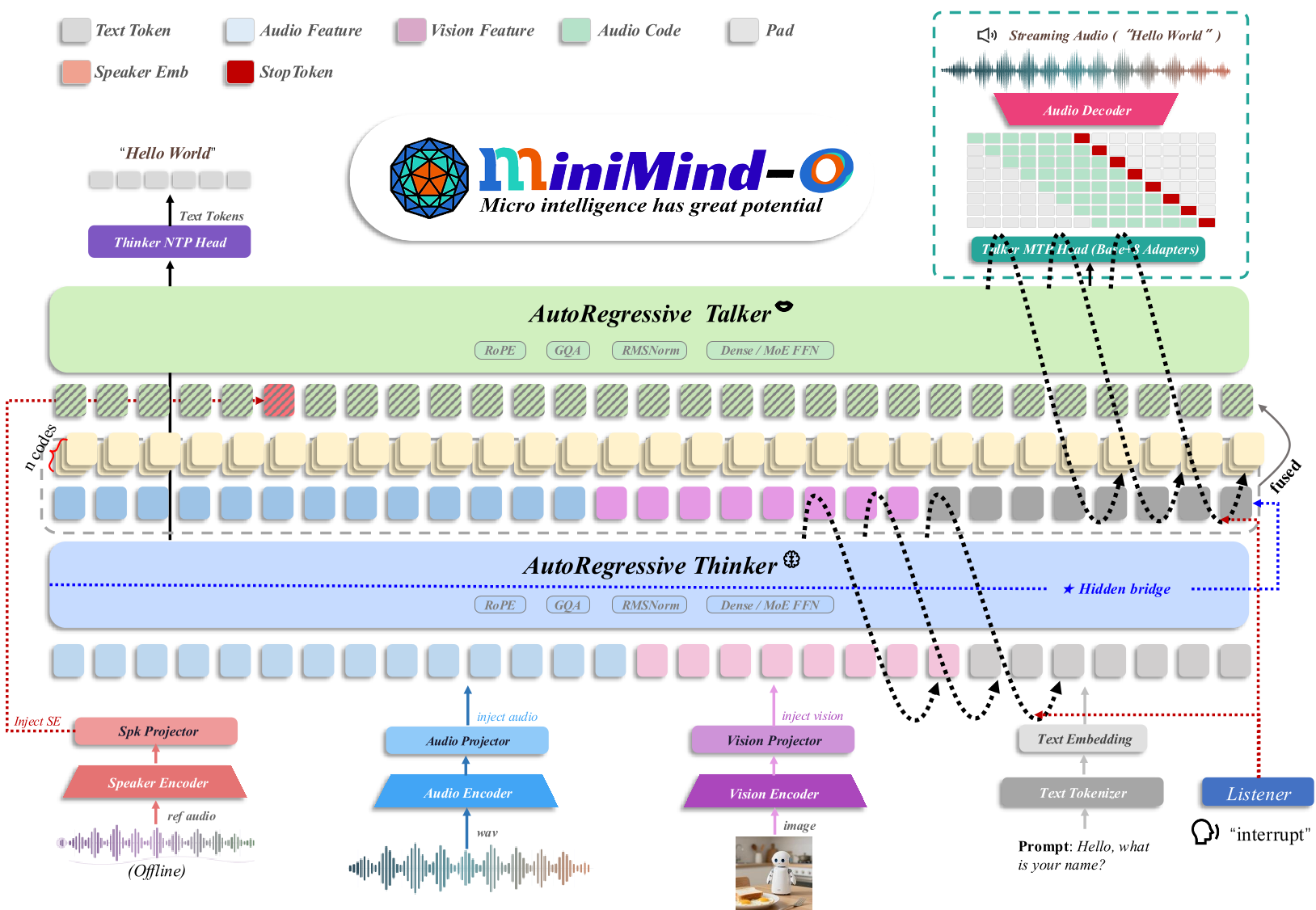 Figure 1: The MiniMind-O architecture, showing the injection of visual and audio features into the Thinker and the subsequent Bridge connection to the Talker.
Training and Data: The Open Recipe
A major contribution of this work is the release of the T2A (Text-to-Audio), I2T (Image-to-Text), and A2A (Audio-to-Audio) datasets in Parquet format. The training pipeline is remarkably efficient, completing a full cycle in under four hours on consumer-grade GPUs (4x RTX 3090).
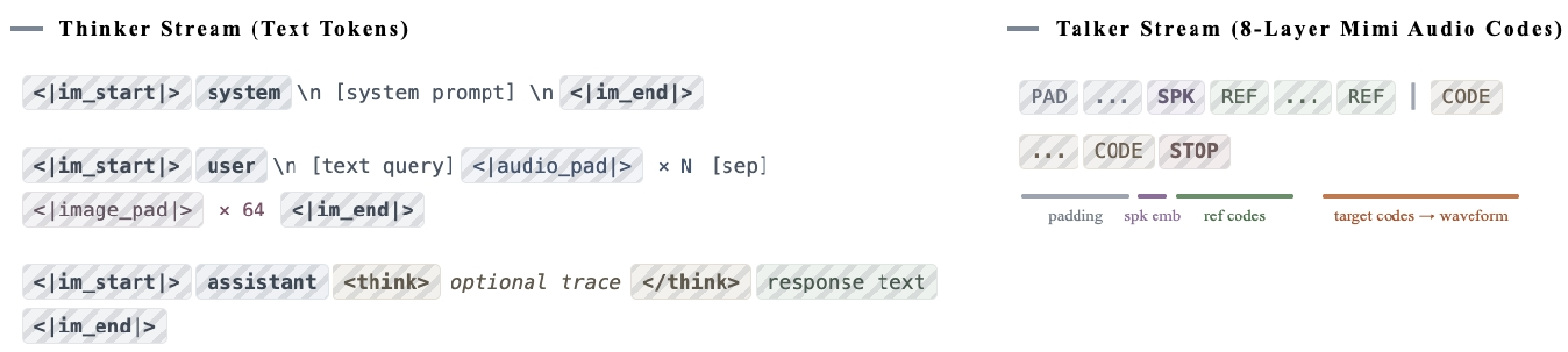 Figure 2: The aligned sequence format allows the model to learn text and audio tokens in a single autoregressive pass.
Experimental Performance: Consistency is Key
The model was evaluated primarily on Thinker-Talker consistency—does the spoken audio actually match the generated text?
- Accuracy: The dense variant achieved an average CER of 0.0897.
- Voice Cloning: By using CAM++ embeddings and reference codec prompts, the model supports zero-shot voice cloning with a similarity score of 0.5995.
- VLM Capabilities: Despite its size, it can describe images via speech, trailing larger models like Mini-Omni2 (0.5B) but remaining within the same performance tier at 1/5th the size.
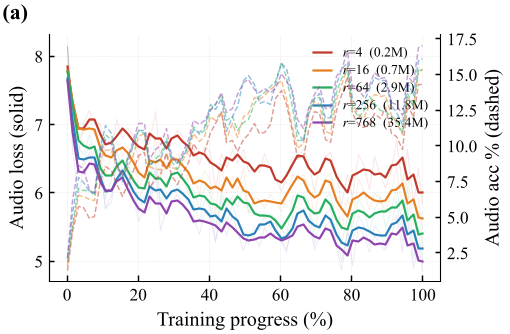 Figure 3: Ablation studies showing that the Talker's output head rank is more critical for audio quality than the input embedding rank.
Critical Insight & Future Outlook
The value of MiniMind-O isn't that it beats GPT-4o; it's that it democratizes the technology. It identifies that middle-layer bridging and efficient codebook interfacing are the "scale-critical" choices that allow tiny models to act like giants.
While it currently struggles with long-form English stability and fine-grained visual details, it provides the first "fully inspectable" blueprint for the next generation of on-device interaction models.
Conclusion
MiniMind-O is more than a model; it is a compact and reproducible recipe. For researchers, it offers a way to study multimodal alignment without a million-dollar compute budget. For developers, it suggests a path toward highly efficient, speech-native assistants that can run locally on mobile hardware.