
Beyond the Hawking Explosion: Squaring the Energy-Entropy Debt of Black Holes
Minimum lifetime of a black hole
This paper derives fundamental lower bounds on the total lifetime of an evaporating black hole within the framework of "asymptotically semiclassical spacetimes." By combining the Bondi energy flux with the entanglement entropy of Hawking radiation, the authors identify a purification phase following the traditional Hawking evaporation, concluding that the minimum lifetime scales as for an initial mass .
TL;DR
The "death" of a black hole is not the end of its story. This paper proves that for a black hole to return information to the universe (purification), it must endure a final phase that lasts significantly longer than its initial evaporation. Applying fundamental energy conservation laws to quantum entanglement, the authors derive a minimum lifetime scaling of , and potentially an exponential one, effectively turning old black holes into long-lived "white hole" remnants.
Context: The Asymptotic Perspective
Most attempts to solve the information paradox dive deep into the "firewalls" or "fuzzballs" of the black hole interior. This work stays safely at Future Null Infinity (). By treating the black hole as an isolated system and focusing on observables available to a far-away observer, the authors sidestep the messy, unknown physics of the Planckian bulk. They rely on "Asymptotically Semiclassical Spacetimes," a middle-ground where quantum effects dissipate far from the source.
Motivation: The Hidden Cost of Purity
Early-stage Hawking radiation is thermal and "mixed"—it carries no information. If the total state of the universe is to remain pure (unitary), the later stages of radiation must be correlated with the early parts to cancel out the entropy.
The authors reveal a crucial Energy-Entropy Relation: This formula implies that reducing entanglement entropy () always costs mass. Since a black hole at the end of its Hawking phase has very little mass left but a massive "entropy debt," it must squeeze out the remaining information very slowly to avoid overspending its remaining energy budget.
Methodology: The Three Phases of Evaporation
The paper structuralizes the life of a black hole into three distinct acts:
- Phase A (Hawking Phase): Thermal emission. The black hole shrinks to Planck mass while entropy skyrockets.
- Phase B (Quiescence): A potential "waiting period" where radiation stops but the mass remains constant.
- Phase C (Purification Phase): The focus of the paper. Information is released.
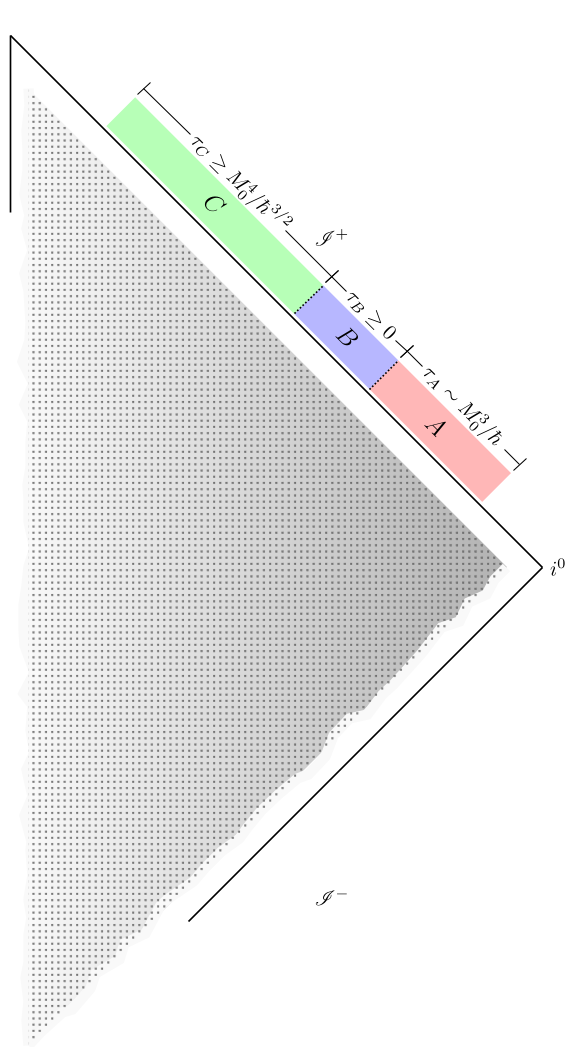 Figure 1: Conceptual diagram of the three phases of black hole evolution at null infinity.
By using the Cauchy-Schwarz inequality on the integral of the redshift exponent , the authors show that the time required for to hit zero while hits zero must satisfy the bound.
The "Stable" Remnant & The White Hole Transition
A striking finding is the behavior of the Redshift Exponent . In the purification phase, becomes negative.
In general relativity, a positive (surface gravity) is the hallmark of a black hole. A negative is the signature of a White Hole. This supports the "Black-to-White Hole transition" theory, where the remnant acts as a white hole releasing information at a glacial pace.
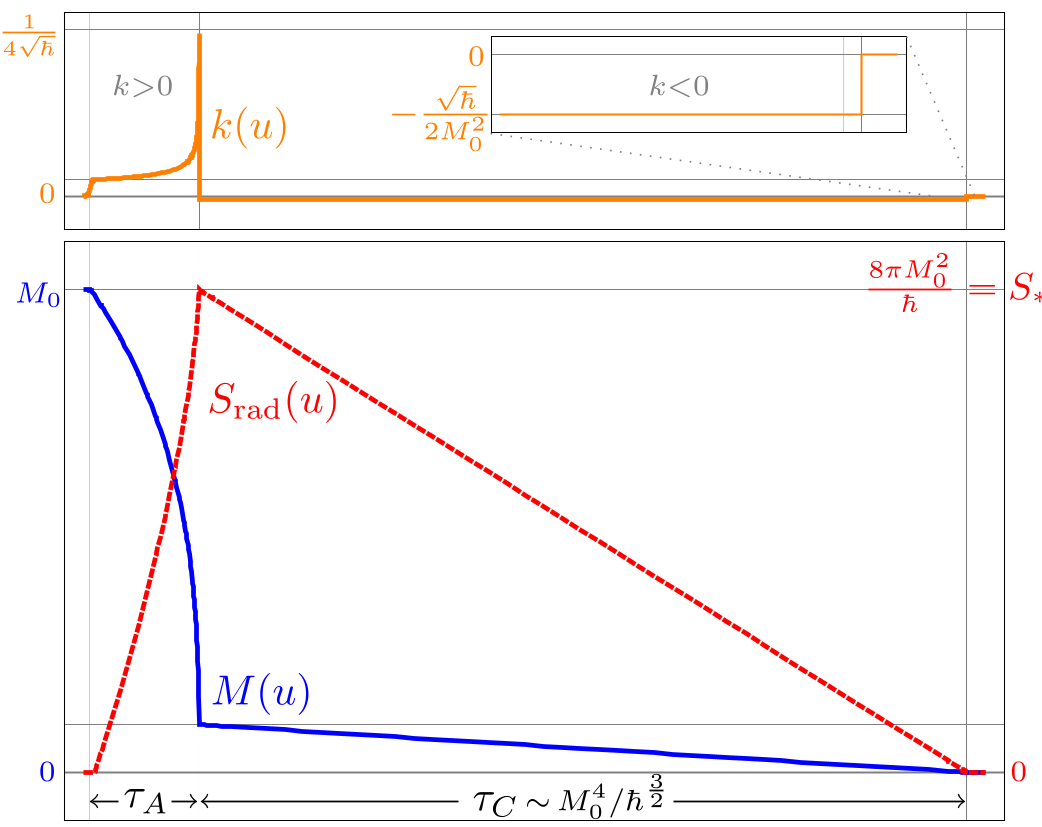 Figure 2: Performance metrics (Mass, Entropy, Redshift) for the "Metastable Remnant" scenario where the lifetime becomes exponential.
If we assume the remnant is metastable (due to the discrete nature of space-time in Loop Quantum Gravity), the lifetime doesn't just scale with ; it explodes exponentially: .
Moving Mirror Analog
To visualize this bulk-less approach, the authors map the process to a Moving Mirror in 2D.
- Hawking Phase: The mirror accelerates, mimicking the horizon.
- Remnant Phase: The mirror decelerates and eventually returns to rest, but with a spatial "displacement" (memory).
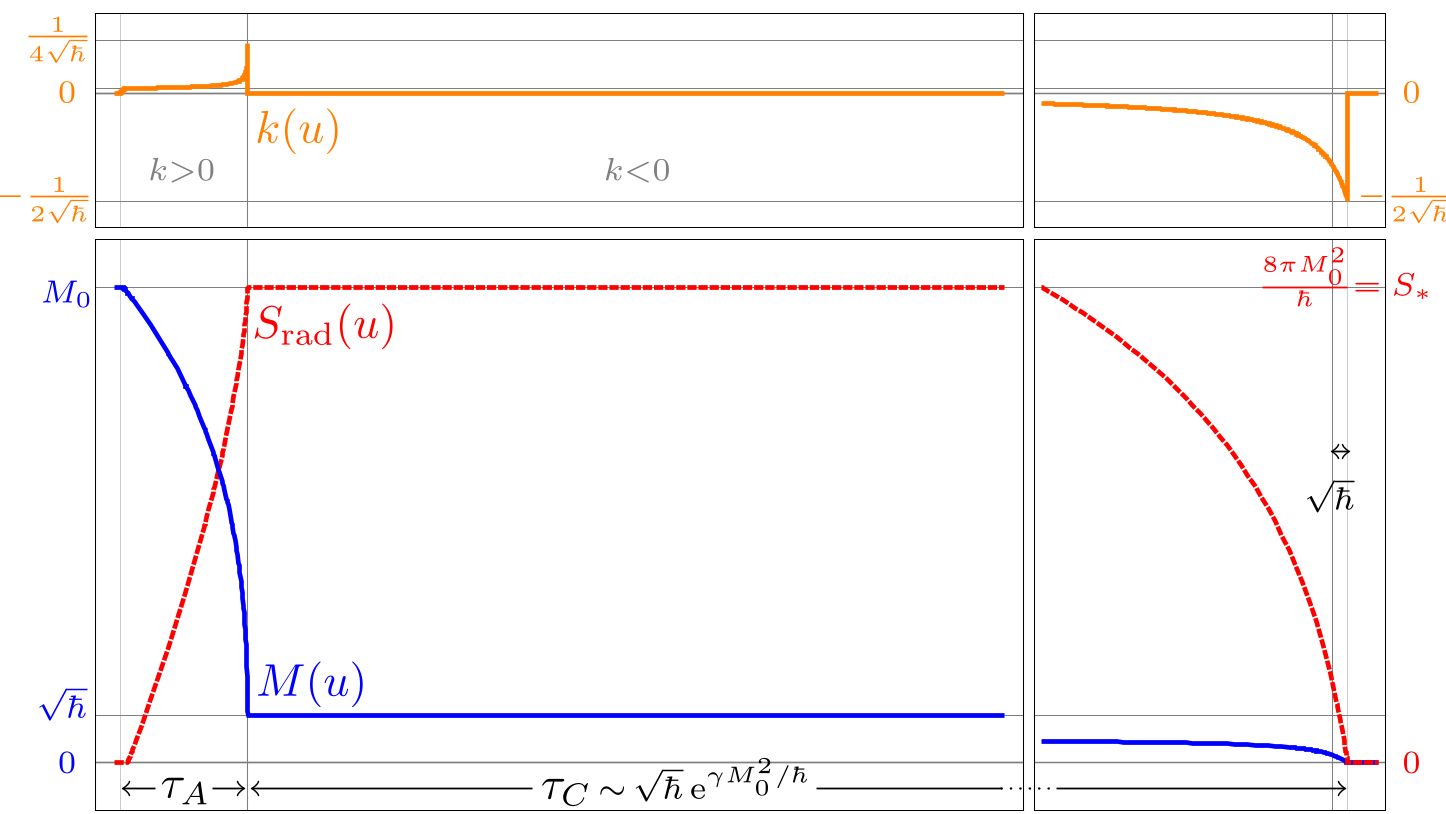 Figure 3: The trajectory of the moving mirror analog across the three phases.
Conclusion & Insights
This paper provides a robust, model-independent argument for long-lived black hole remnants.
Key Takeaways:
- Information has weight: You cannot purify a quantum state without a corresponding sacrifice in Bondi mass.
- Dark Matter Candidate: If primordial black holes formed in the early universe, their or exponential purification time means they are likely still here today as Planck-sized "white hole" remnants.
- Limitations: The exact duration of the "quiet" Phase B remains a mystery, requiring a full-fledged theory of Quantum Gravity to solve.
Future work will likely look closer at the "memory effect" (the displacement ) and whether this signature can be detected in gravitational wave backgrounds or high-energy cosmic rays.