
Arqade: Automating the Quantum-Classical Interface for qLDPC Codes
Mitigating Classical Resource Costs in Quantum Error Correction via Generalized qLDPC Predecoding
Arqade is an automated framework designed to generate lightweight predecoders for any quantum Low-Density Parity-Check (qLDPC) code. It mitigates classical resource costs by handling over 90% of the decoding workload locally, significantly reducing the utilization of computationally expensive second-level decoders like BP-OSD.
TL;DR
As we move toward fault-tolerant quantum computing (FTQC), the bottleneck is shifting from the quantum chips to the classical controllers that must correct errors in real-time. Arqade is a breakthrough framework that automatically designs hardware-efficient "predecoders" for any quantum low-density parity-check (qLDPC) code. By resolving up to 99% of simple errors locally, Arqade reduces the workload on heavy-duty classical decoders by orders of magnitude, even supporting hundreds of thousands of logical qubits within cryogenic power budgets.
The Bottleneck: Why "Global" Decoding Doesn't Scale
In the quest for FTQC, we replace noisy physical qubits with stable logical qubits via Quantum Error Correction (QEC). Currently, the surface code is the benchmark, but general qLDPC codes (like Bivariate Bicycle codes) are the future—they offer much better encoding rates, meaning we need fewer physical qubits to get the same logical performance.
However, there is a "classical tax." Decoding general qLDPC codes usually requires Belief Propagation (BP) combined with Ordered Statistics Decoding (OSD). OSD is computationally expensive (think matrix inversions), creates massive latency, and demands significant power. In a system with millions of qubits, you cannot give every logical qubit its own OSD instance; they must share. This leads to resource contention—a traffic jam in the classical controller that can stall the whole quantum computer.
The Insight: Let the "Small" Errors be Solved Locally
The authors observe that the vast majority of errors are "length-1"—sparse, simple patterns that don't need a supercomputer to solve.
Predecoding acts as a filter:
- Level 1 (Predecoder): Fast, local hardware logic catches 90%+ of simple errors.
- Level 2 (Global Decoder): The expensive BP-OSD system only wakes up when the predecoder is stumped by complex, dense error patterns.
Previously, predecoders were hand-crafted for the surface code's specific geometry. Arqade automates this for any code by parsing the Detector Error Model (DEM) and turning graph edges into "predecoding primitives."
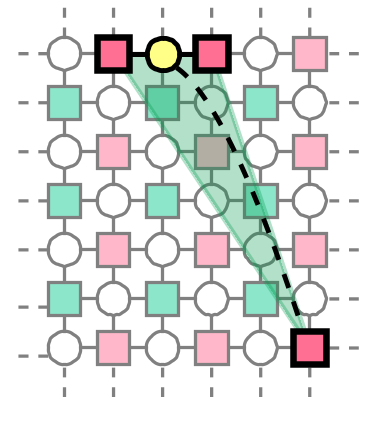 Figure: Predecoding primitives for Color and Bivariate Bicycle codes.
How Arqade Works: From Graph Theory to Silicon
The technical "secret sauce" of Arqade lies in two phases:
1. Automated Logic Generation
Arqade looks at the code's syndrome measurement circuit and identifies every possible single-fault error. It then "prunes" these:
- Round Offsets: If an error looks the same in Round 1 as in Round 2, use the same logic.
- Composites: If an error is just a combination of two smaller ones, let the smaller ones handle it.
2. Conflict Resolution via SMT Solving
In hardware, different predecoding "units" might try to update the same syndrome bit at the same time. This is a data hazard. Arqade treats this as a Graph Coloring Problem. Primitives that conflict are connected in a graph; the framework uses an SMT (Z3) solver to find the minimum number of pipeline stages needed such that no two units in the same stage conflict.
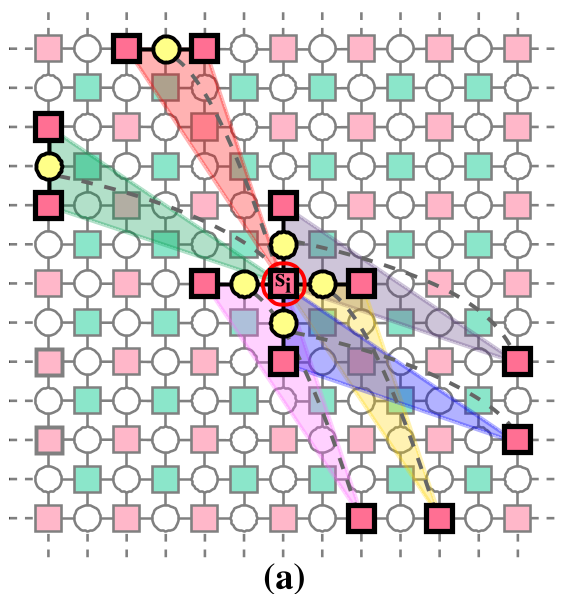 Figure: Translating syndrome conflicts into a colored hardware pipeline.
Results: Shattering the Resource Ceiling
The impact of Arqade is most visible in its ability to "quiet" the global decoder:
- Utilization Reduction: In Bivariate Bicycle codes, the usage of the global decoder dropped by up to 3,963x.
- OSD Mitigation: It resolved 72.71% of the cases where the BP decoder would have normally "given up" and required expensive OSD post-processing.
- Cryogenic Scalability: When implemented as a cryogenic ASIC (at 4 Kelvin), Arqade is so efficient it can handle up to 360,000 logical qubits while staying under a 1.5W power envelope.
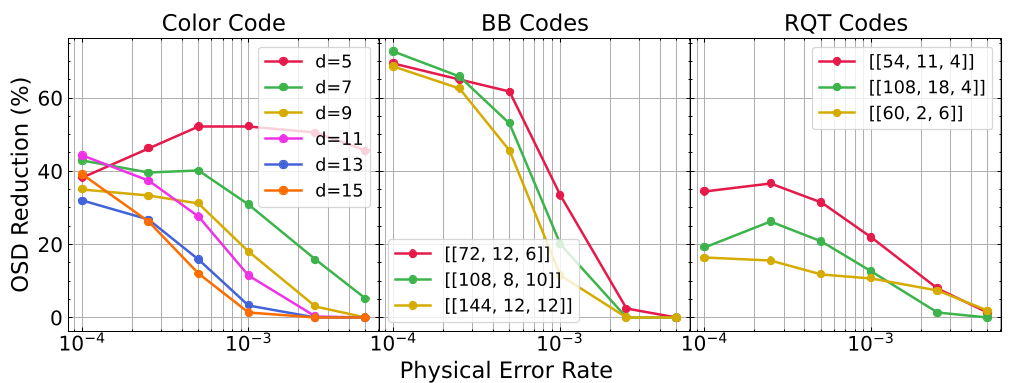 Figure: Reduction in OSD utilization across various qLDPC codes.
Critical Analysis & Takeaways
Arqade represents a shift from "Quantum Information Theory" to "Quantum Systems Engineering."
Why it matters:
- It is code-agnostic. As theorists invent new qLDPC codes, Arqade can generate the interface hardware automatically.
- It enables resource sharing. By making the global decoder's job easier, we can have one OSD instance serve thousands of qubits, drastically lowering the cost of a quantum computer.
Limitations: The framework currently focuses on length-1 (single edge) errors. For very high physical error rates where errors cluster together, the predecoder's coverage drops. However, in the high-fidelity regime (error rates < 10^-3), Arqade is an essential piece of the fault-tolerant puzzle.
Future Outlook: The next step will likely be co-optimization: designing quantum codes specifically to have "hardware-friendly" predecoding properties, potentially leading to even faster and lower-power classical controllers.